

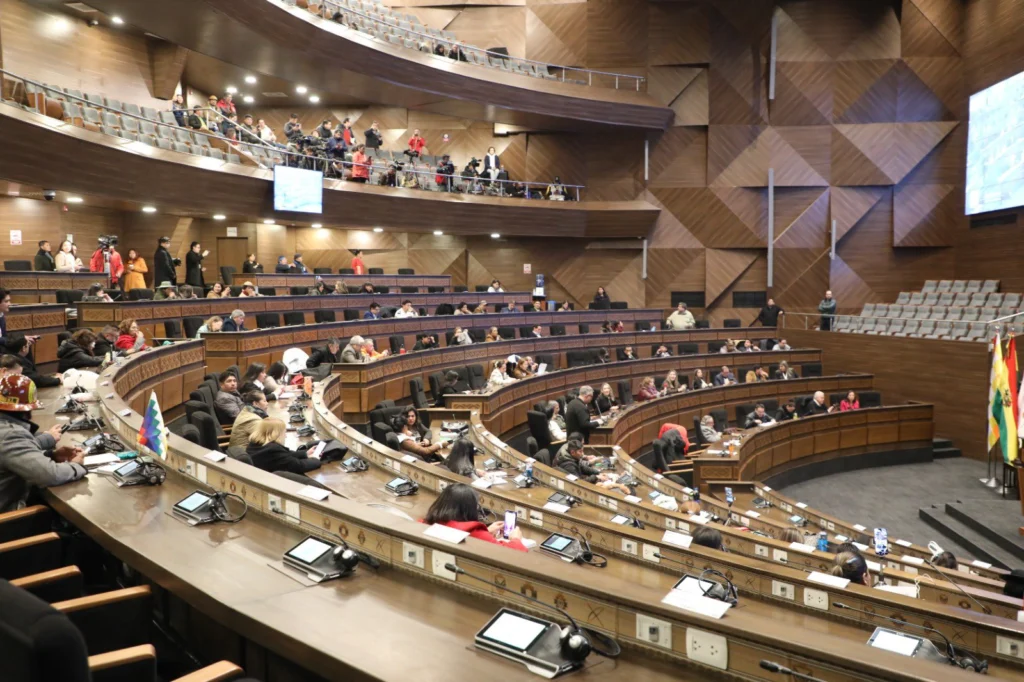
The Legislative Assembly of Bolivia this Sunday validated the presidential decree that declared a state of emergency to lift road blockages installed at the beginning of May by peasant sectors and supporters of former president Evo Morales who demand the resignation of the president, Rodrigo Paz.
[Bolivia Rejects International Delegation of Human Rights Observers: Bolivia’s Parliament Validates State of Emergency Decree Against Roadblocks](https://www.telesurenglish.net/bolivias-parliament-validates-state-of-emergency-decree-against-roadblocks/)
The decree was approved by more than two-thirds of the senators and deputies attending a session that began near midnight on Saturday and ended this morning.
The resolution approves “the declaration of a state of emergency due to internal commotion established by supreme decree 5636,” signed on Saturday by Paz.
The session was called by the Vice President of Bolivia and head of the Legislative, Edmand Lara, a declared opponent of the Paz Government.
Before starting the debate, Lara said that he did not agree with the state of emergency and later withdrew because he suffered a “decompensation,” so the direction of the session was left to the president of the Senate, Diego Ávila.
La Asamblea Legislativa Plurinacional (ALP) aprobó con más de dos tercios de votos la resolución que respalda el Decreto Supremo que declara el Estado de Excepción en Bolivia.
21/06/2026#SiempreBolivia #BTVInforma pic.twitter.com/cOxQTol2Oy
— Bolivia Tv Oficial (@Canal_BoliviaTV) June 21, 2026
Paz decreed on Saturday the state of emergency to lift road blockades, a provision that does not imply the suspension of rights, but does prohibit road blockades and the use of weapons, explosives and “violent elements” and provides for the “temporary support” of the Armed Forces to the Police in the control of “public order.”
After the government of Rodrigo Paz declared a state of emergency in Bolivia, a group of social organizations categorically rejected the measure, considering that it would be used to persecute popular leaders. They called for unity and asserted that they would intensify blockades until the president resigns.
“The struggle continues,” declared in separate statements the 6 Federations of the Tropic of Cochabamba, the Single Syndical Confederation of Rural Workers of Bolivia (CSUTCB), and the Túpac Katari and Bartolina Sisa federations, which rejected supreme decree 5636 —which authorizes the support of the Armed Forces to the Police to clear roads— and cataloged it as “an act of militarization of social life and a violation of our fundamental rights.”
After an emergency meeting between their representatives, the 6 Federations of the Tropic agreed to “resist the state of exception assumed by the Government” and announced the massification of blockades in the department of Cochabamba.
Furthermore, they rejected the pacification agreement signed between the Executive and the Bolivian Workers’ Central (COB) and considered that the platform headed by Mario Argollo betrayed the struggle after 51 days of blockades.
The Bolivian police and army have begun to dismantle roadblocks on the main roads connecting the west and center of the country. The unblocking operation is carried out with the deployment of agents and military from cities like El Alto to remove obstacles and restore traffic.
The delegation, headed by Ernesto Justiniano, Minister of Defense, arrived in Achica Arriba, where confrontations between protesters and security forces took place on May 23 during an attempt to clear the road.
At the site remained the debris of an official vehicle that protesters burned at the time, as well as the police offices, sanitary control, and toll booths, all razed by a crowd.
Justiniano stressed that “there have been no inconveniences” and that “tranquility” has been observed.
From teleSUR English via This RSS Feed.