

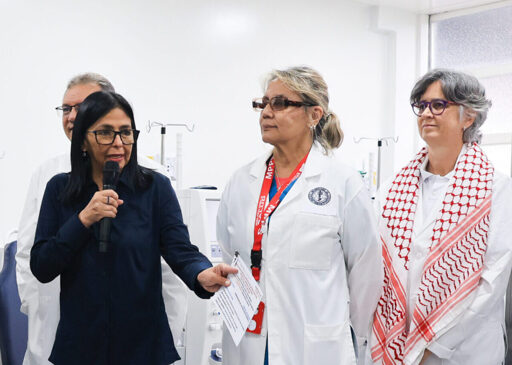
Despite having the necessary foreign currency resources, Venezuela cannot access vaccines and medicines through the channels created by the World Health Organization (WHO) via the Pan American Health Organization (PAHO). This is due to the unilateral coercive measures and the economic blockade imposed by the United States regime.
This was stated by the vice president of Venezuela for Science and Technology, Health, and Ecosocialism, Isabel Iturria, in an interview, where she noted that this situation is incomprehensible and impossible to understand. She emphasized that these vaccines are meant to protect the population, not to produce weapons of mass destruction, nor to harm anyone, adding that Venezuela has had to perform acrobatics to cope with the situation.
The full interview follows.
**—What kind of country do we have after January 3?**Undoubtedly, January 3 had an extraordinary impact on the Venezuelan government and people, and even beyond Venezuela, I believe, on the world. Seeing what happened materialize raises concerns about international relations and leads to a different perspective. For us, in particular, there was an initial moment of shock—that instant of confronting reality. Once again, US military superiority was evident. I believe that it was a clear military defeat for Venezuela, just as it had been a military defeat for Commander Chávez on February 4 [1992]; however, with his slogan of “for now,” Chávez transformed that military defeat into an ethical and political victory.
In the end, I believe that is what is happening in Venezuela: from that military defeat, an ethical and political victory has emerged, which has been led in a very special way by Acting President Delcy Rodríguez in terms of maintaining peace in Venezuela, preventing the spread of chaos, and even preventing an outbreak of conflict among Venezuelans. The economy was stabilized, and the continued functioning of the state was ensured. The Supreme Court met, analyzed the grave and unprecedented circumstances, and formulated a response within the constitutional framework. This guaranteed peace in the country… The pursuit of unity and the peaceful resolution of disputes among Venezuelans is a vital element that has been revalued since January 3.
I believe progress has been made in the unity of the Venezuelan people, who have embarked on this nationwide pilgrimage called for by the acting president and the government. United we can build a future together, in which we can continue to live together and maintain our values and the things that unite us, from what we eat to what we sing—from lulling children to sleep with the national anthem, as the Conny Méndez song says, to the possibilities of great changes that have come from from the National Assembly: the Amnesty Law that has allowed freedom for a huge number of people, and the modification of the Hydrocarbons Law to facilitate foreign investment and public-private partnerships in Venezuela for the development of oil resources. That is, there has been a set of changes that were energized, for better or for worse, by that bombardment, but that somehow generated progress within the great blow that January 3 represents for Venezuelans.
**—One of the first measures taken by the acting president was the launch of the Health and Life Plan. What is the message behind this initiative?**February had not even begun, and I had not yet been assigned this responsibility that is keeping me busy these days, when the acting president launched the 2026 Health and Life Plan from the University Hospital of Caracas. She instructed us to identify the needs felt by the Venezuelan people—needs that we could address quickly with very few resources, given the blockade under which we live. At that time, we identified three aspects in the 1×10 Good Governance program as pressing needs that could be addressed without requiring prolonged hospitalizations and with supplies that we can partially obtain within the country.
So, three areas were identified: hemodynamics, pacemakers, and cataract care. These are three sectors that primarily serve the elderly, who have been severely affected by the US-generated economic crisis. Doctors and healthcare teams that regularly work in our hospitals were more than willing to take up this task. They accepted the challenge of the increased number of patients and did so so with quality, speed, and with limited resources.
We have made significant progress, such as creating an electronic medical record for these patients treated in the hemodynamics and pacemaker units. This electronic record not only allows us to plan and track the supplies used, but also to properly monitor these patients, who must be monitored in subsequent years to guarantee their quality of life. In these months of great difficulty, we have been able to perform more hemodynamic procedures in public hospitals than ever before in the history of Venezuela. I did not imagine we could do so much; the effort has been immense… I believe there have been extraordinary advances in these four months, and, as the acting president says all the time, the main achievement is that we maintain peace and are able to achieve, even amidst our differences, the reconciliation and unity of the Venezuelan people. That is why we are marching through the streets.
The number of catheterizations has increased to levels never before seen in our public hospitals. Significant progress has also been made in pacemaker implantation. Over 15,000 patients have undergone cataract surgery. These are people whose quality of life has been transformed after these procedures.
**—What has happened to the vaccines and medicines?**If we talk about health and understand it according to constitutional principles, health promotion, quality of life, and prevention are core strategies for the design of our National Public Health System. From that perspective, vaccines are a fundamental element. Supply has been very difficult. The sanctions themselves prevent Venezuela from paying for vaccines, even though it has the resources to do so. Currently, the usual purchasing mechanism that we use in Venezuela and in most countries of the world—the WHO’s Revolving Fund, the PAHO Revolving Fund, and the WHO Regional Office for the Americas—which is a mechanism through which a virtually global plan is developed for the acquisition of vaccines by different countries, is completely halted. The regular vaccine supply chain, which usually had a quarterly plan in Venezuela, is now at a standstill.
The United States has not donated any vaccines, nor has it allowed us to pay for them. We have received donations from Brazil, for which we thank President Lula, who, just as he helped us with dialysis supplies, has also assisted us with the provision of some vaccines. This has helped us to make progress in some areas, but in others we are facing difficulties, as the logistics chain is not functioning smoothly. Nevertheless, this year we were able to launch the yellow fever vaccination program. We conducted a training campaign for our students at the University of Health Sciences as vaccinators. The program was deployed in affected states. Now we are working intensively on a rabies vaccination plan for dogs and cats throughout the country. This is a task in which we not only protect pets, but also human lives. In short, regarding vaccines, we are facing a blockade. It is incomprehensible. No one can claim that vaccines will be used to harm anyone, to start a war, or to produce a weapon of mass destruction; vaccines can only be used to protect people from diseases. However, they are part of what the blockade is and the difficulties we have to deal with.
**—Where were you when the acting president called you for this responsibility?**I was at home.
**—Were you surprised?**Of course. We had already discussed some changes she was considering at the SSO [Social Security System] within the Ministry of Health, but at that time, the position of vice president for the sector, which is different from the minister, was not planned. Vice presidents had previously been ministers from their respective areas; however, in this administration, we have two vice presidents: one for Finance and the other for the Economy. In my case, the vice president is not a minister, but rather another individual, partly because these are particularly complex and important fields at this critical time. The aim is to have an additional person to assist in the planning and coordination of the tasks and strategies that arise here. So, yes, it was a surprise.
**—Moreover, you did not want to leave the Children’s Cardiology Institute, right?**I never want to leave the cardiology center, and I have not. Yes, one can set a condition, although we are not here to set conditions, but to work wherever we are assigned, for as long as we are assigned, and to do our best. I always say: leave me with my tasks at the cardiology center, and when I finish the tasks you assigned me here, send me back to the cardiology center, because that is my reason for being and my work in this life.
Isabel Iturria graduated from the Central University of Venezuela (with a magna cum laude mention) in 1991. She graduated as a specialist in Internal Medicine in 1995 and in Cardiology in 1998. She has a degree in Cardiology from the Autonomous University of Barcelona, Spain. She completed a Diploma in Public Health Administration, a course in Hospital Administration and Health Services Management (Tokyo), and since 2006 she has been the president of the Dr. Gilberto Rodríguez Ochoa Latin American Children’s Cardiology Hospital Foundation, created by former President Hugo Chávez in Montalbán, Caracas.
(Ultimas Noticias) by Manuel Abrizo, with Orinoco Tribune content
Translation: Orinoco Tribune
OT/JRE/SC
From Orinoco Tribune via This RSS Feed.