

More than 41 million voters will choose between Iván Cepeda’s reform agenda and Abelardo de la Espriella’s far-right platform.
RELATED: Colombia Boosts Security Ahead of June 21 Presidential Vote
Colombians head to the polls on Sunday for a presidential runoff that will decide between two sharply contrasting political projects, as more than 41.4 million eligible voters choose between left-wing candidate Iván Cepeda and far-right contender Abelardo de la Espriella.
Cepeda, representing the Historic Pact coalition, has campaigned on continuing the public policies introduced under President Gustavo Petro. His platform focuses on reducing poverty, expanding universal access to education and healthcare, combating corruption, strengthening agricultural development, advancing peace efforts and increasing the state’s presence in historically neglected territories.
De la Espriella, candidate of the Defenders of the Homeland movement, has proposed a markedly different agenda centered on shrinking the state, reducing social spending and restoring a militarized security strategy. His proposals include building 10 mega-prisons, resuming aerial bombings against armed groups, reinstating aerial fumigation of coca crops and ending the government’s “Total Peace” policy.
A diferencia de @IvanCepedaCast, el señor de la Espriella acusa sin pruebas.
Nosotros ya lo denunciamos por sus oscuros vínculos con el paramilitarismo, por enriquecimiento ilícito con dineros de la salud, y estamos investigando a fondo el tema de la compra de votos
Si… pic.twitter.com/hWYSWaIOol
— Pacto Histórico Oficial (@PactoCol) June 17, 2026
Text Reads: Unlike @IvanCepedaCast, Mr. Espriella accuses without evidence.
We already reported him for his dark ties to paramilitarism, for illicit enrichment with health sector funds, and we are thoroughly investigating the issue of vote-buying 
If he has evidence, let him report us.
Both candidates concluded their campaigns hours before polling stations open, using their final public appearances to reinforce their messages and appeal to key sectors of the electorate.
The Historic Pact and the political organizations that make up the Alliance for Life also called on supporters to protect the vote during Sunday’s election.
“We have organized and prepared a massive electoral protection operation, with 89,881 polling station witnesses, 4,980 scrutiny commission observers, 3,294 lawyers and 338 systems auditors, covering 90 percent of polling stations and 96 percent of scrutiny commissions,” the coalition said.
Electoral concerns and campaign allegations
The Historic Pact and the Alliance for Life warned that several practices could undermine the integrity of the electoral process.
“We are concerned about certain actions that put the free exercise of the right to vote, the transparency and the peaceful conduct of the elections at risk, particularly undue pressure on voters, threats, coercion, vote-buying, aggression, stigmatization and violence against people who are part of our campaign,” the coalition said.
The warning followed allegations of vote-buying schemes intended to benefit De la Espriella. According to the report, the candidate has also previously faced accusations over alleged links to paramilitary groups and illicit enrichment involving public healthcare funds.
The report also states that 11 Democratic members of the U.S. Congress sent a letter to the White House warning against interference in Colombia’s internal affairs and expressing concern over support for a candidate they described as having a “deeply troubling” record.
The lawmakers recalled De la Espriella’s alleged ties to leaders of the United Self-Defense Forces of Colombia (AUC), designated by Washington as a terrorist organization in 2001. They also referred to reports linking the candidate and his wife to at least 14 shell companies registered in the U.S. state of Florida and involved in multimillion-dollar real estate transactions with funds of unclear origin.
Human rights organization Temblores also publicly criticized De la Espriella, describing him as an opponent of human rights. Breaking with years of political neutrality, the organization said it decided to intervene because it considers the candidate’s rhetoric—portraying political opponents as enemies—to pose a threat to democratic life.
“Questioning a democratic government is one thing; allowing the rise of a political project that has built much of its identity around the stigmatization of opponents, that promises to impose its worldview ‘by reason or by force,’ and that invites its supporters—through the collective call ‘we are going to tear the left apart’—to destroy those who think differently is something entirely different,” Temblores said.
The organization also recalled the systematic killing of 5,733 members, leaders, councilors, mayors, members of Congress and supporters of the Patriotic Union throughout Colombia’s history.
“Under a possible presidency of Abelardo de la Espriella, the guarantee of human rights and our existence as an organization defending them would be at risk,” it added.
Voting logistics
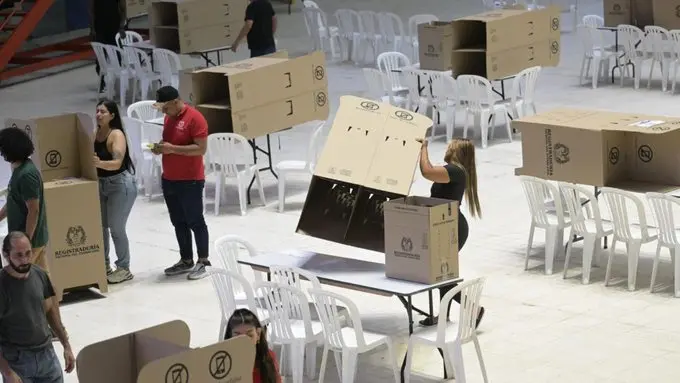
A total of 41,421,973 citizens in Colombia and abroad are eligible to vote in the runoff. Women account for 21.2 million registered voters and men 20.1 million. Voting will take place at 122,016 polling tables across 13,742 polling stations.
More than 228,000 members of the security forces have been deployed nationwide to protect polling stations, safeguard voters and maintain public order. Special security measures have been established for 5,720 polling stations located in areas considered at risk because of the presence of illegal armed groups or other security concerns.
The Colombian government also closed the country’s borders on Saturday, saying the measure is intended to ensure the runoff is held without external interference and under transparent conditions.
The first round was held on May 31, when roughly three out of every five eligible voters cast ballots. De la Espriella received 10.3 million votes, or 43.78 percent, while Cepeda secured 9.7 million votes, equivalent to 40.98 percent.
From teleSUR English via This RSS Feed.