

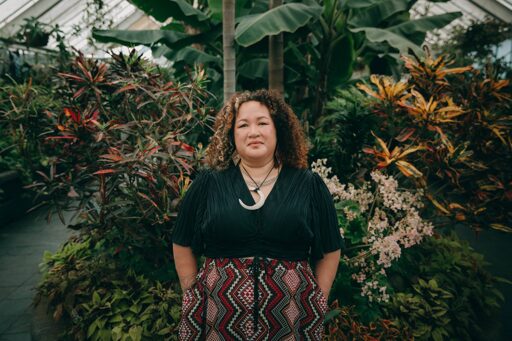

Nafanua Purcell Kersel, who won the poetry prize at this year’s Ockham Book Awards for Black Sugarcane, her first book. “The stories in Black Sugarcane were always in me. They’re stories about my family, they’re stories about my life experience, but they’re not necessarily just mine. I didn’t expect that I would have an outlet for these stories, and that the outlet would be poetry.” (Photo: Ebony Lamb)
Nafanua Purcell Kersel*(Satupa‘itea, Faleālupo, Aleipata, Tuaefu) didn’t set out to write a poetry book — that’s just how the stories she wanted to tell came out.*
And now that poetry book, Black Sugarcane — which began as the manuscript for her master’s in creative writing at the International Institute of Modern Letters at Te Herenga Waka–Victoria University of Wellington — has won the prestigious Mary and Peter Biggs Award for Poetry at this year’s Ockham Book Awards.
Here’s Nafanua in talanoa with Dale Husband.
Tēnā koe, Nafanua. Congratulations on your success with your mahi. I’ve only read little snippets of your poems, but I like your style. You’re like a soldier for change, but using words instead of bullets. Good on you.
I’m glad you say that, because I remember reading a review where someone said that my poetry was definitely not protest poetry, and I was like: “Huh?”
I like that you’re working to encourage our Māori and Pasifika peoples to use poetry and other forms of communication to bring our thinking on stage, and challenging it, too. But I always start with names, and maybe you’d be kind enough to tell us about your name and your clan.
Nafanua, as you may know, is quite an important figure in Sāmoan history. She’s described in English as a warrior goddess, but she’s so much more than that. She’s become part of the myths and legends of Sāmoa, but she was a living person. She was a toa, a warrior, and she became the first person to hold all four ali‘i or paramount titles in Sāmoa.
She’s called Nafanua because “Na” means hide and “fanua” is Sāmoan for whenua, the land. The story is that she was born as a blood clot and her mother hid her in the land so that her father’s clan couldn’t claim her.
Anyway, she ended up living in Pulotu, the underworld, and she decided to come up from the underworld into the world of light when she heard anguished cries from Faleālupo in Savai‘i. She arrived by sea, and there are different tellings of the story, but the idea is that she organised the people to go to war against their oppressors, and she’s credited with bringing in the chieftain matai system that we still practise to this day.
Wow!
And there’s a whole Joan of Arc trope as well, because she defeated the oppressors, and although she had incredible skill with her weapons, she defeated them also by virtue of being a woman. The story goes that her top was blown up by a gust of wind during battle, and her opponents saw that she was a woman and retreated, humiliated at having been outfought by a woman.
So, there’s a lot in her story, and it’s a very big name to carry. But my mum’s family is from Faleālupo, and they have familial connections to Nafanua, and that’s why my parents gave me that name.
It’s a beautiful story, but I can’t help thinking that Sāmoa is such a Christian land now, and so much of the richness of the kōrero of Sāmoa has probably been lost or overshadowed by Christianity.
Or rewritten even.

Nafanua’s mother, Gisa Fuatai Purcell (back right), her Aunty Molly Purcell, and Grandma Anasoa Purcell, sitting with (from left) Nafanua, Carlos, and Salamasina.
How do you feel about the huge presence that the Christian faith has throughout Sāmoa today?
I grew up Catholic. When people visit Sāmoa and ask me what they should do, I always tell them to go to church. And that’s because if you go to a Sāmoan church, it will be so moving that you will have a spiritual experience, whether you are spiritual or not.
I think there are some really beautiful things about the way that we practise Christianity. We practise it in a specific way that’s very Sāmoan. And I appreciate that.
In terms of the old religion, there’s a line of thought that Christianity brought light into some dark, backward ways. But I like to think of the pre-Christian times with more grace than that. You know, nothing is black and white, or light and dark.
There’s so much more nuance and subtlety to it, so I find myself often in a contradictory place. I have grown up Christian, and I enjoy the experience of how we practise Christianity, and yet I’m trying to also hold on to the amazing practices that we had before Christianity.
Sure, there were also some questionable practices, but that’s just the same now, post-Christianity. There’s always going to be some light and some dark, and a lot of grey areas in between.

Some of the Purcell ‘āiga after mass for Grandma Anasoa’s 90th birthday. (Photo supplied)
In the Māori model, it’s very similar. We have all our atua and our gods that we revere and acknowledge, and we don’t see Christianity as subsuming them. They’re still rich and valid, and I think people find their way through with the acknowledgment of both. But I think it’s neat that our Pasifika peoples are able to do that, too — not forget the kōrero of the past, and just incorporate it into how we move forward.
I definitely think it’s easier to hold both of those realities when you’re living away from Sāmoa, in the diaspora, as I am. The matai governance system is how we practise those pre-Christian ways, and we also practise them through our tatau. That’s one thing colonisers couldn’t take from us.
Have you got some tatau yourself?
I do. I have a malu that I’ve been wearing for six or seven years now. I had that done in Sāmoa with my twin sister Salamasina.
The rituals and practices around tatau are still very much rooted in pre-Christian traditions, and just like in te ao Māori, the ways that we do things are all connected to a story. Even the coming of Christianity is connected to a story. Nafanua is widely understood to have had a prophecy about the Pālagi and Christianity coming to Sāmoa. Right from those origin stories, there’s a connection to why things happen and why we do things the way that we do. To me, what’s really important is the story behind the practice.
What’s the story about twins in Sāmoa?
There’s a story that Nafanua’s mother was one of the twins, Tilafaiga and Taemā, who brought tatau to Sāmoa, and it’s said that they came from the ocean and they sang a song as they came towards the land, towards the people there, about tatau.
They were singing that only women could get tattooed, but they got distracted because they saw this amazing giant clam. Have you ever seen a giant clam? They’re luminescent, so they glow underwater. The twins dived down towards this giant clam, and by the time they came back up, they were quite confused. So they changed the song and said that only men could get tatau, and not women. And so tatau for men, the pe‘a, became dominant.
So that’s the connection to me and my twin having our malu done together, because you never have a tatau on your own. The idea is that when you go on the tatau journey, you have a partner, a soa. You don’t go alone. And you come back together. So for me and my twin to have our tatau journey together, and the story of tatau starting with twins, that felt like a really potent story of our own to weave into our family.
In my book, I have several poems that have twin characters, and in one of the poems, they have an otherworldly journey as well.

Nafanua with her parents, Gisa Fuatai Purcell and Lautafi Selafi Purcell. (Photo supplied)
Tell us about your mum and dad. Did your folks encourage you down the poetry line, or was there something happening in your school life that maybe contributed to that?
My mum, Gisa, was a voracious reader. She loved novels. Our house was full of books, and in the 1980s, before mobile phones, she was one of those mums that you would try to talk to, but her face was always in a book. Nowadays, we have a phone to distract us and to take us away from life a bit. But for my mum, novels were her favourite hobby. That was her escape, and she was a daily reader.
I picked up a Stephen King novel at 11 or 12 and never looked back. Before that, I had loved the library and loved reading, but that was my first adult book, and it was just one that I picked up off Mum’s shelf because it was there.
So I grew up in a house where reading was normal, where books were everywhere. My dad, Lautafi, still had one of his English exercise books from when he went to school at St Paul’s, and I remember him showing me Shakespeare and some of the stuff that he enjoyed about English. We lived in Wellington, and by the time I was finishing high school at St Mary’s, he was working as a policy analyst, and that’s a vocation where language is important.
We came to Aotearoa in 1993 when I was four, and so English is my second language. Sāmoan was my first language, but the ESOL (English as a second language) model wasn’t as widely practised for education at that time. So my parents were advised to speak only English to us to accelerate our English learning. As a result, I can understand Sāmoan very well, but I do have a bit of a blockage when it comes to speaking it, and I think that was mostly a result of that era of education.
Mum and Dad moved back to Sāmoa in the early 2000s, and both of them had a second flush in their careers. I watched my mum do postgraduate study at 43, and then watched her have another wave in her career at that later stage in life. That also gave me the role modelling to go and get my master’s in creative writing at 43, after 15 years of not studying.
My dad ended up working as a politician in Sāmoa. He’s now retired. And my mum worked in information and communication technology. She worked at an international level, at the UN and for the Commonwealth. And those things happened in their mid-40s through to their 70s. Watching my parents’ careers has been really inspiring for me. It’s encouraged me to keep pursuing the things that interest me and that I love.
I’ve seen both of my parents speaking in public, speaking in their villages, speaking on behalf of Sāmoa on international stages, and I feel like those oratorical skills were successfully modelled for me in Aotearoa by my parents through their careers.

In Sāmoa. Nafanua with her sons Axel and Ulimasao Kersel, her dad Lautafi Selafi Purcell, brother Carlos Purcell and grandmother Anasoa Purcell. (Photo supplied)
The role of oratory in Sāmoan culture mirrors that of the pae kōrero on the marae and the best of our oratory. Orators have a beautiful grasp of metaphorical language that ties generations together through references to weather, animals, and geographical features. It really is a special talent that we have as Pasifika peoples.
And it’s fertile ground for the types of work that Black Sugarcane celebrates. Do you think sometimes that the ability that you have to weave thoughts together is partly a cultural gift, a taonga tuku iho, if you will?
I really do. When I’m writing a poem, it feels sometimes like a poem comes to me almost fully formed. I can’t explain where that comes from. But I experience it as a sense of connection. Other times, when I try to go in really purposefully, I can write something good, but there needs to be a moment of connection for me. Even if I work on a poem for months and months, if it doesn’t feel like it’s working, sometimes I have to change something about it in order to feel that connection.
So I do think that a lot of my ability comes from where I come from, and who I come from, and I’m just adding another loop in the thread of what we can see as ability. I also think that one of the themes in Black Sugarcane is my relationship with carrying this big name.
I didn’t come to be known as Nafanua until I was a full-grown adult, because it didn’t feel like a name that I could carry into the world when I was younger. So, one of the themes in the book is what it takes to carry that name despite the sense of lost language. And how do I connect to my ancestors? How do I connect and feel like I’m really contributing to the culmination of skill and ability and stories?
The stories in Black Sugarcane were always in me. They’re stories about my family, they’re stories about my life experience, but they’re not necessarily just mine. I didn’t expect that I would have an outlet for these stories, and that the outlet would be poetry.
This book began as a manuscript that was written for my master’s in creative writing at IIML, the International Institute of Modern Letters, at Te Herenga Waka.
When I started the course, I didn’t know I was going to write a poetry book. I was open to writing whatever form came. But they needed to be poems because that’s how the stories needed to be structured and shaped to make sense of the connection I was feeling to the stories and the characters in the stories, and to all the ones that came before — as well as the points of disruption in my personal story, my family’s story, and the story of our people.
You know, there are points there where there might be a gap, like Christianity disrupting the way things were before. Moving to New Zealand and starting to live in a Pālagi world — that, for me, was a disruption in my personal story. So, what cultural stories do I feel that sense of disruption with, and how do I create so that I can better understand and connect to that moment? Does that seem like I’m really over-conceptualising it?
Well, no, because I sense that you humbly feel as though you’re a conduit between the old and the new world. I can’t help noticing that your poems are what I would call accessible literature. Some of your poems are only two or three lines long. I like that because when you mention poetry, a lot of people’s eyes glaze over, but when you find a little phrase or a piece that resonates, then the job is being done, isn’t it?
Yeah.

At the 2026 Ockham New Zealand Book Awards with her family. From left: Ulimasao, Axel, Nafanua, Matt and Tawa. (Photo: LK Creative)
I’m curious to know when that comes to you, because often musicians will say: “Oh, it just came to me.” Do you sit at your desk and say: “I must write.” Or do the ideas come to you in other ways? And is there a time of the day when that happens more regularly than others?
You know, I’ve never really pinpointed it. But a few of the poems that I have in mind when I say that poems come fully formed — they always come as I’m just falling asleep, in that time between waking and sleep.
But aside from that, I knew that the only way I could actually focus and write something that could possibly be a book was to give myself time and space. And that’s what I had during my year at IIML, which was a nine-month process of generating poems for my master’s manuscript.
To answer your question, there’s no specific time of day, but I do need to be able to set a finite start and end time to focus on writing. Sometimes poems come to me because I’m inspired by something I see or by something that’s happening in my life that I can’t really process, so I start by writing. If I’m feeling a sense of grief, I’ll try to write my way through it. I can go to the poem in a purposeful way like that, in order for poems to come.
Poems are just one way that the daily things I observe in my world and the way that I process them come out. There are other creative outlets in my life, but I do feel that it’s about giving myself opportunities to reflect and process, and to stop, breathe and connect.
So it’s interesting to me to think of writing poetry as a career. “Career” feels like such a linear word, like a progression, whereas writing poems doesn’t feel like that to me. It feels like something that ebbs and flows in my life, and once I make it a priority, it helps me with all the other parts of my life as well.
For me, poetry starts with sound, it starts with oratory, it starts with the spoken word, and that was my start. I wouldn’t have published any poetry if I hadn’t had the experience of speaking my poetry out in the world.
The spoken word is where I feel the poetry lives. Publishing it in a book was far scarier for me than speaking it on a stage in front of people.
Was there an event or occasion when it all came together for you, and you thought: “Yeah, this is why I commit to putting these thoughts down on paper so that I can communicate them in a live performance?”
Absolutely. The Hawke’s Bay Poetry Slam 2020 was my first live reading. We had just come out of lockdown. It was in my second year of an illness that I still live with, a rare chronic condition, and so the illness was happening, then Covid was happening, and lockdown was happening. And then, out of lockdown, there was the Hawke’s Bay poetry slam. And I thought: “I’m gonna go for it. I’m going to put myself out there and do it, and share my poetry and see what happens.”
It was the first time my kids had ever seen me doing something other than being their mum, and that was a really powerful moment for me. I won the poetry slam and ended up going to Christchurch for the national poetry slam. I was one week out of surgery, and I took my whole family. All the local poets and artists and writers and publicans here in Te Matau-a-Māui (Hawke’s Bay) came together and put on a fundraiser so that I could get to Christchurch and take my kids and my husband.
The whole experience of sharing my poetry and feeling it land, and really feeling a sense of that creative vā, was very powerful. And then integrating that into the community and into my family every step of the way felt like the right thing to do. It felt like I was being myself. It felt like I was able to share that connection I feel when I’m writing.
That was 2020. In 2022, I decided to apply for a master’s degree. I thought it would be a good step towards publishing in journals and having my poems put into print. I had this experience of my own mortality, and it became important to me to have something, even if it was a manuscript and not a published book, that was tangible, that I could share with my children.
One theme that runs through Black Sugarcane is about inheritance, which we’ve described as taonga tuku iho. It’s what I’m passing on and what has been passed on to me, a non-monetary inheritance. One of the questions I’m asking is what do I have to offer forward that doesn’t look like the dictionary definition of inheritance? What is this taonga tuku iho?
And that was my main purpose for doing the mahi, for travelling to Pōneke every week for my master’s to write this book. It was so my kids could have something they could hold in their hands that had our family stories in it, and where they could see their names.
They’re all teenagers, so they’re like: “Hmm.” But I’m sure it’ll grow on them!

“When I’m writing a poem, it feels sometimes like a poem comes to me almost fully formed. I can’t explain where that comes from. But I experience it as a sense of connection.” — Nafanua Purcell Kersel. (Photo: Ebony Lamb)
It’s been a beautiful kōrero, and it’s hard to beat what you’ve just said, but is there anything you’d like to add?
I do workshops with rangatahi, and it’s poetry, but it’s also movement, choreography, dance. And the reason I don’t teach it on my own is that everything is a collective. We come together in that way because I believe that these taonga tuku iho don’t live in just one way.
The thing that I really want to pass on, especially to our young ones, is that poetry doesn’t have to look, feel, or sound a certain way. As long as it’s true to you, it doesn’t even have to be factual. It can be about feelings. It can be truth, but not necessarily fact.
Poetry is one way that we practise our language and it’s how we connect to each other, how we connect to the world, and how we connect to our cultures. It’s a way to keep yourself open to what might come.
(This interview has been edited for length and clarity.)
An extract from Black Sugarcane, by Nafanua Purcell Kersel, published by Te Herenga Waka University Press**

Admissions interview
Epsom, 1991
The office clerks ask Mum to leave
the room. Nua looks at Sina, who gives her
the don’t ask me, how should I know? face.
One of the clerks checks the forms
while the other rolls out a map and asks
the twins to point out their home address.
I still don’t get it Nua’s eyebrows say to Sina
as they find their street name and point.
The clerks look down to both index
fingers resting on the same spot, less than
two centimetres away from the flat
green grid of school.
The clerks look at each other
and shrug, like,
Okay then, I suppose.
The post Nafanua Purcell Kersel: ‘It starts with the spoken word’ appeared first on E-Tangata.
From E-Tangata via This RSS Feed.