


Bullets:
China and Iran built a bilateral trading system that moved millions of barrels of oil to China in exchange for infrastructure.
The BRICS countries are highly motivated ditch the US dollar across their banking systems, and thereby protect their own.
Iran’s closure of the Strait of Hormuz stopped most outbound oil shipments from Persian Gulf countries, except Iran itself.
The MOU between Iran and the United States will unfreeze $100 billion in sanctioned Iranian funds.
Inside China / Business is a reader-supported publication. To receive new posts and support my work, consider becoming a free or paid subscriber.
Report:
Good morning.
China, Russia, and the other Global Majority countries have set up their own financial system, outside the US dollar, and in particular outside the Western banking system.
The new system is expanding; the BRICS countries are doing much more of their trade in their own local currencies, and thereby completely avoid the risk of having their money frozen or seized by regulators in Washington or in the EU.
This is a fantastic primer of how the US dollar system works. American citizens, if we’re honest with ourselves, can understand how coercive the dollar trading system is, and can understand the risk that companies and countries have when doing business with US dollars.
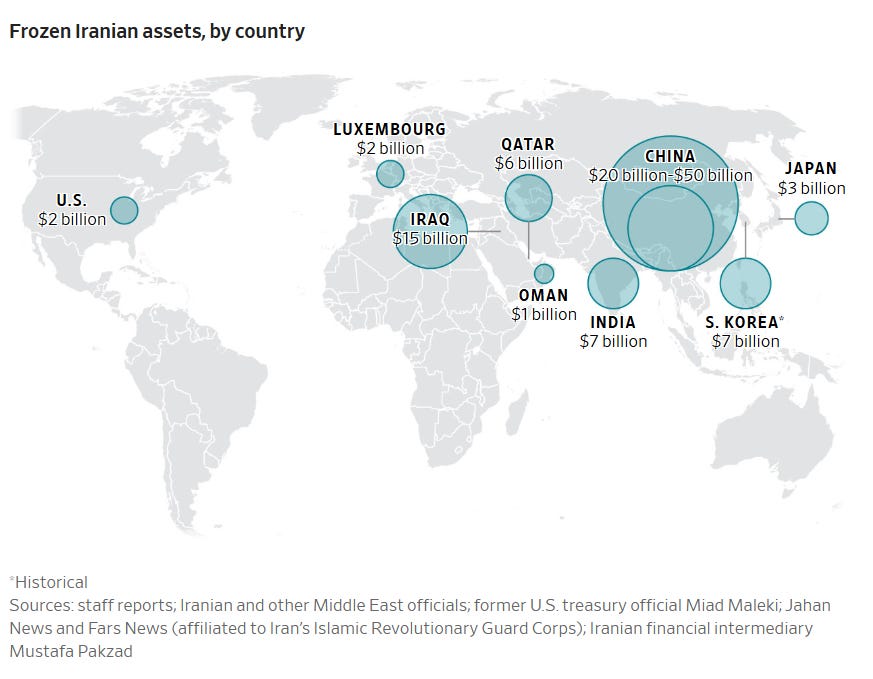
Consider this map. Iran has been under economic sanction for most of our lives, no matter how old we are right now. So the first question, right away, is how the United States can freeze Iran’s funds, outside the United States? Iran has $2 billion in deposits in the US, but tens of billions more in Iraq, India, Korea, and Qatar. There may be as much as $50 billion of Iranian funds locked up in banks in China.
These funds, in US dollars, are for energy that Iran delivered, and is still waiting on payment for. That part is important. The US can stop countries from paying Iran for oil because of the petrodollar system. And the Treasury Department can block banks from the entire dollar system if they release those funds to Iran, in this case.
The question is, how? If the money is sitting in a bank in Switzerland or China, how can Washington stop the money? And the answer is that the US has absolute control over US settlements, no matter where those dollars happen to be at the moment. American regulators can simply switch off access to the whole system and effectively freeze funds.
Obviously that is a very powerful tool, at the sovereign-state level, and is one that policymakers are always tempted to use, and always do. Understanding how it works is important to understand the risks involved to countries outside the United States, who trade with each other using dollars. And it’s also important to understand why there is such an urgency for those countries to set up their own system.
This is how the system works, in a nuts-and-bolts way. A US dollar held in a non-US bank is a digital record, and is an obligation of that foreign bank to its customer. The value of that relationship is wholly based on whether or not that customer can use those dollars, held on deposit. To make that go, all the banks outside the US need a correspondent bank, in the United States.
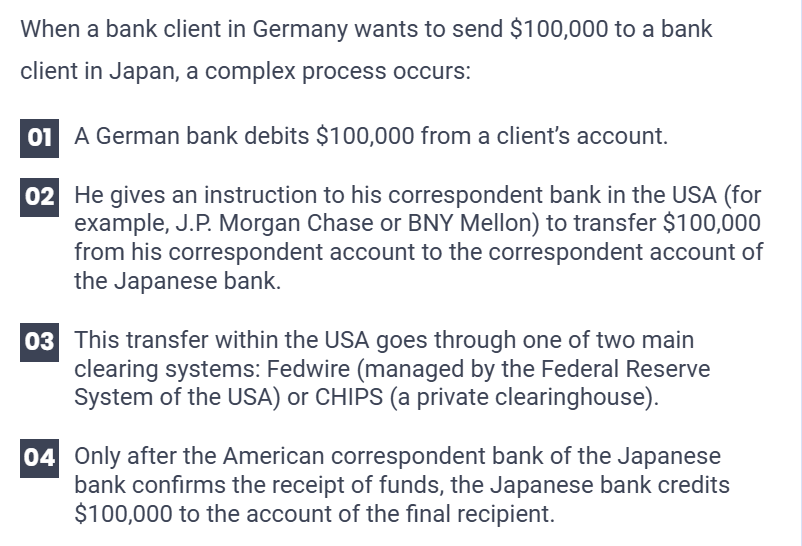
Let’s suppose a company in Germany is buying from a company in Japan, and needs to pay $100,000 USD for the products. These are all friendly countries, then, lately anyway: Germany, the United States, and Japan.
First the bank in Germany takes $100,000 out of the company’s account, there. From the buyer.
Then, the German bank sends an instruction to its correspondent bank in the United States, to transfer $100,000 from the German bank’s account, probably in New York, to the Japanese company’s correspondent bank, which is also probably in New York.
Those two correspondent banks then clear and transfer the funds; funds move to the correspondent bank of the Japanese company’s domestic bank.
That done, the Japanese supplier is credited with the $100,000. The seller’s bank, in Japan, gets $100,000 USD, or the yen equivalent.
That’s the system. Obviously, this transaction takes some time, and generates fees for the American banks that aren’t really doing much of anything at all except receiving and sending messages between themselves, just down the street from each other, and very often inside the same bank.
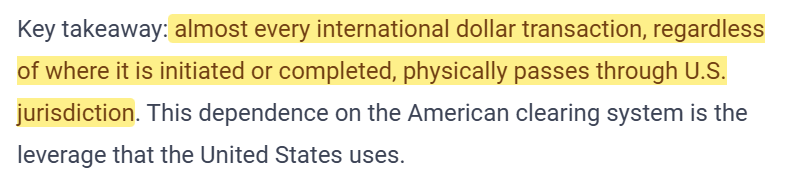
Almost every US dollar transaction happens this way.
Now come the sanctions. The Office of Foreign Assets Control is part of the Treasury Department, and they enforce the economic and trade sanctions of the United States. OFAC maintains a list called the SDN, which is people, companies, organizations, ships, industries, and governments.
When the United States imposes sanctions against one of those parties, they go on that SDN list. All American companies and people and banks are banned from doing business, and required to block the transfer of any property in their custody. When a foreign bank is put on the SDN, those correspondent banks are legally required to immediately freeze all the funds held on deposit there:
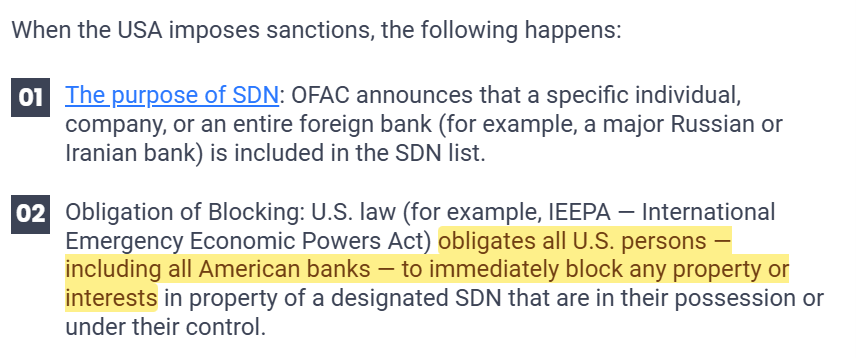
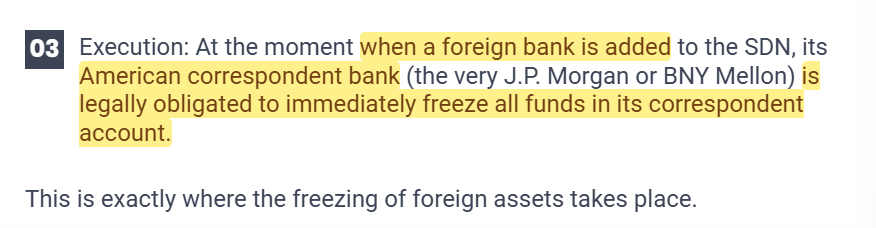
At that point, nothing moves. No money is going in, or getting out, of those accounts. The bank cannot process any USD trade. If they try to send a payment it will be blocked, and if a payment comes in, the funds are frozen at the correspondent bank level. That’s another risk—the bank may be under sanction, but the individual customers may not be, and their accounts are frozen anyway.
The US Treasury also works closely with regulators in Europe. SWIFT is a messaging system between banks, and the SWIFT system makes it even easier for regulators to lock up funds. SWIFT is used by banks everywhere, even those not using dollars. So locking banks out of the SWIFT system effectively shuts down trade in USD, and also in euro. It’s not a “freeze”, in the way being put on the SDN list is, but moving money around without SWIFT is really hard to do. Also, that is, until lately.

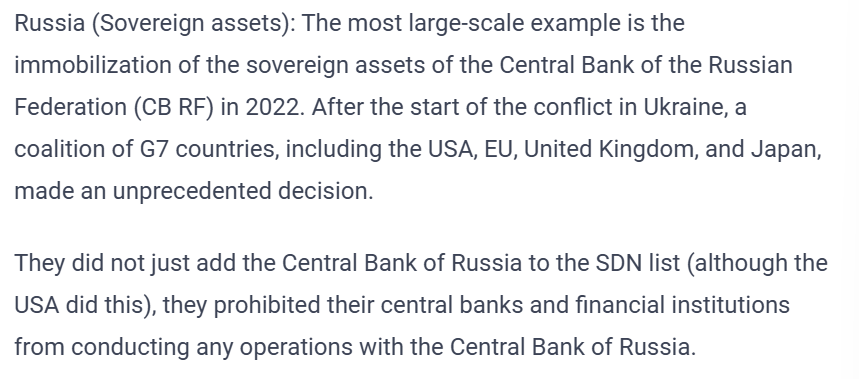
This was a watershed moment in global finance, and geopolitics. The BRICS countries wanted to set up their own system, eventually, but they were taking their time about it.
But then the assets of the Russian Central Bank were frozen in the EU and in the United States, and that turbo-charged the effort of the Global South countries to get away from our system. $300 billion in Russian gold and FX reserves were held in custody in banks outside Russia; that was money that Russian companies had already earned, selling energy to Europeans. Suddenly they couldn’t access it anymore.
Back to Iran. The United States cut off any bank from the dollar system if that bank does business with banks in Iran. South Korea, Japan, and India bought oil from Iran. That oil was delivered, by Iran, but the dollars were frozen there. India is a BRICS country and was a major buyer of Iranian crude. Now they cannot use dollars to buy any more.
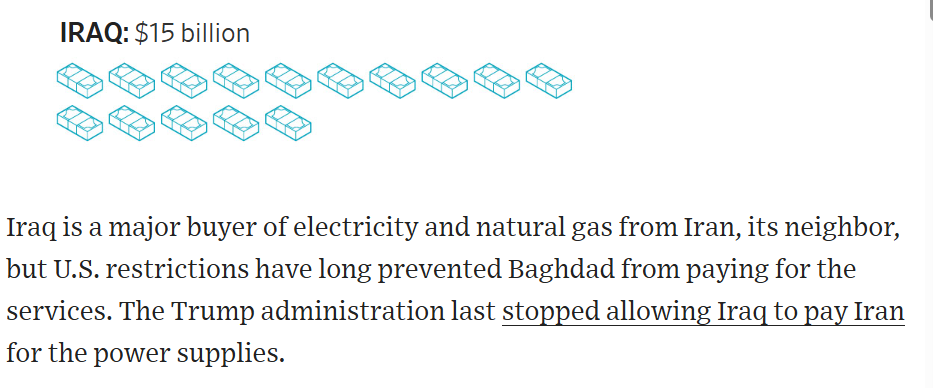
Iraq buys electricity and gas from Iran, which is next door. For years there was a waiver from the United States that allowed for those sales, in dollars, so that Iraq could keep their lights on. But last year the Trump Administration put the sanctions back, on even that trade.
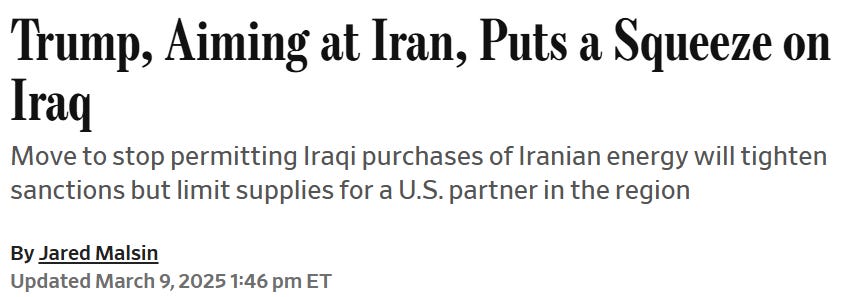
The policy was aimed at Iran, but it left the Iraqis scrambling to buy electricity and gas from somewhere else, obviously at higher prices. A spokeswoman for the American embassy in Baghdad explains that “Iraq needs to eliminate its dependence on Iranian energy” sources as soon as possible.
There are consequences to all of this. Anyone who is concerned about whether one day in the future they may run afoul of American policy, for some reason, needs a new system, and is happy to do business with anyone who sets one up. And the BRICS countries have done exactly that.
Iraq cannot buy electricity from Iran, because they must do that trade in dollars. That’s because of the treaty with the United States, which routes the proceeds of Iraq’s oil sales through banks in the United States directly, then disbursed later to the Iraqis. Even those funds are subject to freezing and seizure.
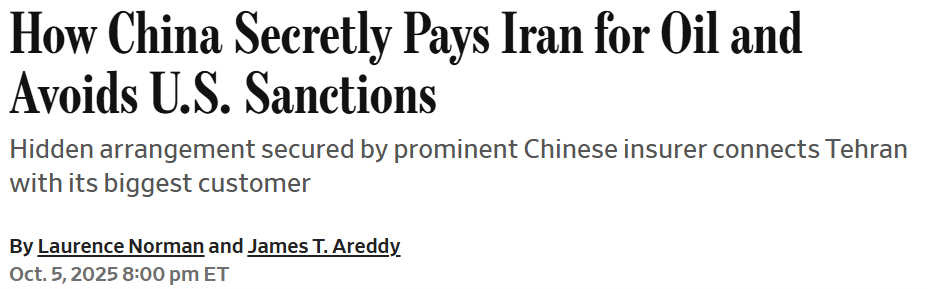
But China buys millions of barrels of Iranian oil, outside the US dollar system. The China-Iran oil trade is similar to a bartering system: Iranian oil is shipped to China, who builds infrastructure in Iran.
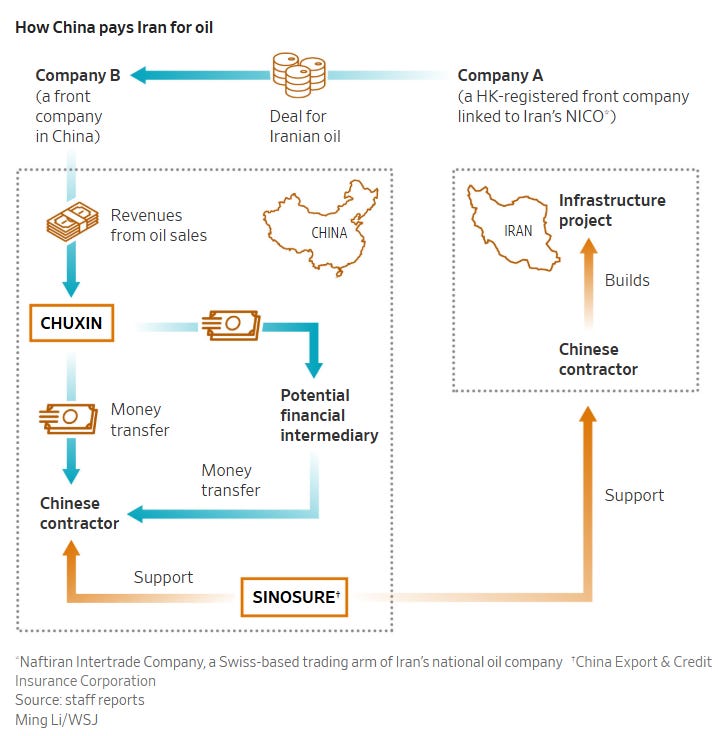
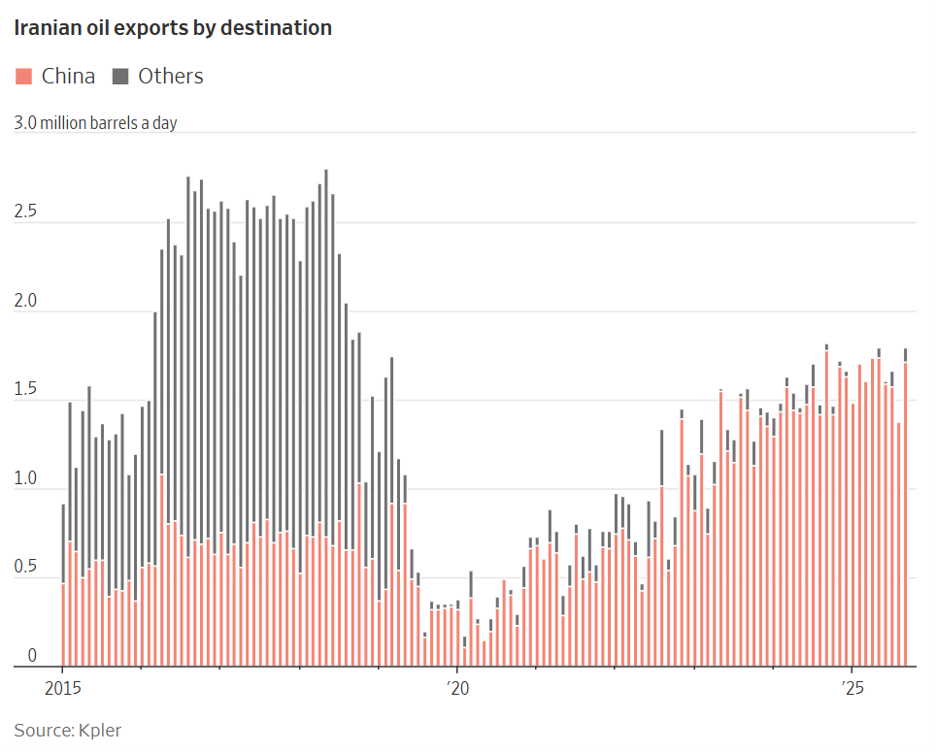
This is the plumbing that China and Iran set up, and at no point are US dollars used, nor, obviously, are any funds zipping through correspondent banks in New York. Iran exported $43 billion of oil last year, and 90% of that oil came here:
In the Memorandum of Understanding between Iran and the United States to end the war and open the Strait of Hormuz, Iran is allowed to immediately sell oil on open markets, and the sanctions come off. About $100 billion will be un-frozen, along with another $300 billion on the way for reparations.
This is a key point here: Iran was smuggling out the oil anyway, and earning billions of dollars. Iran closed the Strait of Hormuz for oil sales for everyone else, except for their own, and were getting far higher prices for that oil than before.
The United States was in an impossible position, and the thinking there is that they may as well take all the chains off in exchange for oil flowing smoothly again, for everyone. And American banks can’t make billions of risk-free profits skimming off the top of the Persian Gulf oil trade until it’s moving again.
We can think of it this way. China set up that system, which is outside the US dollar and US banks. Iran sold oil last year, despite the sanctions, using that system, going around the US dollar. This year, oil tankers went around the US blockade, and got Iranian oil to other markets here in Asia. And all that trade was outside the dollar too.
Iran. China. Russia. Those are BRICS countries. And they’ve blown up petrodollar system for themselves, and for anyone else who wants to join.
Be Good.
Resources and links:
Dollar Architecture: How U.S. Sanctions Freeze Assets Abroad
https://ofacblockedfundslawyers.com/us-sanctions-freeze-dollar-assets-abroad/
See Where Iran’s Billions of Dollars in Frozen Assets Are Held
https://www.wsj.com/world/middle-east/iran-frozen-assets-7e926b39
Trump, Aiming at Iran, Puts a Squeeze on Iraq
https://www.wsj.com/world/middle-east/trump-aiming-at-iran-puts-a-squeeze-on-iraq-d37622e8
The Trump-Iran Deal Allows Tehran to Immediately Sell Oil
https://www.wsj.com/world/middle-east/the-trump-iran-deal-allows-tehran-to-immediately-sell-oil-37a1ebe5
How China Secretly Pays Iran for Oil and Avoids U.S. Sanctions
https://www.wsj.com/world/middle-east/how-china-secretly-pays-iran-for-oil-and-avoids-u-s-sanctions-b6f1b71e
Now it’s oil: China, BRICS and OPEC+ build new trading system, locking out US suppliers and banks
Iran’s shadow oil trade endures near Singapore despite war
https://www.france24.com/en/live-news/20260416-iran-s-shadow-oil-trade-endures-near-singapore-despite-war-1
Ships With Iran Oil Anchor Off India as Trump Announces Blockade
https://www.bloomberg.com/news/articles/2026-04-13/ships-with-iran-oil-anchor-off-india-as-trump-announces-blockade
Iran still exporting millions of barrels of oil through Strait of Hormuz even as other traffic paralyzed
https://edition.cnn.com/2026/03/16/business/iranian-oil-exports-hormuz-strait-intl-cmd
How the U.S. controls Iraq’s oil revenues
https://www.reuters.com/business/energy/how-us-controls-iraqs-oil-revenues-2026-01-23/
U.S. Withholds Iraq’s Own Money Over Ties to Iran
https://www.nytimes.com/2026/04/22/world/middleeast/iraq-us-dollars-shipment-iran.html
Sanctions List Search
https://sanctionssearch.ofac.treas.gov/
China isn’t dumping dollars. They’re dumping banks, and setting up a new financial system.
Inside China / Business is a reader-supported publication. To receive new posts and support my work, consider becoming a free or paid subscriber.
From Inside China / Business via This RSS Feed.