

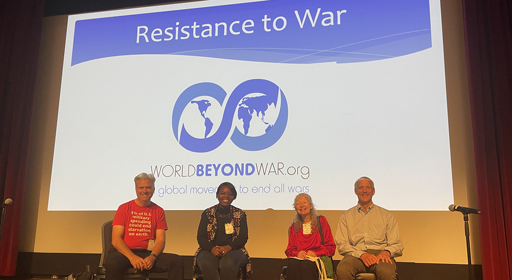

World BEYOND War’s David Swanson, Kathy Kelly, Sellah N. King’oro, and John Reuwer, spoke on June 19 at the University of Massachusetts – Amherest at the conference on Resistance Studies.
Part 4 of 4: Flotilla As Resistance, by John Reuwer, June 19, 2026

David told us the importance of creating a vision for a world where people understand their interconnectedness enough to abolish war, and the critical part that academia plays in articulating that vision
Kathy gave us three eautiful examples where people came forward with creative and unexpected resistance in the middle of the horror of war.
Sellah showed us how the war culture is not just politicians or even budgets, but requires the cooperation of countless people, including those who transport weapons all over the world, and reminds us that that cooperation can be removed at any time, to the benefit of all.
I would like to add another element of resistance to war.
To create a World Beyond War and a just and sustainable peace we have to answer the basic question of whether people can protect themselves without pointing a gun at someone. I think it is fair to say that most people believe that violence is the final arbiter of conflict, No matter how much they wish for nonviolence, negotiations, diplomacy, or the rule of law, if someone they deem a bad guy is coming at them with a weapon, they want a good guy with a better weapon to protect them. Are there other ways we can protect one another? I have been on the frontlines of conflict zones on five continents, including several U.S. cities with a high violence and homicide rate. I have seen people use nonviolent methods to protect themselves and others in dozens of ways. Much of this is done spontaneously out of human intuition – recognizing the better angels of our nature in ourselves and others.
There is also a relatively new field of practice referred to as Unarmed Civilian Protection (UCP) and Unarmed Civilian Defense (UCD) that is being effectively employed by dozens of organizations around the world. The problem is these projects are very small, so that few people are exposed to the amazing work they accomplish. The reason the projects are small is that those who benefit from violence, that is the war profiteers and power hungry politicians do not want to fund alternatives to violence. On the contrary, they spend lots of money convincing people to be afraid and to count on them to protect them with violence that they then extract from those same people.
One of the ways to get around this is to demonstrate on a larger scale people willing to go unarmed against guns and manage to make a difference. To be most effective, this will mean taking the risks that soldiers take, including injuries and deaths for the sake of peace. The Flotillas to Gaza were such an demonstration. What inspired this latest effort?

We heard yesterday four powerful examples of resistance from the occupied peoples forum. I am going to present my view of the Palestinian people as an example of incredible resistance to war. Put aside for a moment the armed resistance by Hamas culminating in the attack on Israel on October 7, 2023 that escalated the violence of the 78 year occupation of Palestine. What I want to talk about today is the nonviolent resistance by 98% of Palestinians practicing sumud, the word they use for steadfast perseverance, that combination of resilience and resistance. While I have been to the West Bank enough times to witness the incredible sumud of the people there, I will focus on Gaza because of all the global conflicts since WW2, it is unique in what civilians have and are facing. Though it is not the deadliest conflict on the globe at the moment, it is unparalleled in that:

- The population is totally captive. When the Russians began the attack on Ukraine, almost a quarter of the population left the country. In Sudan and the Congo, huge numbers of people are displaced to safer areas. But in Gaza only a few percent have been able to leave. There is wall and a berm on three sides, and the sea on the other, totally blockaded by Israel. The people are trapped in an open air killing field.
- The amount of explosive ordinance dropped on Gaza per capita is unmatched anywhere. The equivalent of at least six Hiroshima bombs on an area a little larger than Washington DC
- A higher percentage of women and children have been killed than in any other conflict. WCNSF
- More health care workers killed, health care facilities destroyed, and more journalists killed than in any other conflict.

In spite of this, Palestinians persist in the activities of daily life, the incredibly hard work of finding food and clean water, protecting their children from weather, injury, and rat bites. They do what schooling they can in tents in the heat and cold, rain and blazing sun.
Yet they do more – they bring as much joy to life as they possibly can.
Here are amputees running in a 2 kilometer race that was part of a marathon run this spring. Imagine running a marathon around Gaza at this time.
Here is Ahmed Muin Abu Amsha, who noticed how much his community was suffering from the awful and endless buzzing of drones never knowing which would just watch, and which would kill, wrote a song that changes the hum of drones into music, mitigating the fear the noise used to bring.

Every Sunday Doctors Against Genocide host a webinar where they speak in real time to medical personal from Gaza who are caring for their people the best they can.
Here you see that Doctors in Gaza actually graduated a medical school class this year despite the constant bombings and deprivations.
On the right you see a book designed by a nurse who endured the shortage of doctors during mass casualty events so many times that he needed to so something. Nurses are often forced by circumstances to do procedures far beyond their training. This extensive manual is a shorthand guide for them. I have seen it, and find it worthy of any advanced EM practitioner.
Palestinians have become the bravest and most skilled medical rescuers in the world by being forced to work in horrific conditions for so long.
It is all this incredible nonviolent activity to protect each other that inspired…

The Gaza Sumud Flotilla.
Sending boats to Gaza in an effort to break the siege began in 2008, but have mushroomed in size in the last two years.
Allow me to present the 2026 Flotilla to Gaza as a rather significant step in the direction of civilians protecting civilians.
2000 people from over 45 countries actively participated, 600 sailed on 81 boats. 500 unarmed civilians went eyeball to eyeball with heavily armed troops of one of the most lethal militaries in the world, took some serious injuries, but returned home with our heads held high. We were cheered on by tens of thousands of people the world over. Did we actually protect people in Gaza? Not directly, but by absorbing a little of the brutality of the IOF directly, we brought much press attention to what Palestinians suffer every day. The cruel bravado of Ben Gvir was denounced by leaders the world over. The Flotilla probably brought more attention to Palestine than anything since the announcement of a false cease-fire. Israel denies torturing prisoners, but the testimonies of the captives bought world attention, including an article in the NYT that showed skeptics that indeed torture has been used routinely extensively against Palestinian hostages.
This six month project cost somewhere around $3.5 million dollars. That is the cost of a single Tomahawk cruise missile like the one that killed the 165 school girls in the opening salvos of the US attack on Iran. That is 0.35% of what what what US taxpayers spend every day for the war on Iran.
Let me finish with a thought experiment in what I call leveling the playing field when it comes to comparing violent and nonviolent resistance.
If you say the Flotilla should quit because it did not deliver aid and did not do much to actually save Palestinians, in my mind that is the equivalent of saying if you sent a handful of troops into a battle to protect civilians, and they lost that battle and got people killed, they should just give up. Most people would say don’t give up, just send in more troops and more weapons.

Imagine if the Flotilla had a budget of 0.01% of the $1B US taxpayers spent on attacking Iran, or $100,000 dollars a day. It could float 500 ships with 3500 people on board.

Or how about 0.1%, or $1M/day? t could float 5,000 ships with 35,000 people on board. What would the Israeli navy do against that? How would what they do be seen by people around the world?
Before we sailed, we talked about this a bit. What if the Israelis blew one of our boats out of the water? Should we turn and run? I think Israel could easily have held their own in the propaganda war for opinion over one boat, at least in the West by saying, “What they did was stupid, coming into an active war zone between Israel, the U.S., and Iran. What did they expect?”
What if they blew up a second, then a third? My take was that we should continue, because at some point, seeing so many unarmed civilians who had not been sufficiently demonized would trigger global outrage that could have a profound effect on the uncritical support for Israel.
Most people were not prepared to go to that level of risk, but I can imagine a flotilla or other nonviolent action strategy that would be prepared for that.
We can talk about this in discussion, but let me challenge you to be bold and creative in your thinking as you think about how we could demonstrate the power of nonviolence. I think it is very likely we will not have the just and peaceful world we want until enough of us are willing to take the same risks for peace that soldiers take for war. The 600 risk takers on the Flotilla advanced this idea by galvanizing tens of thousands of people around the world to take action.
The post Resistance to War, Part 4 of 4: Flotilla As Resistance appeared first on World BEYOND War.
From World BEYOND War via This RSS Feed.