

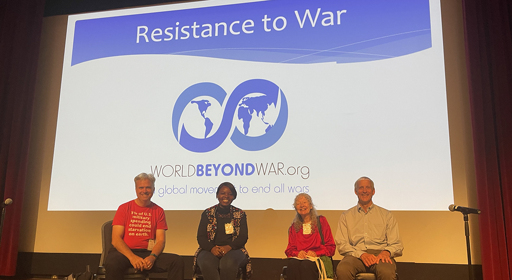

World BEYOND War’s David Swanson, Kathy Kelly, Sellah N. King’oro, and John Reuwer, spoke on June 19 at the University of Massachusetts – Amherest at the conference on Resistance Studies.
Part 3 of 4: Hidden Power in the Pipeline, by Sellah King’oro, June 19, 2026
When we talk about the global war system, we usually focus on the big things: political speeches, massive military budgets, and the violence we see on the front lines. It can feel like an unstoppable machine. But if we look closely, we see something important: the war machine has a very real weakness. No matter how much money is spent in a capital city, and no matter how advanced a missile is, that weapon is useless if it cannot physically reach the battlefield. If the pipeline breaks, the war machine stops.

Weapons do not move by magic. They move through ports, railways, highways, and airports. They must cross oceans, pass through shipping containers, and travel through narrow logistical chokepoints. And at every one of those chokepoints, there are working‑class people. There are port workers, truck drivers, rail operators, and cargo handlers.
Today, I want to take us to the African continent to explore a powerful form of resistance: the ability of ordinary workers to interrupt this pipeline and say, “Not on our watch, and not through our infrastructure.”
Let’s begin in South Africa, a country with a long history of resisting state violence and building international solidarity. South African dockworkers, especially those organized under unions like SATAWU, understand that their labor has global consequences.

In April 2008, a Chinese ship called the MV An Yue Jiang arrived in Durban. It carried millions of rounds of ammunition and mortar bombs destined for Zimbabwe during a tense and repressive election period. These weapons were meant to strengthen a regime and intimidate civilians.

When the ship docked, South African workers refused to unload it. They would not touch the cargo. They understood that by refusing to move those weapons, they were protecting lives across the border. Because of their action, the ship was forced to leave Durban and drift at sea, unable to complete its mission.
And this was not an isolated moment. In May 2021, during the bombardment of Gaza, the Israeli-owned Zim Shanghai arrived in Durban. After a call for global solidarity from Palestinian trade unions, Durban dockworkers again refused to unload the ship. They made it clear that their labor would not support injustice. They showed that peace can be created through logistical refusal.
But the 2008 story did not end in South Africa. When the MV An Yue Jiang failed in Durban, it tried to reroute to Mombasa, Kenya. The war machine was looking for a softer entry point.
But Kenyan dockworkers were ready. Supported by the Dock Workers Union and civil society, they publicly declared that they would not handle the weapons either. By shutting down Mombasa as an option, they blocked the backup plan and forced the ship to abandon its mission entirely. This is what happens when workers understand their power in the global supply chain.


Of course, weapons do not stay at the ports. Once they land, they move inland through rail networks in South Africa, Kenya, and Tanzania; through major trucking corridors like Mombasa–Kampala and Durban–Johannesburg; and through air cargo hubs in Addis Ababa, Johannesburg, and Nairobi.
These routes reveal a new map of resistance. Rail workers and truck drivers can refuse to transport military cargo. But to do that, they need transparency. That is why unions across the continent are demanding full cargo disclosure. They want the right to know whether they are transporting food or artillery.
We saw the importance of this during the Tigray conflict. Investigations reported that Ethiopian Airlines was being used to move weapons and soldiers. Even though the airline denied the claims, the global reaction was immediate. Workers understand that hiding weapons inside civilian cargo turns ordinary employees into unwilling participants in war. By demanding transparency and coordinating across borders, transport workers are trying to ensure that no train, truck, or plane becomes a silent partner in violence.
But we must also be honest about the challenges. In Mombasa today, thousands of private port workers, known locally as Bangaizas, are protesting for fair wages and safe conditions. Their struggle shows us something important: global military and corporate logistics depend on exploited, unprotected labor. When workers try to organize, they often face intimidation, violence, and legal threats. Governments and corporations want quiet ports and compliant workers so that trade, including military cargo, moves smoothly.
This is why the peace movement cannot be separated from the labor movement. Supporting African dockworkers and transport workers in their fight for union rights is part of building a democratic barrier that can choose to block the movement of weapons. A worker who is exploited and afraid can be forced to load a weapon. A worker who is unionized and protected has the power to say no.

To close, I want us to rethink how we imagine dismantling the war system. The war machine is not an abstract idea. It is a physical network of ships, trains, trucks, and planes. It depends entirely on the labor of working‑class people in the Global South.
When dockworkers, truck drivers, and rail operators coordinate across Durban, Mombasa, Addis Ababa, and beyond, they create what activists call “globalization from below.” They show that if powerful actors can globalize war, ordinary people can globalize resistance.
Peace is not only negotiated in high‑level meetings. Peace is being negotiated right now on the docks, rail lines, and airport tarmacs of Africa, by everyday people who are holding the line and stopping the war machine in its tracks.

The post Resistance to War, Part 3 of 4: The Hidden Power in the Pipeline appeared first on World BEYOND War.
From World BEYOND War via This RSS Feed.