

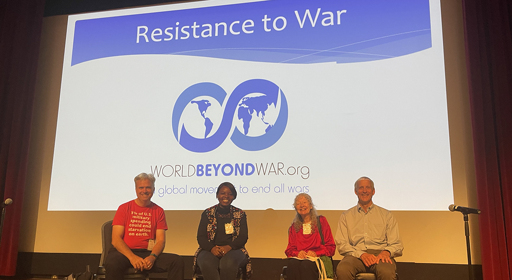

World BEYOND War’s David Swanson, Kathy Kelly, Sellah N. King’oro, and John Reuwer, spoke on June 19 at the University of Massachusetts – Amherest at the conference on Resistance Studies.
Part 2 of 4: We Will Not Be Silent, by Kathy Kelly, June 19, 2026
This conference summons us to escalate our resistance to war planners and war makers. As a member of World BEYOND War, I’m grateful to be here and learn from you.
I’d like to recall a story from 20 years ago, in the summer of 2006. I happened to be in Ireland as a defense witness for Irish activists who were part of the “Pitstop Plowshares” action. Prior to the 2003 U.S. Shock and Awe bombing and invasion of Iraq, five activists entered the Shannon airport and did 2 ½ million dollars worth of damage to a US navy warplane parked on the tarmac. The trial lasted for three years, but that summer, in 2006, skillful defense barristers argued that the five had legal excuse to do what they did and that all of us in the courtroom should ask ourselves what was our excuse not to do more. “What will rise ye?” asked Mr. Nix, a defense barrister. The Irish jury acquitted the five on all charges. While activists were gathered for the trial, word arrived from activists in Beirut, urging internationals to join them for an action in defiance of Israel’s war against people living in the south of Lebanon. June 12th was the beginning of a a 34-day war between Israel and Hezbollah. A group of Yuppies in Beirut called on internationals to hurriedly join them in a convoy they were organizing to deliver relief to Lebanese people living in southern Lebanon. Four of us who had been part of the trial in Ireland traveled to Beirut to join the group planning a convoy to southern Lebanon. While in Beirut, we witnessed increasing numbers of refugees from southern Lebanon seeking relative security in Beirut.
They told about the dangers and privation faced by those who had no means of escape. Organizers of the convoy packed the trunks of their cars with food, water, and medicine. They wanted to show solidarity, and defy Israel’s ongoing war. 57 cars assembled to form the convoy.
Lebanese police blocked it before we had reached Litani River which divides the north and the south of Lebanon. We returned to Beirut, and a cease fire was signed two days later.
Two young Lebanese men, both named Mohammed, offered to take me and my traveling companions to southern Lebanon. From Dr. Norman Finkelstein, of De Paul U., we had received evidence of massacres that the Israelis had committed in their attacks against unarmed civilians in towns and villages in southern Lebanon
Norman’s tragic list steered us to the town of Qana. In that town, one extended family, the Shalhoub family, had been assured that a particular building had a fortified basement which Israeli bombs couldn’t penetrate. But U.S. weapon makers assiduously created newer versions of bunker busting bombs which could burrow underground and, upon exploding, raise the temperature so high that no one could survive. Condoleezza Rice had urged the Israelis not to sign a ceasefire until the U.S. could ship the newest bunker busting bomb to them. Unaware of this development, the Shalhoub family would bring their children to the fortified building to sleep overnight. They would tuck them in and then return in the morning to bring them home.
Our small group of enquirers arrived in Qana on the day that family members were burying their children. Someone in the town directed us to the home of Umm Zahara, whose six-year-old daughter had been killed by a U.S. manufactured bunker buster bomb. The funeral had been delayed until rescue workers could exhume the bodies. The rescue workers had found the bodies of Zahara and her four-year-old cousin sleeping in each other’s arms. The corpses of the children were immaculate. Both little girls were killed because bunker buster explosion had caused their internal organs to implode.
One by one, neighboring women approached Umm Zahara and embraced her. When she saw Farah and me sitting quietly on a cement ledge, she nodded, then pointed upward. The gesture caused her to wince. She was wearing a neck brace and a medical hood. Then she asked us: “ Didn’t they notice? Didn’t they see? My Zahara, I take her each night to this place to be safe, and each morning, she runs to me, I pick her up, get her breakfast.”
She asked her son to bring newspapers that showed a helmeted relief worker shouting in agony as he held up her daughter’s body. Then she asked her son to bring a framed picture. We saw the beautiful face of an innocent child. Umm Zahara tapped the plastic over the photo. “Who,” she asked, “is the terrorist?” “Is she the terrorist?” It was only later that I realized, when she pointed upward, that she was pointing at the drones which undoubtedly recorded the actions of the Shalhoub family.
Later, Irish activists from Derry, Northern Ireland, visited the Shalhoub family, and recorded Umm Zahara’stestimony. After they returned to Ireland, they worked out a plan to occupy a local Raytheon software facility. On August 9, 2006, they entered the Raytheon factory in Derry and occupied it for hours. While there, they opened the windows and pitched the computers out the window. During their trial in Belfast, in 2008, they argued they were not guilty because they acted lawfully to prevent more serious crimes in Lebanon. The jury unanimously acquitted them.
Following the action, activists kept up consistent pressure, including continuous protests and mass blockades. This decade-long campaign succeeded. In 2010, Raytheon officially pulled out of Derry.
The Derry 9 and the Palestine Action activists in the UK have acted in the tradition of Plowshares Actions pioneered by the Berrigan brothers, Phil and Dan, both of whom, as Catholic priests engaged in nonviolent property destruction by burning draft cards in Catonsville, Maryland, in 1968. Their group was called the Catonsville Nine. All served between 2 ½ to 3 years in prison after being convicted. Last week, Palestine Action activists were sentence to prison terms of six to eight years, after a judge deemed them to be terrorists for opposing genocide.
As we imagine solidarity, worldwide, I want to include Afghan children, child laborers who were learning literacy but also studying nonviolence with the Afghan Peace volunteers ten years ago.
They gathered as many toy guns as they could. Sakina, holding the yellow-handled hammer, pounds one of the guns to bits and pieces. When all of the guns were destroyed, they buried the pieces and planted a tree on top of the grave of guns. The Afghan Peace Volunteers who tried hard to embrace the teachings of Gandhi and Dr. King have been forcibly displaced by the Taliban takeover, but now a chapter of World BEYOND War has been formed which is comprised of Afghans in diaspora.
This morning let’s recall Hans and Sophie Scholl who, with the White Rose collective in German, resisted the Nazis during WWII. The Gestapo caught them distributing leaflets and three days after their arrest they were beheaded. All of their leaflets were headlined “We Will Not Be Silent.” They are remembered to this day. But what are we to say about over 260 Palestinian journalists who would not be silent about Israeli war crimes that have harmed and killed innocent civilians?
Health care workers have also been systematically killed.
Surveillance technology developed and sold by U.S. tech conglomerates have created the algorithms that target people, who are then hunted by predatory aerial vehicles, targeted by snipers, burned alive in press tents, slaughtered in hospitals.
Students aiming to resist the ongoing genocide have been threatened and intimidated by universities across the U.S. and around the world. We share an urgent responsibility to collectively insist, during this ongoing genocide, “We Will Not Be Silent.”
The post Resistance to War, Part 2 of 4: We Will Not Be Silent appeared first on World BEYOND War.
From World BEYOND War via This RSS Feed.