

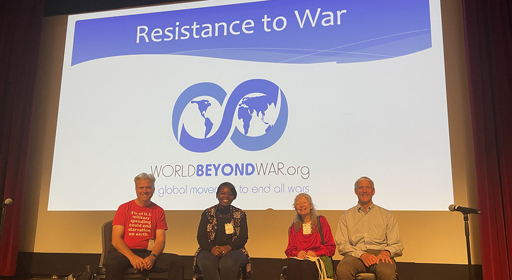

World BEYOND War’s David Swanson, Kathy Kelly, Sellah N. King’oro, and John Reuwer, spoke on June 19 at the University of Massachusetts – Amherest at the conference on Resistance Studies.
Part 1 of 4: War and Resistance Studies, by David Swanson, June 19, 2026
In the 1990s I was doing a Master’s in Philosophy at the University of Virginia when some UVA professors and students began a campaign to get everyone who worked there paid a living wage. It was the first organized activism I worked on, the first time I planned events, recruited people, and argued against misleading claims from opponents of positive change. I got involved in living wage efforts around the country and eventually ended up working for a group called ACORN, but the leading lights for us were Robert Pollin and Stephanie Luce at the Political Economy Research Institute at UMass Amherst. When I later took on military spending, no documents were more valuable than reports from Robert Pollin and Heidi Peltier showing that spending on education, infrastructure, or energy, or doing nothing at all, would get you more jobs than military spending — even though I always pointed out that justifying military spending with jobs was psychopathic. In fact efforts to tell the truth about war and end war have benefited from numerous books and reports and professors from Amherst. Not long ago I was on a webinar with Chris Appy. I don’t know how Amherst escaped the name-changing fad, but I’m glad it’s here whatever its name.
I also want to give a shout out to some 130 people who were arrested here two years ago for using the first amendment and opposing genocide. Thank you. And — on behalf of old people — I’m sorry.
The absorption of academia over the past 80 years into the Military Industrial Congressional Intelligence Media Academic Think Tank Complex has had a major impact on the normalization and proliferation of warmaking and on the transfer of public investments from useful spending to war spending. Recent prohibitions on discussing Palestinians as though they were humans or the Israeli military as though it were a military are part of a broader process of making universities dependent on war spending, replacing the humanities with the sciences, and creating a culture in which Starbucks can claim that to not sell coffee at a death camp in Guantánamo would be a political action, whereas selling coffee there is simply life. This university, too, is a military contractor. There have been human societies without war or even murder. There have been societies that could be traumatized by the murder in an ordinary Hollywood film. But in the United States divesting from militarism is more difficult than ordering something vegan at a Fourth of July barbecue.
In U.S. academia there is often a focus on the United States, with numerous attempts, for example, to get single-payer healthcare to work in theory, utterly uninterested in the fact that it works in practice. When it comes to things like military spending or incarceration, or gun violence, this bias involves focusing on a small corner of the world with a bizarre and freakish problem that does not exist at anything like the same scale elsewhere. The new fashion of measuring military spending as a percentage of an economy is an attempt to come up with charts that both the U.S. and the rest of the world can fit on. This month, a number of academics worked with the Project on Government Oversight to produce a report called “The True Total U.S. Military Budget.” That report showed that U.S. military spending last year could be accurately measured as $2.3 trillion. Another half trillion because Trump wants it and another $0.2 trillion for war on Iran would make $3 trillion next year. Even if the rest of the world hits $2 trillion, the U.S. government alone will be spending to kill on behalf of 4% of the world’s population 150% of what the rest of the world spends to kill on behalf of 96% of the world’s population. Per capita that would be $8,746 for wars from the U.S. government for every man, woman, and child in the United States, as compared with $241 on average from the rest of the world’s governments for every person in the rest of the world. Is there something about the U.S. person that requires 36 times as much investment in warmaking as the non-U.S. person? Of course not. Nor is there anything in so-called “human nature” that requires another dime for this madness anywhere. But if anyone should use the feeble excuse of “human nature” it should probably not be the outlier with little in common with 96% of humanity.
On a side note to Senator Ed Markey from Massachusetts: thanks for speaking against military spending. But no thanks for proposing to block a deal with Iran in order to push the Iranian nuclear weapons propaganda and continue the war. Really, no thank you. Not helpful. Academia needs to deliver us from the superficial positioning of partisans.
Congress is going to talk about military spending as though it is half what it is, and call it “defense.” Superstitious excuses like “human nature” and “deterrence” and “global policing” are going to slide along unchallenged in common sense, unless academia steps up. The impact that war has on life, on the environment, on nuclear risk, on international cooperation, on the rule of law, on bigotry, on civil liberties, and on the diversion of resources means it’s war or us. We abolish ourselves or war. But people right now find it easier to imagine abolishing us than abolishing war. It’s easier to picture nukes or AI or diseases or ecosystemic collapse eliminating life than it is to imagine an institution that requires massive investment being ended, to imagine our society behaving like so many others in history and prehistory that have not used war. We claim there is always a war somewhere, and yet there is always not a war millions of somewheres, and most individuals tend to do everything they can to not be in wars — in the polling the U.S. is catching up to Europe in those who say they would never take part in war. The world’s hospitals have yet to record a single case of PTSD from war deprivation. And yet we cannot imaging abolishing it — academia needs to step forward. We need the wisdom of Jean Paul Sartre that we can do something new and the wisdom of anthropology that peace is nothing new at all.
Also this month, a group of academics put out a 200-page report on the impact of militarism on Hawaii from its illegal takeover through today. The report from the Institute for Policy Studies is called The True Cost of the Military in Hawaiʻi. We need a similar report for each state, county, and city. What is the environmental, economic, and cultural impact locally and globally, what is the contribution to the risk of more wars, and what are the prospects for putting land and people to better use? Several years back Connecticut, the actual state government of Connecticut, put together a committee to study transition to peaceful industries. You know how every year for many years the weapons dealers have warned that military spending has practically dried up? For some reason, Connecticut picked that year to believe that nonsense. But such studies are needed and won’t happen without academia.
Also this month a group in the UK called Demilitarise Education published a report called University and Arms Database which examines the influence of military money on higher education in the UK, including its production of greenwashing of militaries’ horrific impact on our environment. The report is not completely unlike one from 11 years ago from VICE that ranked U.S. universities by their militarization. But why aren’t universities themselves reporting on this?
On the front page of World BEYOND War’s website we go after myths that war is ever inevitable or justified or necessary or beneficial. This is something our institutions of higher learning should be focused on. War is arguably the worst thing we do. Tearing down false conceptions that keep it going ought to be near the top of our to-do list. There is an organization called the Peace and Justice Studies Association that does some good things, but mostly the good things it does are not related to war and peace, instead falling under that all-encompassing heading of “justice.” There’s also a U.S. Institute of Peace in Washington D.C., with its weapons-dealer funders carved in marble, and yet to find a single U.S. war it opposes. Something I find much more valuable is Peace Science Digest, which is published by the War Prevention Initiative. It collects and summarizes research useful to peace. It turns out that what makes war likely is not the wrong religion or scarcity of resources or lack of education but things like the presence of fossil fuels and a societal acceptance of wars. It turns out that in many dozens of cases in which war might predictably be offered as the only choice, goals have been achieved using nonviolent activism. We arguably have as thoroughgoing and destructive an epidemic of denial of the powers of nonviolent activism as we have of climate collapse.
Last year in Peru, protests forced out a brutal and illegitimate president. In 2024 in Korea, people nonviolently undid martial law. In 2024 in Bangladesh, a student-led movement replaced an oppressive government without war. This month in Bolivia, people shut down the capital because campaign promises weren’t kept. I tried unsuccessfully to explain to someone there that I can recall neither a campaign promise being kept in the United States nor people shutting down the capital. The people of Albania are working on overthrowing their governement over just one horrible Trump project. How many do we have?
We also, of course, need industrial scale debunking of U.S. origin myths and Israeli origin myths. They’re from the same time period, in so far as U.S. origin myths are based in the transformation during World War II of the U.S. government into a massive and permanent war machine that can supposedly fix any problem with superior violence, just like the protagonists of most of our movies. In these myths, the U.S. and Japan did not publicly build up to war for many years against the resistance of peace advocates on both sides, the U.S. did not publicly organize the world’s governments to refuse to accept Jews and others from Germany condemning them to their fate, the West did not end World War I so disastrously that accurate predictions of WWII immediately emerged, Western governments and corporations never supported the Nazis as preferable to communism, the Nazis never studied U.S. segregation and eugenics, Japan was not ready to surrender until after nuclear bombings, the majority of top officials in the U.S. military and the U.S. governments own commission never argued that Japan would have surrendered without that slaughter, the U.S. military never hired top Nazis into its ranks at the end of the war, and the world is basically unchanged from those mythical days so that in 2026 you can justify military spending by pointing to an event that happened before color televisions.
We need to resist the actions of governments and corporations. We need sometimes to resist the very air we breathe. We need to stop calling each other the bomb, offering bullet points, crediting speakers for killing it, and speaking of war crimes in the first person as if we did them even while sitting in jail for protesting them.
We need to resist, but not as the Democrat who works to keep a Republican war going in order to be opposed to it. We need to resist with the intention of actually resisting, reversing, and overcoming. A useful resistance works to put itself out of work. That’s why, at World BEYOND War, we try to paint a picture for people of what a world beyond war might look like. When people used to ask me what I would replace war with, I would snap back at them with “What would you replace torturing kittens with?” or whatever. But people asking that are clearly imagining that there is some purpose served by war that can’t go unfulfilled. Did you know that Trump and many of those closest to him attended military academies? I would abolish those, but I would be obliged to explain to people like Trump’s parents where else they could unload him, even if the new place might not turn out such a sadist at graduation. The same goes for war as a whole. We need in-depth portraits of what it would look like to have international courts with prosecutors who aren’t destroyed for noticing Israeli crimes, of disarmament agreements followed through on, of cooperation not just around soccer tournaments and corporate trade but also around health, housing, and hunger.
We never do seem to get away from the fact that we are primates. I don’t mean that we’re as loving as bonobos or as testy as chimps. I mean we like to imitate. We don’t like to do things until we’ve seen them, in history or in fiction. We need historical and fictional accounts of living without mass murder, and we need them by the boatload. Let’s work together.
The post Resistance to War, Part 1 of 4: War and Resistance Studies appeared first on World BEYOND War.
From World BEYOND War via This RSS Feed.