

“What shall it profit a man, if he shall gain the whole world, and lose his own soul?”
Elon Musk is, at least on paper, the world’s first trillionaire. He reached that milestone on June 12, after SpaceX debuted as a publicly-traded company on the U.S. stock market at an initial offering of $150 per share. At the time of writing, that price has risen to about $185, taking Musk’s estimated net worth to $1.4 trillion as the company becomes bigger than Amazon. Depending on how you evaluate the historical Malian emperor Mansa Musa, Musk may be the richest person to ever live.
Among pro-capitalist pundits, Musk’s ascension to trillionaire status has been the occasion for a round of sycophantic applause, as they all rush to tell us why it’s good for one individual to control this much of the world’s resources. At Fox News, we’re told that Musk “earned every penny,” and is living proof that “capitalism continues to reward individuals who create extraordinary value.” Similarly, an op-ed in the Los Angeles Times tells us that his SpaceX fortune is “a testament to human ingenuity, immigrant success and American greatness.” The National Review offers “Three Cheers For Elon Musk,” calling criticism of his hyper-wealth “revolting. Repulsive. Grotesque. Un-American.”
Now, there are all kinds of political and economic reasons why these claims are wrong, and we’ve discussed them at some length elsewhere. Two of the most important are that by hoarding wealth, billionaires and now trillionaires are actively keeping other people in poverty, making the whole thing monstrously unethical, and that their vast fortunes allow them to buy political power and make a mockery of the word “democracy.” Both of these things are true of Musk, who has bragged about using his wealth to get Donald Trump elected and likely killed hundreds of thousands of people across Africa with his “DOGE” aid cuts. (If you start to count the lives Musk could save if he put his money to good use, the numbers get even more staggering.)
But another, morbidly fascinating aspect of this whole moment is that, despite possessing wealth that rivals the emperors of the ancient world, Musk’s existence is a bizarre and cursed one in many important ways. His personal relationships with the people closest to him, by all appearances, are dysfunctional and abusive to varying degrees. He desperately wants to be adored by the public, but with every attempt, their approval slips further from his grasp. Instead of enjoying his money and leisure, he spends his waking hours obsessing over racist conspiracy theories and paranoid fantasies about the end of the world. And to add the final insult, he doesn’t evenhave a trillion dollars in any real sense; he just has to spend a lot of time and energy keeping up an elaborate fiction that he does.
In a way, Musk’s fans are right: he’s a perfect example of capitalism at work, with its relentless drive for growth and acquisition at the expense of everything else. It’s just that those are terrible principles to base a human life on.

You Can’t Buy Human Connection
It’s an old truism that money can’t buy the things that truly matter in life. This is only sort of the case. Money can certainly buy you a lot of the necessities that make it easier to be happy, like stable housing, leisure time, and better health, and research suggests that up until you hit about $100,000 per year in income, money can indeed improve your life satisfaction. But it’s also true that just because you’re wealthy, it doesn’t mean anyone will like you, especially if your money and status corrupt your ability to have healthy relations with other people.
Elon Musk’s first wife, Justine Wilson, has recounted what it was like to be married to him, and it was about as unpleasant as you might expect. Musk was initially charming, but she says that there was a disturbing warning sign when he told her during a dance at their wedding reception that “I am the alpha in this relationship.” Unfortunately, she said, “the will to compete and dominate that made him so successful in business did not magically shut off when he came home,” and in their family “Elon’s judgment overruled mine, and he was constantly remarking on the ways he found me lacking.” When she frequently reminded him that she was his wife, not an employee, he would apparently reply “If you were my employee I would fire you.” Despite their “dream lifestyle, privileged and surreal,” Musk was a terrible husband, and she felt “disposable.” Wilson told him she wanted “equality, partnership, and “to love and be loved.” He was unwilling to provide them, and told her in effect that “our status quo works for me, so it should work for you.” When she made clear that it didn’t, he divorced her the next day.
Within weeks of filing for divorce in 2008, Musk was dating the much-younger British actress Talulah Riley. The two married, then divorced, then married again, then divorced again, and Musk’s second wife, like his first, felt “she had given up her own career, while he frequently abandoned her for his.” Perhaps the trillionaire’s most high-profile relationship has been with the musician Grimes, with whom he shares three children—X Æ A-Xii, Exa Dark Sideræl, and Techno Mechanicus. (To be fair, some of the blame for the naming may belong to Grimes, who now says she’s changed Exa Dark Siderael’s name to simply the letter “y” or a question mark, representing “the eternal question… and such.”) This relationship, too, ended badly, spilling out onto Twitter, with Grimes reporting that she had been going bankrupt in a massive custody battle with Musk.
These are not Musk’s only children. The prolific breeder has at least 14 by various mothers. (Plus those to whom he gives his sperm away, whose numbers are unknown.) Musk has made it clear that he values quantity of procreative output over the quality of his relationships with his kids. Ever the student of history, he decided to populate the world with as many of his genetic offspring as possible, reportedly “after reading that Genghis Khan had done something similar.” (Good role model, Genghis Khan.) He is terrified of population decline, and “really wants smart people to have kids.” Musk appears to hold the pure genetic determinist view that what matters is not whether you’re involved with a child’s life but whether you have Good Smart Person Genes, which he believes he does. He also reportedly believes that “your wealth is directly linked to your IQ,” and so encouraged “all the rich men he knew” to reproduce.
Unsurprisingly, Musk goes about this project in the creepiest way imaginable, sliding into women’s DMs on the social media platform he owns, Twitter/X. The Wall Street Journal reports that he replies to lesser-known users and “sometimes interacts through direct messages, some of whom he eventually solicits to have his babies.” Social media influencer Tiffany Fong, for instance, noticed that Musk “started liking and replying to her posts,” driving engagement and revenue to her account, and then “sent her a direct message asking if she was interested in having his child,” even though they had never met in person. Fong declined, and when Musk found out that she had told others about his offer, he chastised her and unfollowed her, leading her new earnings to evaporate.
Musk has even preyed on women who have worked for him, with a former employee saying he “asked her on multiple occasions to have his babies.” Shivon Zilis, a Neuralink executive and former project director at Tesla, testified in a court proceeding that Musk “was encouraging everyone around him at that time to have kids and he’d noticed I did not,” so he “offered to make a donation.” Zilis went on to have four of Musk’s children, and attained “special status” among the mothers of his “legion” (his name for his progeny) because he actually spends some time with her. Zilis has said that “I can’t possibly think of genes I would prefer for my children.” But note that she did not say “I can’t possibly think of a man I would prefer to raise my children with.” According to the Wall Street Journal, Zilis moved to “a compound in Austin where Musk imagined the women and his growing number of babies would all live among multiple residences,” although Grimes reportedly refused to move to the property.
In 2022, Business Insider reported that Musk exposed himself to a flight attendant on his jet, rubbed her leg, and offered to buy her a horse if she would give him a hand job. (Note that many men do not have to offer to exchange horses for hand jobs, because there are women in the world willing to have sex with them for free, due to their winning personalities. Musk, lacking such an asset, must resort to equine bribery.) Tesla ended up paying the woman $250,000 to keep quiet about the incident. After the story broke, SpaceX employees posted “an internal letter protesting what they viewed as the company’s failure to take harassment allegations seriously,” after which eight of them were fired, leading them to file a complaint with the NLRB.
It has to be said, this set of psychosexual preoccupations bears a striking resemblance to those of Musk’s fellow oligarch, the late Jeffrey Epstein. Musk seems to have a higher age preference, as all of the women he’s been publicly involved with have been over 18 (for instance, Riley was 22 and Musk was 37 when they began dating.) But like Musk, Epstein reportedly hoped to “seed the human race with his DNA by impregnating women” on a large scale, and had a compound of his own at Zorro Ranch in New Mexico for that purpose. Like Musk, much of his harassment took place on a private plane, where the women in question were a captive audience. There are even emails between the two, sent on Christmas Day in 2013, where Musk rather pathetically begged to visit Epstein’s properties. The common denominator between the two men is treating women as things to acquire and collect, rather than people. It’s a form of perversity that’s really only available to the super-rich.
Musk is an objectively terrible father to his “legion.” Many of his children he appears to have little interest in communicating with at all. When he was asked what was so great about having children, he said that kids were “delightful” but “struggled to come up with any other reasons that had anything to do with building a relationship with the children themselves.” Musk has ignored Grimes, who had pleaded to keep their son X out of the limelight and protect his privacy, instead dragging his toddler in front of TV cameras repeatedly. The worst example of Musk’s parenting, though, is his disavowal of his 22-year-old trans daughter, Vivian Jenna Wilson, whom he has publicly condemned, saying “she was ‘not a girl’ and was figuratively ‘dead,’” alleging that “he had been ‘tricked’ into authorizing trans-related medical treatment for her.” Musk’s transphobia is so extreme that he says he got into right-wing politics specifically because of Wilson, and his public attacks on her are even more galling given that when he comments negatively about someone online they tend to receive threats. For her part, Wilson says that her father “would harass her for exhibiting feminine traits,” on one trip “constantly yelling at me viciously because my voice was too high.” He was neglectful and absent, but also “cruel” and “cold” when present, “uncaring and narcissistic,” as well as “quick to anger.” (This is consistent with accounts of how Musk treats his employees as well.) Wilson notes that she doesn’t actually know exactly how many half-siblings she has, along with the extraordinary fact that “if I had a nickel for every time I found out I had half siblings through Reddit, I’d have two nickels… which isn’t a lot but it’s weird that it happened twice, right?”
The influencer Ashley St. Clair, who had one of Musk’s children in 2024, said that while Musk seemed “very normal” before she got pregnant, “it just got so f—king weird.” When the child was born, Musk requested to keep his name off the birth certificate, while one of his deputies pressured her “to sign documents keeping the father of the baby and details regarding her relationship with Musk secret in return for[…] a one-time fee of $15 million for a home and living expenses, plus an additional $100,000 a month until the baby turned 21.” But after St. Clair expressed support for Musk’s trans daughter, Musk said he was “filing for full custody today” because her “support for trans ideology meant that she was ‘implying she might transition a one-year-old boy.’” He also “sought a gag order in New York to force Ms. St. Clair to stop speaking publicly.” In other words, in addition to his cruel treatment of his trans daughter, he threatened to keep one of his other children from seeing their mom because St. Clair disavowed transphobia. Again, the theme of treating people as possessions returns, because Musk is interested in his children only if they turn out the way he prefers; otherwise, he’ll cast them aside as he might a defective rocket engine.
Building a healthy, loving family, then, and building normal human relationships, are something Musk has no interest in, and likely couldn’t achieve even if he did. His vast wealth allows him to treat people like dirt and suffer few consequences. When the mother of one of his children displeases him, he can threaten to ruin her with a costly custody battle. When he is accused of sexual harassment, he can cut a check. But the end result of all of this is multiple failed marriages and an ever-growing brood of biological children who will lack any kind of meaningful parent-child relationship with their dad.
You Can’t Buy Cool
If his relationships to the people close to him are a train wreck, Musk’s relationship with the public isn’t much better. As the years go on, it’s become clear that he badly wants to be seen as cool, funny, and popular, and yet the harder he tries to win everyone’s admiration, the less cool he becomes. Lately, his public antics just exude a desperate, sweaty energy that makes him painful to watch. There was the godawful “let that sink in” joke that he used to announce his arrival to Twitter’s headquarters, carrying a physical porcelain sink; the stupid X-shaped jumping jack he kept doing for a while, apparently to resemble the logo of “X the Everything App”; the cowboy hat incident; the photo he posted of his bedside table with a huge gun and four cans of Diet Coke on it; the poem (Maybe religion’s not so bad / To keep you from being sad). In his comprehensive, largely flattering biography, Walter Isaacson writes that Musk’s “jokes tended to be filled with smirking references to 69, other sex acts, body fluids, pooping, farts, dope smoking, and topics that would crack up a dorm room of stoned freshmen.” (More like a classroom of sixth-graders.)
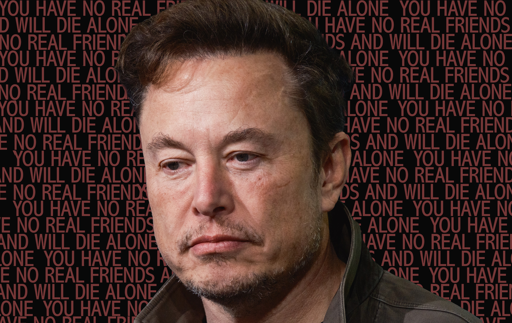
At one point, Musk admitted that he pays other people to play video games for him, so he’ll quickly get the highest scores and levels and Twitch streamers will see him as a “living god of video games.” For him, the point is not to enjoy the games, but to acquire whatever token or icon marks you as having won them, and thus earn the admiration of nerds who watch livestreams all day. And he couldn’t even get that, because when Musk attempted to stream himself playing Path of Exile 2last year, the audience trolled him relentlessly, posting “YOU HAVE NO REAL FRIENDS AND WILL DIE ALONE” over and over in the chat box. But just caring about this kind of thing in the first place is the pathetic part, and apparently no amount of money can fix that.
In fact, the money itself may be the problem. Once you reach a certain level of wealth, if you’re not careful, you become surrounded by “yes men” who tell you everything you come up with is brilliant, no matter how non-brilliant it actually is. It’s a familiar pattern with American celebrities and financial elites. Howard Hughes had his mansion full of urine jars. Michael Jackson had his oxygen chamber and monkey, and his staff largely overlooked his questionable relations with children. Ye has his song where he rhymed “they don’t understand the things I say on Twitter” with “Heil Hitler.” (Notably, Musk and the artist formerly named Kanye West were friends for over a decade.) This is the kind of behavior where, if any non-rich person tried it, they’d be socially ostracized, sent for mental treatment, or at the very least told to shut up. But where an ordinary person might be considered “weird,” “creepy,” or “banned from the mall,” the rich are merely “eccentric,” and get to carry on making a spectacle of themselves indefinitely.
The closest Musk ever came to being cool was in the early years, when he was still something of an underdog compared to the CEOs of the big aerospace and auto companies. Today, that’s gone, and his personal concept of “cool” is clearly just stuff he sees in video games, comic books, and YouTube and Reddit posts. To him, the height of “cool” is to pretend to be Iron Man, or post “epic memes” all day. It’s left him with a small, fanatical fanbase of similarly maladjusted internet guys, and he seems genuinely confused why everyone else in the world doesn’t love him, too.
One person who is cool is Musk’s daughter, Vivian Wilson, who is a proud leftist and opponent of billionaires who has posed for Vogue and is fronting major fashion campaigns. Ashley St. Clair has even speculated that part of the reason Musk has attacked Wilson is “jealousy,” that he is “just mad that Vivian is a million times cooler than he will ever be.” Even a trillion dollars cannot make a bitter, reactionary, terminally-online middle-aged deadbeat dad cooler than his fashion icon trans daughter.

You Can’t Buy Peace of Mind
Really, Musk doesn’t even seem to be enjoying his massive wealth that much. Many people, if they got hold of even a few million dollars—let alone a trillion—would be napping on a beach somewhere people have never heard of Twitter. Instead, Musk seems to spend a huge chunk of his free time on the app, responding to the most racist posts he can find. In that way, his life is not very different from that of the stereotypical, unemployed loser who lives in a basement and does the same, surrounded by empty Cheeto packets and Monster Energy cans. When you scroll through his feed, the sheer amount of racial fearmongering is overwhelming.
Take just a few examples from this June. Here’s Musk saying that “there are large numbers of anti-White hate crimes every day in America,” in a reply to a far-right account called “End Wokeness.” Here he is complaining that “the system is severely biased against Whites,” in response to the news that a white 19-year-old had been sentenced to 19 years in a British prison for “attempting to behead a Kurdish barber with an axe.” On another occasion, he retweeted someone called “Rothmus” who said that “the welfare state has been more destructive to the black family than slavery.” (This is a particularly offensive bit of nonsense, as enslaved people routinely had their young children taken from them by force and sold at auction, while the welfare state does not do that.) More often, Musk simply responds with “concerning” or “!!” to any post that highlights a crime committed by a Black person or an immigrant, bringing it to the attention of his 240 million followers—and by extension the entire app, since he has reportedly instructed the software engineers to boost his posts, whether anyone wants to see them or not.
Just one of many, many examples.
The irony is that Musk is, by definition, one of the most powerful people in the world, and he’s visibly terrified of the least powerful. According to the Washington Post, Musk posted about “race and his concerns about perceived threats to Whiteness” 850 times between October 2025 and April 2026, for an average of four racist tweets per day. He has turned a major social media network into a sewer, and appears to spend hours every day posting this bile from his own phone. That’s approaching what Victorian physicians would have called a monomania, or an idée fixe—a singular, unhealthy obsession that consumes one’s life.
But it’s not quite fair to say Musk is single-mindedly obsessed with racial panic. He’s also obsessed with the end of the world, and seems to believe that he’s destined to play a messianic role in preserving humanity from otherwise certain doom. Musk told St. Clair that he was trying to produce his legion of children in anticipation of a coming cataclysm. “To reach legion-level before the apocalypse, we will need to use surrogates.” (Will the children die in the apocalypse? Will they be hidden in a bunker? It is not clear what Musk intends.) A key part of the sales pitch for SpaceX is that it will allow H. Sapiens to become a “multiplanetary species,” giving us a backup world (probably Mars, but possibly the Moon too) in case the Earth becomes uninhabitable. The exact cause of the impending crisis is a little vague. Sometimes Musk says superintelligent AI could “kill us all”; sometimes it’s a nuclear war with Russia; sometimes it’s “low birth rates,” which he claims will “end civilization.” The details don’t seem to matter as much as the apocalyptic frame of mind itself.
Not that Musk seems to find humanity itself particularly worth saving. He is not Zohran Mamdani, who seems most at home in huge crowds and among street food vendors and taxi drivers. In fact, Musk seems to abhor being around everyday people. Part of his gripe against public transit is that it involves being around “a bunch of random strangers, one of who might be a serial killer.” He wondered why someone would “want to get on something with a lot of other people,” which is part of why he posits ridiculous unworkable schemes to crisscross cities with auto tunnels—the concept of a train or bus is abhorrently collectivist. The feeling of disdain is mutual: polling shows Musk is the least-liked public figure in America among the general public.
The Money is Kind of Fake Anyway
There’s an old Dr. Seuss cartoon from World War II—not, thankfully, one of the racist ones about the Japanese—that depicts Adolf Hitler with a megaphone strapped to his head. He’s chanting increasingly implausible numbers of “Russians Killed” to Goebbels, who’s banging away frantically at a typewriter: “Million! Billion! Trillion! Rillion!” It’s a fitting analogy for what’s going on with Elon Musk, and not only because he keeps lending his support to German far-right parties. After a certain point, the superlative numbers cease to mean much of anything, and the whole concept of “more money” becomes kind of fake. There’s no meaningful difference, in terms of your quality of life, between having “500 billion dollars” and having “a trillion dollars”; there’s no product or property you could buy at the second point that you couldn’t at the first. For all practical purposes, $500 billion was already “unlimited money.” In that way, becoming a trillionaire doesn’t actually give you anything, other than a score-keeping exercise against other rich guys, like Jeff Bezos or Bertrand Arnault. It’s a hollow victory; a plastic trophy that says “I won capitalism” on the side would do just as well.
Not that Musk actually has “a trillion dollars” in any commonly understood sense, or ever could. We’re not talking about a Scrooge McDuck style money pile in a vault somewhere, or even a bank account with a balance that reads “$1,000,000,000,000.” The “wealth” being tallied consists mostly of shares in SpaceX and Tesla, Musk’s two biggest and most famous companies, together with miscellaneous other ownership stakes in Twitter/X, the obnoxiously-named “Boring Company,” the sketchy Neuralink brain chips, and so on. Maybe he has a few leftover pocket emeralds, but mostly it’s just the hypothetical value of stocks, which is based in turn on the hypothetical future profits of the companies. In a word, it’s all gambling.
Really, Musk couldn’t access “a trillion dollars” if he tried. He’s trapped in a paradox: if he attempts to sell all those shares, or even if there’s a believable rumor that he will, it would be a blaring red disaster signal for the future of the companies, leading their value to plummet almost instantly. It’s a funny kind of “wealth” that only stays “wealth” as long as you don’t touch it. And because the $1 trillion number is so comically large, it’s unclear if enough dollars even exist for the transaction to be possible. According to the Federal Reserve, there is currently about $2.4 trillion of physical currency in circulation, so if Musk wanted to collect his riches in cash, he’d take home roughly half of all the existing bills and coins. Add in all the “reserve balances” that commercial banks deposit with the Federal Reserve itself, and you get a “monetary base” of about $5.4 trillion for the United States. Expand that to the “M2 monetary base,” which includes things like savings deposits and money market funds, and you’re looking at roughly $22.8 trillion. Whichever figure you choose, $1 trillion is a comically large fraction of the overall existing money for one guy to “own,” and if he tried to actually lay hands on it, it would probably cause serious structural problems for the entire monetary system.
If we want to be all Marxist about this, we can invoke the term Marx himself used for such things: “fictitious capital.” As old Karl described it, this pseudo-wealth “exists only in the form of claims to capital,” or claims on hypothetical future income. It can be traded and exchanged endlessly, racking up enormous values on paper, but can’t actually be “realized in the form of commodities” at any one time. For the overall global economy, fictitious capital is a problem, because if the gap between the on-paper value of the wealth that’s supposedly circulating and what’s actually being produced gets too big, it won’t be sustainable. That’s a very simplified version of what happened in 2008, when too large a portion of the economy was based on dodgy “subprime loans” and “derivatives” that could never actually be repaid or collected. But for an individual like Musk, to be a paper trillionaire with a fortune of mostly fictitious capital must be a bizarre experience.
Essentially, Musk’s entire financial status is based on a series of illusions and propaganda narratives. If he wants to keep it, he has to maintain the expectation that he’ll some day deliver actual, material goods and services equal to the gargantuan valuations of his companies. He has to promise to put a human being on Mars in ten years (that was 14 years ago), or build humanoid robots that can do all your household tasks (one model was just a guy in a Spandex suit), or create a version of the Cybertruck that doesn’t suck (a definitional impossibility). The claims keep getting more grandiose as the stock values climb, and the stress of keeping the whole house of cards upright just doesn’t seem worth it.

You’d Feel Sorry for Him, if Not For the Body Count
From a certain angle, Musk can seem like a pitiable figure. He has been given the whole world, but has not managed to achieve the things that really make for a fulfilling life. Despite possessing more wealth than the greatest emperors and potentates, he will still “brood for years about slights” on social media. By all accounts, he did also have a difficult childhood, albeit one cushioned by the privileges enjoyed by white people in Apartheid-era South Africa. He was raised by an awful father, Errol Musk, who has been accused of monstrous acts of sexual abuse against children, resents Elon in particular, and according to Musk’s sister, would spend hours “calling you worthless, pathetic, making scarring and evil comments, not allowing you to leave.” (Elon said of his father: “Almost every crime you can possibly think of, he has done. Almost every evil thing you could possibly think of, he has done. It’s so terrible, you can’t believe it.”)
But even if “hurt people hurt people,” it doesn’t make Musk’s behavior any less horrifying.
Musk isn’t particularly philanthropic, of course. His Musk Foundation sometimes doesn’t even give away the minimum amount of money required by law, and in 2023 its largest gift went to another nonprofit called The Foundation run by his associates, which itself runs a private elementary school for children of his employees. The Times reports Musk’s giving “has been haphazard and largely self-serving — making him eligible for enormous tax breaks and helping his businesses.” He did resist Peter Thiel’s pressure to withdraw from Warren Buffett’s Giving Pledge, but the reasoning Thiel reports he gave was not particularly altruistic: “What am I supposed to do – give it to my children? I certainly can’t give it to my trans daughter; that would be bad.”
But Musk isn’t just stingy with his own fortune. When he took a role in the federal government he deliberately used his position to take food and medicine from the world’s poorest people, gleefully destroying the agency that provided U.S. medical aid to needy countries, resulting in hundreds of thousands of deaths. Musk is a supporter of brutal imperialism (“we will coup whoever we want”), and even flirts with outright neo-Nazism. He is a booster of some of the most hateful and dangerous politicians around the world, and even said that the serial sexual abuser Andrew Tate would make a good U.K. prime minister. Musk bears a significant responsibility for the second Trump presidency. He vowed that even though “I can’t be President… I can help Trump defeat Biden and I will.” And he did, by spending hundreds of millions of dollars on the election. Every horror we are now experiencing, from killings by ICE agents and the building of huge immigrant concentration camps to the brazen attempts to loot the public treasury, are squarely the responsibility of Elon Musk. So there are about 8 billion people on Earth we should feel sorry for before we feel even an ounce of sympathy for Musk, as pathetic a figure as he may be.
And yet his entire existence is a cautionary tale, a living moral fable. Yes, our primary focus should be on how capitalism affects the lives of the global poor and the working class, because they are the vast majority of humanity. But Musk shows us that capitalism isn’t good for the rich, either. Like a black hole or a neutron star, the gravitational pull of all that money warps their lives into shapes they would never otherwise have taken. It turns them grotesque, sucks away their joy and humanity, and kills their ability to relate normally to others. Removing Musk’s outlandish wealth and power is not just necessary for the preservation of democracy. It’s a favor to him, and offers the only hope for his redemption.

From blog via This RSS Feed.
Ah, yes, fElon is the true victim here. 🙄
He’s about to find out how far monopoly money will get him
