

Summary of Von Mises
According to libertarians, the Economic Calculation Problem is the ultimate kryptonite against socialism — a decisive argument that no one has ever refuted. Austrian economist Ludwig von Mises presented it as a logical proof that socialism is inherently irrational.
In a capitalist economy, private ownership allows resources, goods, and capital to be freely exchanged. These exchanges generate market prices that reflect scarcity, demand, and opportunity cost. Entrepreneurs use those prices to compare costs and revenues, determine profitability, and choose the most efficient production methods (Mises 1949, ch. 26). This process of monetary calculation, Mises argued, is what makes rational resource allocation possible (Mises 1920).
In a socialist system, by contrast, the state owns the means of production. Because these assets are not traded on a market, no genuine prices for capital goods (machinery, land, raw materials, etc.) can form. Without such prices, central planners supposedly cannot perform meaningful cost–benefit analysis. They may know physical quantities, but they lack a common unit to compare economic value across alternative uses (Mises 1922, pt. II, ch. 5).
Mises maintained that the information necessary for economic calculation cannot be directly derived from physical quantities alone. Steel, labor, coal, machinery, and land are qualitatively different inputs that cannot be compared through simple measurement. Market exchange generates prices that reduce these heterogeneous goods to a common monetary denominator, allowing alternative production plans to be compared. Millions of exchanges produce prices that summarize dispersed information about relative scarcity and demand. In his view, the market functions as a mechanism for coordinating information that no individual planner could assemble independently.(Mises 1949, 92–97; 1920; 1922).
Without price-based calculation, Mises concluded, socialist planning must be arbitrary, leading to waste, inefficiency, and eventual collapse.
Mises’ Method: Praxeology
Mises did not base this on empirical observation of actual economies. He derived it deductively through praxeology — his “science of human action.” Starting from the axiom that humans act purposefully to achieve ends under conditions of scarcity, he claimed to logically deduce all economic laws. Prices, profit, loss, and exchange are treated as necessary implications of this universal structure of action, independent of history or institutions. (Mises 1949, ch. 1–2; 1933; 1940)
The Core Argument Summarized
Under capitalism (according to Mises):
- Means of production are privately owned.
- Owners buy and sell them, generating real market prices.
- Prices serve as an information system revealing value and scarcity.
- Entrepreneurs perform economic calculation by comparing monetary costs and expected revenues.
Result: rational allocation toward the most profitable (hence “efficient”) uses.
Under Socialism:
- The state owns all means of production.
- No genuine buying and selling of capital goods occurs (the state cannot sell to itself).
- No real prices for capital goods exist.
- Without prices, rational monetary calculation is impossible.
Result: planners cannot compare alternatives rationally; decisions become arbitrary.
When Mises calls socialist calculation “impossible,” he does not mean it is logically self-contradictory (like P ∧ ¬P). He means that, given his definitions, rational socialist planning is incoherent because it lacks the necessary precondition (market prices for producer goods). The argument is essentially definitional:.
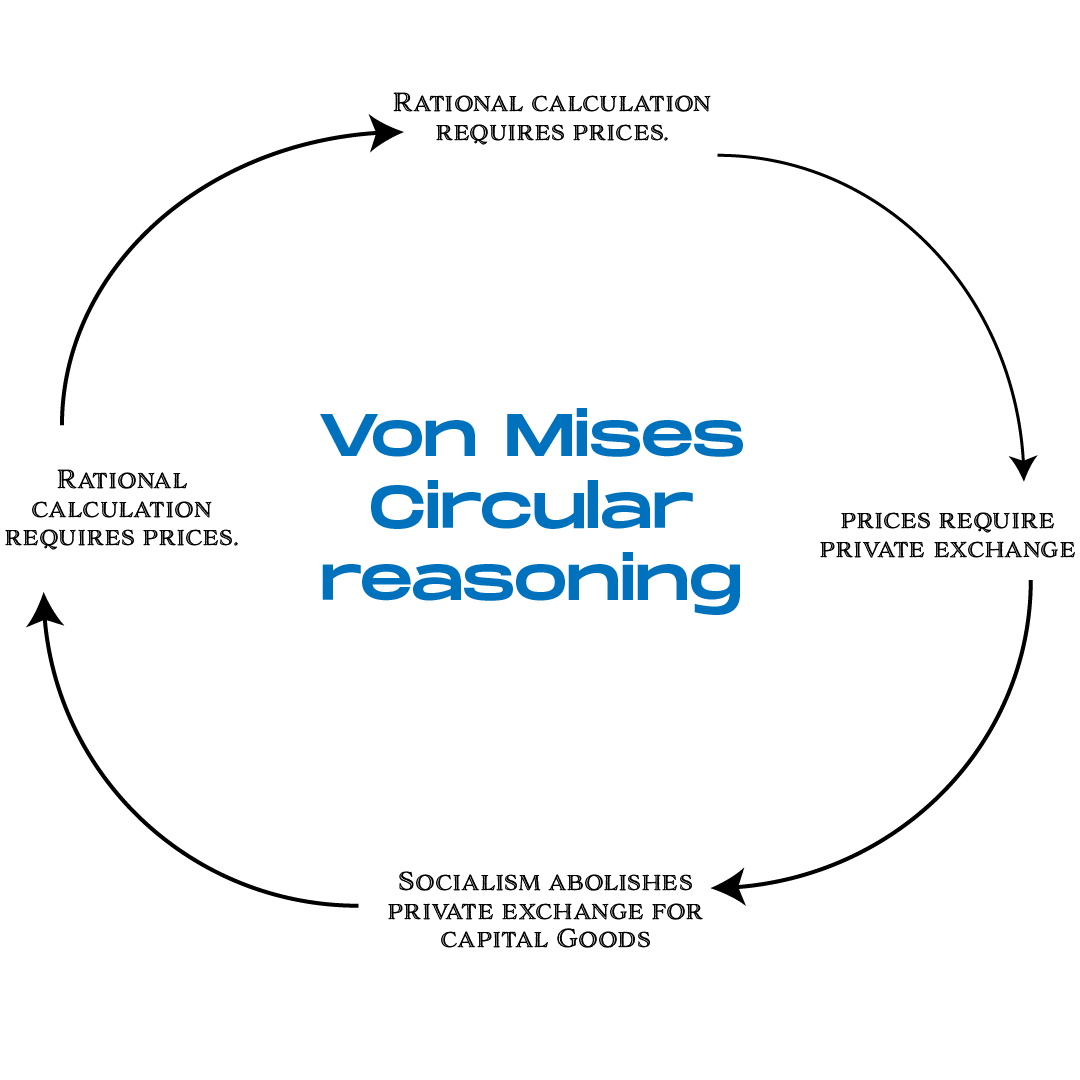
The Hidden Assumptions
Mises begins by arguing that subjective value cannot serve as a universal unit of economic calculation. Individuals can rank their preferences, but they cannot assign them precise numerical values that allow all goods and production processes to be compared directly. This point is largely uncontroversial. (Mises, 1920)
However, Mises then makes a much stronger claim. From the observation that subjective value cannot provide a universal calculation unit, he concludes that market prices are necessary for rational economic calculation. Yet this conclusion does not automatically follow from the premise. Demonstrating that one method is inadequate does not prove that only one alternative remains.
At this stage of the argument, Mises has shown that subjective value alone cannot solve the calculation problem. He has not yet demonstrated that market prices are the only possible means of comparing alternatives, allocating resources, or coordinating production. Other methods—whether based on physical planning, engineering calculations, inventories, labor requirements, technological coefficients, or modern computational techniques—are dismissed rather than systematically ruled out.
The hidden assumption is that market-generated prices are the sole viable mechanism for economic calculation. But this is precisely the point that must be proven, not assumed.
Hidden Assumption: Profitability Reveals the Best Use of Resources
A central assumption in Mises’s argument is that profitability indicates that resources are being used more effectively. If a producer cannot compete profitably, Mises argues that others have found a better use for the resources involved (Mises 1949, pp. 300–302, 334–336; see also 1920)
Yet profitability in this system often comes not from genuine improvements or feeding more people, but from engineered scarcity and the quiet destruction of life. In 2009, amid a severe dairy crisis of collapsing prices and oversupply, the industry-run Cooperatives Working Together (CWT) program dramatically expanded its “herd retirement” initiative. Dairy cooperatives invited farmers to submit bids; those accepted were paid to sell their entire herds for early slaughter, removing cows from production to shrink the national milk supply.

Over 500,000 cows were culled to raise price of milk
By the end of 2009, the program had removed hundreds of thousands of additional cows that year alone (contributing to a total of over 500,000 across the program’s lifespan from 2003–2010). These were healthy, productive animals—many from smaller family farms—not old or diseased stock. Farmers received payments funded in part by assessments on their own milk production, while the removed milk volume (hundreds of millions of pounds) helped lift farmgate prices modestly.
Yet the per-unit consumer impact was tiny: analyses tied to the program showed price increases on the order of just $0.01 per 100 liters in some contexts, with processors and speculators capturing much of the gain.Healthy cows were deliberately culled, their early deaths engineered for market balance.
As one attorney for the subsequent class-action lawsuit put it, “This cow-killing program exploited both the animals and the consumers.” Farmers broke down in tears loading their herds onto trucks, calling it the hardest thing they had ever done. Entire livelihoods vanished not because demand was low, but because there was “too much” milk in a system that rewards withholding abundance.
The goal was never to produce more, innovate, or meet real human need—it was to restrict output so the remaining milk could be sold in a more expensive price .Later antitrust settlements in the price-fixing cases (including multi-million-dollar payouts with no admission of guilt) underscored the human and animal cost: half a million cows gone, consumers in multiple states potentially entitled to compensation, all so the system could reward scarcity over usefulness.This is the hidden violence beneath the narrative of capitalist plenty. While grocery aisles overflow with choices, the market quietly demanded the mass slaughter of productive life—and the tears of the people forced to carry it out—just to squeeze out a few extra pennies.
Hidden Assumption: The prices generated by markets reliably communicate the underlying scarcity of resources.
Mises treats market prices as clear, emergent signals that convey real relative scarcities to producers and consumers, enabling rational calculation. Yet this assumes prices arise from genuine competition rather than coordinated power (Mises 1949, pp. 258–259, 331–333; also 1920)
In the 1990s, grain giant Archer Daniels Midland and its competitors ran a global cartel to fix lysine prices — dramatized in the Matt Damon film The Informant! — through secret meetings and production quotas. And for decades, De Beers maintained a near-monopoly on diamonds by hoarding vast stockpiles in London vaults and controlling supply to artificially inflate prices, turning what should have been common stones into symbols of eternal rarity.
Secret video taken by US Government of the Lysine Cartel
In each case, the resulting “market” price did not honestly reflect underlying scarcity or real supply and demand. It reflected the success of collusion, hoarding, and destruction of productive capacity. When the central mechanism Mises relies upon for economic rationality can be so systematically gamed, the claim that unregulated markets alone provide reliable calculation signals becomes difficult to sustain.
Hidden Assumption: The success of an economic system should be judged primarily by its ability to allocate resources
Mises and many of his followers evaluate economic systems almost exclusively through the lens of monetary profitability and allocative efficiency. In this view, the ultimate test is whether resources are directed toward their most valued uses as revealed by profit-and-loss signals in a competitive market (Mises 1949, pp. 300–302, 334–336; 1920). Any deviation from this monetary calculus is seen as inherently wasteful and irrational.
As a materialist, my response is simple: Who cares if the Soviet Union produced “too much pig iron” in one year? Mises’ obsession with theoretical perfection ignores concrete human outcomes. The real test of an economic system is not abstract “efficiency” in monetary terms, but whether it improves people’s lives.
In Tsarist Russia, life expectancy hovered around 32 years. It was a semi-feudal economy with almost no modern industry. Child labour was so widespread that the Tsar was forced to pass a law in 1882 stating that children under the age of 12 were prohibited from factory work, while those aged 12–15 were limited to 8 hours a day. (Polnoe Sobranie Zakonov, 931)Even this minimal reform was weakly enforced and fiercely resisted by industrialists.

Adult Literacy Campaign from the Soviet Union
The Soviet Union, for all its flaws, eliminated mass child labour, raised life expectancy to 68 years by the 1950s, industrialized at breakneck speed, and brought basic literacy, healthcare, and education to tens of millions.
Mises’ “calculation problem” did not prevent these material gains — it merely reveals the narrowness of his metric.Socialist planning achieved what capitalism had failed to do in Russia: rapidly modernize a backward country and dramatically raise living standards for the masses. It fed, housed, educated, and healed millions while building the industrial base that stopped fascism. By any humane measure, this was eminently rational
Prices Are a Poor Measure of Societal Value
Mises treats prices as the only reliable carrier of economic knowledge. Without them, he claims, society literally cannot know what to produce or in what quantities.Prices are one form of information, but a highly imperfect one. They reflect effective demand — that is, what people with money are willing and able to pay — not genuine human need or social priority.

11% of children between age of 3 and 17 work in these mines
Prices embed existing inequalities and power relations rather than revealing objective scarcity or true societal value.For example, in order to mine cobalt (a critical input for electric vehicle batteries and other high-tech goods), children between the ages of 3–17 in the mining communities of the copper-cobalt belt in the Democratic Republic of Congo are heavily involved in the labor. According to a 2017 UC Berkeley CEGA white paper, 11% of children aged 3–17 work outside the household in these artisanal mining areas, while an additional 57% perform domestic household tasks that support the mining economy.Even when prices exist, they reflect the current structure of power and property relations, not moral value or labor input.
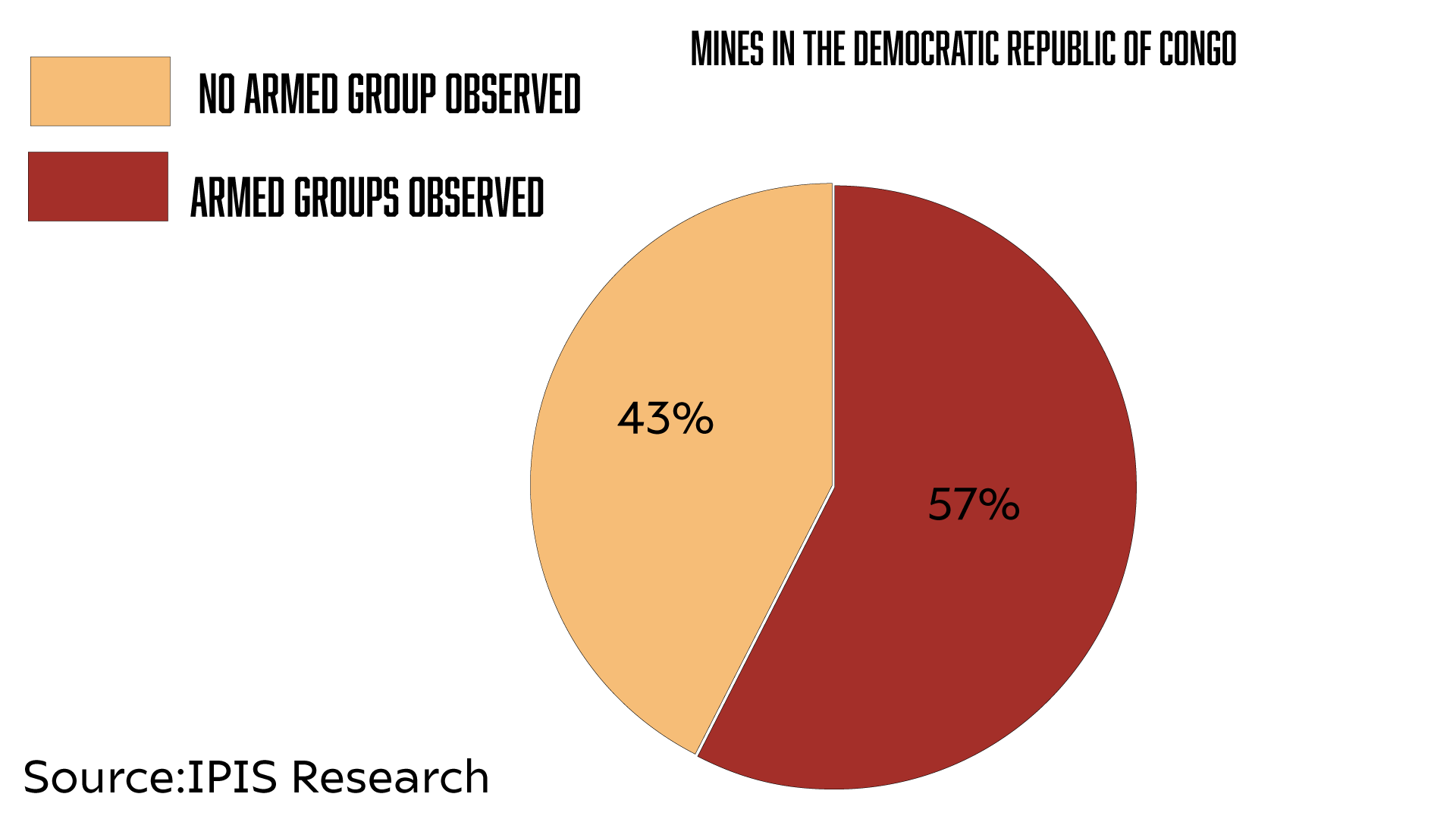
Use of armed groups to force people to Mine
Copper and cobalt from the Congo are “cheap” because they are extracted using widespread child labor and extremely low wages. The resulting low price does not signal economic efficiency or true scarcity — it signals that human suffering has been externalized into a cost advantage for buyers (especially in wealthy consumer markets). The market systematically undervalues goods produced through exploitation because it only recognizes the price paid, not the human cost required to produce them.
Prices Fail to Capture Externalities
Externalities reveal another major flaw in Mises’s theory of prices. Market prices do not capture all social costs — they only reflect the costs borne directly by the buyer and seller during exchange. For example, when a corporation pollutes, it is not the corporation that suffer, but everyone around it.
Conclusion
Libertarians often boast that “no one has ever debunked Mises’ Economic Calculation Problem.”In reality, it has been critiqued and refuted many times — but more importantly, we don’t need to “debunk” it on its own narrow terms. The argument is elegant within its own circular, definitional framework, but it is ultimately irrelevant to what actually matters. It mistakes one historically specific form of information (market prices under capitalism) for the only possible form of economic rationality.Socialist planning has shown that societies can calculate and allocate resources using different metrics — metrics centered on human welfare, physical needs, and long-term development rather than profit. The real calculation that matters is not whether a balance sheet balances, but whether people’s lives improve.The obsession with Mises’ “unrefuted” theoretical proof is a distraction from the actual historical record: socialist economies took backward, impoverished countries and rapidly industrialized them, raised life expectancy, eliminated mass starvation, and built the material conditions for vast improvements in human well-being. That is the calculation that counts.
If you enjoyed our content, please consider being a paid subscriber (if you already aren’t) we rely exclusively on you. If you don’t want to be a member, please consider giving us a one-time tip
Notes
- Ludwig von Mises, Human Action: A Treatise on Economics (1949), especially Chapter I (“Acting Man”) and Chapter II (“The Epistemological Problems of Economics”).
- Mises, Ludwig von. 1920. “Economic Calculation in the Socialist Commonwealth.” (Originally published in German as “Die Wirtschaftsrechnung im sozialistischen Gemeinwesen.”) English translation available in various editions, including the 1990 Liberty Fund reprint
- Polnoe Sobranie Zakonov Rossiiskoi Imperii (Complete Collection of Laws of the Russian Empire), 3rd Collection, Vol. 2, No. 931 (1 June 1882). “On the Regulation of the Work of Minors in Factories, Plants, and Manufactories
- Faber, Benjamin, Benjamin Krause, and Raúl Sánchez de la Sierra. 2017. “Artisanal Mining, Livelihoods, and Child Labor in the Cobalt Supply Chain of the Democratic Republic of Congo.” UC Berkeley CEGA White Papers. https://escholarship.org/uc/item/17m9g4wm
From Historic.ly via This RSS Feed.