

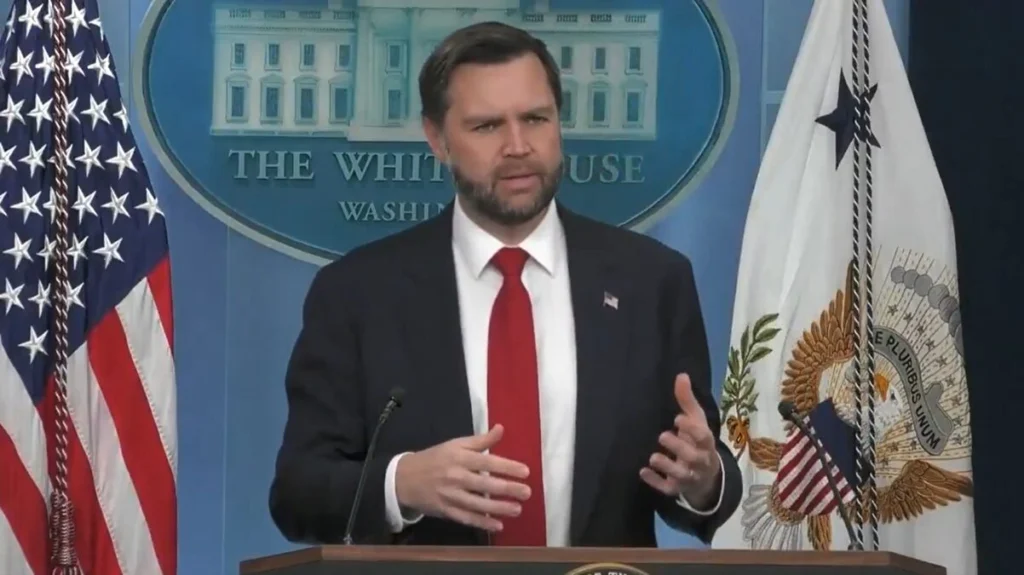
He reveals details of how the Trump administration actually envisions the agreement.
A 60-day countdown to a permanent U.S.-Iran agreement began Thursday, U.S. Vice President JD Vance said, while acknowledging major issues remain unresolved, including the release of potentially hundreds of billions of dollars in frozen Iranian assets and long-term security arrangements for the Strait of Hormuz.
RELATED:
Strait of Hormuz Sees 25 Ship Crossings After U.S.-Iran Pact
STRAIT OF HORMUZ
According to Vance, the signing of the memorandum of understanding (MoU) triggered a 60-day negotiating period that began on Thursday and is set to expire on Aug. 17, when both sides hope to reach a permanent agreement.
The MoU was “signed technically today, Iran time,” Vance said on Thursday, adding that technical negotiations on a permanent deal are expected to begin this weekend.
A final deal with Iran will address the long-term operation of the Strait of Hormuz, Vance said, noting that a permanent agreement with Iran must ensure the crucial global energy waterway is “never used as a choke point for the global economy ever again.”
“We believe international waterways should be free of tolls,” Vance said, adding that the newly signed MoU “contemplates that the Omanis, the Iranians and the Gulf Coast coalition together will figure out a proper security framework for the straits in the future.”
Vance said the U.S. military has allowed more than a dozen ships transiting the strait to reach Iranian ports, lifting the U.S. naval blockade imposed in early April. More oil is now flowing through the crucial waterway, said Vance, adding that more than 12.5 million barrels went through the shipping channel Wednesday night.
U.S. forces on Thursday lifted their blockade of Iranian ports and started carrying out part of the MoU provisions, said the U.S. Central Command said, adding that U.S. warships remain “in the general area.”
NEW
US VP JD Vance on Israel:
'I saw the Axios report that says Netanyahu is fuming. That’s not reflective of the conversations that I’ve had with him. Maybe he is saying something to somebody else that he is not saying to me.
It does bother me that you’ve seen people… pic.twitter.com/qkotNU5maU
— Insider Paper (@TheInsiderPaper) June 18, 2026
FROZEN IRANIAN ASSETS
The release of frozen Iranian assets remains one of the key unresolved issues in the negotiations. As part of the 14-point MoU, the Trump administration promises to “make fully available for use the frozen or restricted funds and assets of the Islamic Republic of Iran.”
Negotiators have yet to determine how much of Iran’s frozen assets will be unfrozen, or when and how the funds would be released, said Vance. “The amount of money, I honestly don’t know. I’ve heard numbers north of US$100 billion. I’ve actually heard numbers north of US$200 billion,” he told reporters.
Washington and Tehran must also “agree on the procedures related to the release of these funds during negotiations,” Vance added, stressing that it was too early in the negotiations to discuss those details.
IRAN’S MISSILES
At the White House briefing, Vance also defended the Trump administration’s softened stance on Iran’s retaining ballistic missiles, claiming it was impossible to tell any country that they’re not allowed to maintain a self-defense capacity. Iran’s missile capabilities and launch infrastructure have been “substantially degraded,” he said.
“We destroyed a substantial number of their ballistic missiles, and their … ballistic missile launchers themselves. It’s not just the bullets, but it’s the actual gun, and that’s what we were extremely effective at destroying,” Vance said.
During the early days of the war with Iran, U.S. Secretary of State Marco Rubio said an “objective of the (U.S. military) mission” was to “deny them (Iranians) the ability to use ballistic missiles to threaten their neighbors, to threaten our bases, to threaten our presence in the region.”
ISRAEL’S REBUKES
The U.S.-Iran MoU calls for “the immediate and permanent termination of military operations on all fronts, including in Lebanon.” However, Israel has said it does not intend to withdraw its forces from Lebanon. Israeli forces carried out sporadic strikes in southern Lebanon on Thursday.
In an unusual blunt rebuke, Vance warned the Israeli government against undermining the U.S.-Iran agreement, claiming that Trump is the “only head of state” who is sympathetic to Israel at this moment. Two-thirds of the missiles intercepted over Israel were shot down using U.S.-made weapons, he noted.
Iranian Foreign Minister Abbas Araghchi told reporters that Iran is used to President #Trump’s threats. They have been repeated in various ways for a long time, but they also know that they have achieved nothing and will achieve nothing with them. #Iran #teleSUREnglish pic.twitter.com/omPsXV2bqh
— teleSUR English (@telesurenglish) May 14, 2026
teleSUR/ JF
Source: Xinhua
From teleSUR English via This RSS Feed.