

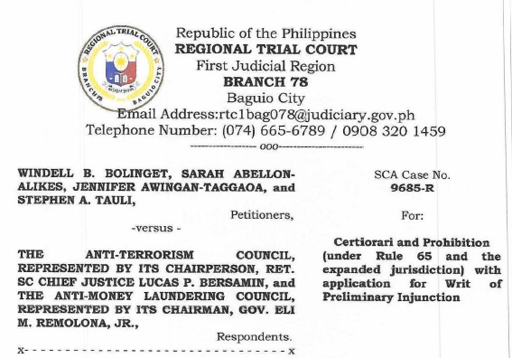
On April 30, Branch 78 of the Regional Trial Court of Baguio City denied the petition for certiorari and prohibition filed by Indigenous Peoples’ rights advocates Windel B. Bolinget, Sarah Abellon-Alikes, Jennifer Awingan-Taggaoa, and Stephen A. Tauli. The petition challenged their designation as “terrorist individuals” by the Anti-Terrorism Council (ATC) and sought to have the third mode of designating terrorists under paragraph 3 of Section 25 be declared unconstitutional. The petitioners have not been convicted of any crime and have been acquitted in other criminal charges filed against them.
Read: Abra court grants plea to junk rebellion raps vs 7 activists in Cordillera
Paragraph 3 of Section 25 allows ATC, an administrative body under the executive branch of government, to “designate an individual, groups of persons, organization, or association, whether domestic or foreign” as terrorists upon finding of probable cause. This prerogative was questioned by the petitioners in the case of Calleja v. Executive Secretary (G.R. No. 252578) where theyargued that designating groups or individuals as terrorists prior to any judicial hearing violates the constitutional guarantee of due process. However, the majority of the Supreme Court agreed with the opinion of Chief Justice Alexander Gesmundo and held that “in cases of terrorism, an extraordinary situation where some valid governmental interest is at stake, postponing the hearing until after deprivation is justified.” According to Gesmundo, alleged acts of terrorism justify a deviation from the usual procedures in due process, citing “self-preservation” of the State.
In denying their petition, Judge Hilario Belmes of Branch 78 relied on the Supreme Court’s ruling in Calleja, stating that “only paragraph 2 of Section 25” was declared unconstitutional and that paragraph 3 had been “resolved by the High Court as valid.” The decision then invokes stare decisis et non quieta movere, or the legal doctrine that obligates courts to “standby with what has been decided,” to pronounce all due process questions under the ATA supposedly “moot and academic.” A case is moot and academic when it no longer presents a justiciable controversy because of supervening events, so that any ruling would be of no practical value or effect (Cordero, et al. v. Gutierrez Development Co., Inc., G.R. No. 205074).
However, the Supreme Court in Calleja provided a caveat to its ruling, stating that the “facial review does not preclude future challenges against any of the provisions on the basis of an actual and as applied case.” This means that the Court did not completely rule out future constitutional challenges, allowing individuals to question specific provisions if they are applied in a way that violates rights. Therefore, there is still a justiciable controversy to be considered. The Calleja ruling itself recognizes the necessity of as applied scrutiny in ATA cases, especially where freedoms of speech, association, and due process are implicated.
As explained by the Supreme Court in *Calleja, “*In an as-applied challenge, the question before the Court is the constitutionality of a statute’s application to a particular set of proven facts as applied to the actual parties. It is one “under which the plaintiff argues that a statute, even though generally constitutional, operates unconstitutionally as to him or her because of the plaintiff’s particular circumstances.”
In other words, the constitutionality of the Anti-Terrorism Act can still be questioned with regard to how it is actually implemented. In contrast, however, Judge Belmes refused to rule on the matter at all, despite the clear ruling of the Supreme Court in Calleja allowing the same*.*
This was pointed out by the National Union of Peoples’ Lawyers in its statement last June 1.
NUPL underscores that the ATA’s designation mechanism, as applied here, deprives the CPA leaders of notice, an opportunity to be heard, and meaningful access to evidence, classical elements of due process under the Constitution. It warns that the court’s refusal to exercise its reviewing power emboldens the state to brand dissenters and indigenous leaders as “terrorists” on the strength of undisclosed intelligence reports alone.
On June 11, the Cordillera leaders had already filed an appeal before the Baguio City Regional Trial Court and vowed to continue challenging their designations as “terrorists” as well as question the constitutionality of the Anti-Terrorism Act as applied. (AMU, RVO)
The post Sidebar | ‘Done and decided’? Baguio court declines to review constitutionality of Anti-Terrorism Act’s implementation appeared first on Bulatlat.
From Bulatlat via This RSS Feed.