

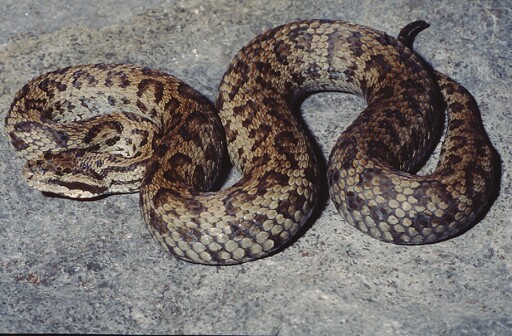
For more than 160 years, the Himalayan pit viper was believed to be a single species, found across the Himalayas in Pakistan, India and Nepal. Now, a new study revealed this snake is actually not one, but five distinct species, including three entirely new to science. For their analysis, the researchers conducted fieldwork to different parts of the Himalayas and collected samples of what was considered to be the Himalayan pit viper from different populations. They also examined historical specimens assigned to the Himalayan pit viper and extracted DNA from them. Their analysis of the snakes’ bodies, skeleton and DNA revealed five separate species: The Himalayan pit viper (Gloydius himalayanus) was first described in 1864. This species is now restricted to northwestern India and typically inhabits elevations between 1,000 and 3,500 meters (3,281-11,483 feet). The Chamba pit viper (G. chambensis) was originally described in 2022 from India’s Chamba District. This study extended its known range westward into the Kashmir Valley. It lives at elevations from 400-2,500 meters (1,312-8,202 feet). The Hazara pit viper (G. hazarensis) is a new-to-science species. It’s found in the Hazara region of northeastern Pakistan at elevations ranging from 1,630-2,900 meters (5,348-9,514 feet). The Hindu Kush pit viper (G. hindukushensis) is also a newly described species. It inhabits the eastern foothills of the Hindu Kush Mountains in northwestern Pakistan between 1,660 and 2,888 meters (5,446-9,475 feet). The Nepali pit viper (G. nepalensis) is new-to-science as well. This viper is distributed across western and west-central Nepal and is…This article was originally published on Mongabay
From Conservation news via This RSS Feed.