

The visionary warnings of a Brazilian football icon who anticipated the hyper-commodified era of sportswashing and FIFA venture-capital takeovers.
In the history of global sports, few figures have challenged the status quo as radically as Sócrates Brasileiro Sampaio de Souza Vieira de Oliveira. Known universally as Sócrates, or “Doctor Sócrates“, the tall, bearded Brazilian midfielder re-engineered the relationship between a professional athlete and political systems.
RELATED: Brazil to Remain Humble Ahead of Its Match Against Haiti
While mainstream sports media often separates athletic performance from social struggle, Sócrates viewed football as an unavoidable platform for political agitation. For the Brazilian captain, the football pitch was not a sanctuary from real-world oppression, but an artistic canvas and a democratic weapon.
#Brazil — Gaviões da Fiel is a Corinthians supporters group with 100,000 members and perhaps the most recognized Brazilian supporters organization in the world. For a supporters group, reaching a membership figure close to the population of many European cities is in itself a… pic.twitter.com/oaQ9Ojhc9T
— Antifa_Ultras (@ultras_antifaa) April 28, 2026
The Amplified Voice on the Pitch
Sócrates explicitly rejected the compromise that professional athletes frequently have to remain neutral and focus entirely on their physical output. He recognized that elite athletes command a massive, highly visible cultural stage that holds latent social power.
Instead of treating football as a mere commercial product, Sócrates understood that the game belonged to the working-class people who sustained it. He believed that an athlete with a public voice had a social responsibility to speak for those silenced by institutional power structures.
During a dark era of state censorship and military rule in Brazil, he weaponized his celebrity status. His career demonstrated a fundamental truth: a sports icon could use their cultural capital to mobilize millions of people and challenge the hegemony of an authoritarian regime.
To understand his impact, one must look at how he defined his own role in society. He did not seek the approval of sports executives or corporate sponsors. Instead, he treated his position as a megaphone for the marginalized.
From Book Burning to the Vanguard of Working-Class Football
The political consciousness of Sócrates was forged in childhood when he witnessed his father burn his own extensive library to escape persecution following Brazil’s 1964 U.S.-backed civil-military coup.
This trauma taught the young Sócrates that the ruling class deeply feared ideas and free expression, permanently shaping his view of state power.
As he grew, he balanced playing professional football for Botafogo-SP with completing a demanding medical degree in Ribeirão Preto. During this period, his radical worldview deepened through interactions with leftist colleagues and progressive mentors like sports journalist Juca Kfouri.
While medicine taught him to treat individual suffering, Sócrates soon realized that clinical practice could not cure a society plagued by systemic poverty and state-sanctioned violence.
Concluding that mass communication and ideas were the true vehicles for structural change, he transferred to Corinthians Paulista in 1978. Based in São Paulo’s industrial heartland and known as the “Team of the People“, this club provided a fiercely loyal working-class environment of factory workers and trade unionists.
Socrates & Zico playing for Flamengo (1986) #CRFlamengo #Brazil #Flamengo #Maracanã #Sócrates #Zico #RiodeJaneiro #futebol pic.twitter.com/HK7ic1V5BU
— MotherSoccer (@MotherSoccerNL) July 21, 2017
Football-Art as Socialist Collective Action
To fully comprehend the political nature of Sócrates, one must examine his fierce rejection of the corporate-driven industrial sports science that emerged in the late 1970s and 1980s.
This era gave rise to result-oriented football, a mechanical approach that prioritized physical endurance, defensive rigidness, and risk minimization, tactics that mirrored capitalist factory production lines.
Sócrates openly rebelled against these hyper-disciplined regimes by proudly identifying as an “anti-athlete.” He smoked, drank beer and refused to let corporate trainers optimize his body like machinery for a balance sheet.
Instead, he championed football-art, viewing football as an aesthetic art form rooted in spontaneous joy and collective expression, famously asserting that the beauty of the game mattered far more than simply winning.
This philosophy was directly reflected in his intellectual style of play. Standing six feet three inches tall, Sócrates bypassed his lack of conventional sprinting speed by using superior spatial awareness and cerebral intelligence to dictate the tempo of matches.
His signature “no-look” backheel pass was not superficial showmanship, but a calculated tactical weapon that allowed him to bypass defensive lines and create space for teammates without turning his body.
By relying on foresight and creativity rather than raw physical exertion, his style of play served as an implicit critique of mechanized athletic systems, proving that collective intelligence and artistic collaboration could triumph over rigid, corporate automation.
The Revolutionary Character of “Magrão“
Nicknamed “Magrão” (The Big Skinny One), Sócrates possessed a visual and cultural presence that defied the commercial sanitization of sports. During an era when sports marketers demanded clean-cut, highly marketable brand ambassadors, he maintained an unkempt beard and long, curly hair.
His goal celebration was entirely un-rehearsed and anti-corporate: he would stand tall, stop running, and raise a single closed fist into the air. This gesture intentionally mirrored the salutes of the Black Power movement and international socialist organizations, signaling an unwavering solidarity with global liberation struggles.
His political consciousness was deeply internationalist, viewing capitalist exploitation and state terror as global phenomena rather than isolated domestic issues. This global solidarity was vividly displayed on the world stage during the 1986 FIFA World Cup in Mexico.
Bypassing official, corporate-sponsored gear, Sócrates wore simple white headbands hand-painted with urgent political messages. Phrases like “Yes to Love, No to Terror“, condemning the U.S. military bombing of Libya, and “Apartheid No” were broadcast to hundreds of millions of viewers worldwide.
By using his physical appearance to transmit anti-imperialist and anti-racist messages, Sócrates protected his autonomy and flatly refused to become a sanitized corporate commodity, keeping his public persona explicitly tied to the working-class struggle.
Goal by Captain Socrates (1982)
#brazil– #cccp
pic.twitter.com/rSeTAOk7jC
— MotherSoccer (@MotherSoccerNL) April 8, 2022
The Critique of FIFA and Corporate Cannibalism
As modern sports transitioned into a multi-billion-dollar enterprise, Sócrates directed his sharpest political critiques at FIFA, identifying it as an insulated, undemocratic cartel rather than a benevolent custodian of the world’s game.
He argued that the governing body was systematically stripping football of its working-class roots to serve a financial elite. Through his public declarations and writings, he denounced the commercial intermediaries and television executives who dictated the terms of the sport.
He observed that FIFA’s aggressive drive to maximize corporate sponsorships and broadcasting rights transformed local, organic fan bases into passive consumers, pricing working-class communities out of stadiums in favor of an affluent demographic.
Crucially, Sócrates anticipated the structural crises plaguing modern football, warning that treating the sport purely as a market commodity would alienate players from their own labor and turn them into hyper-commodified assets.
His critiques laid the foundation for contemporary resistance against financial exploitation in sports. He accurately foresaw how an unbridled drive for profit would lead to predatory agent fees, venture-capital takeovers, and the staging of major tournaments in authoritarian states utilizing “sportswashing” to cleanse their international reputations. Ultimately, he viewed FIFA’s corporate model as a form of institutional cannibalism that consumed the soul of the sport to enrich an unaccountable ruling class.
Inseparable Realities and the Legacy of Corinthians Democracy
The definitive proof of Sócrates’ political theories occurred through a radical workplace revolution within his own club, known as “Corinthian Democracy“. In the early 1980s, under a strict civic-military dictatorship, traditional Brazilian clubs operated under an authoritarian management system, enforcing concentration. In this practice, players were locked in hotels for days with their personal freedom tightly controlled.
Alongside teammates Wladimir and Casagrande, and progressive director Adilson Monteiro Alves, Sócrates abolished this structure and established a flat democracy inside the club. Every decision, from meal times to multi-million-dollar player transfers, was decided by a vote where a superstar’s voice carried the exact same weight as the kit manager, bus driver, or stadium janitor, serving as a practical application of socialist labor principles within a capitalist enterprise.
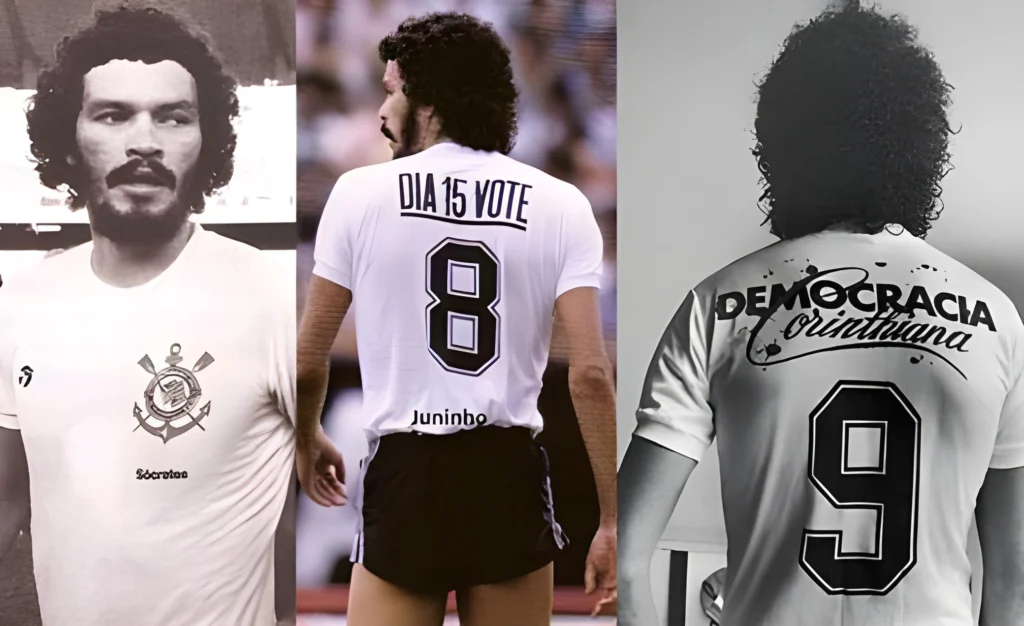
This experiment quickly expanded into an open challenge to the wider military regime. In 1982, the players took to the pitch wearing shirts printed with “Vote on the 15th” to encourage mass electoral participation, later marching out with “Corinthian Democracy” on their backs to demand national democracy.
Operating under this self-managed model, they proved a collective workforce could thrive without autocratic oversight by winning consecutive state championships in 1982 and 1983. Ultimately, Sócrates’ legacy rests on his unwavering stance that sport and politics are entirely inseparable.
Sources: Britannica – FIFA Official Page – Al Jazeera – Jacobin – Marxist.com – El País – Futbol Retro – BBC – Brasil de Fato – Graffiti
From teleSUR English via This RSS Feed.