

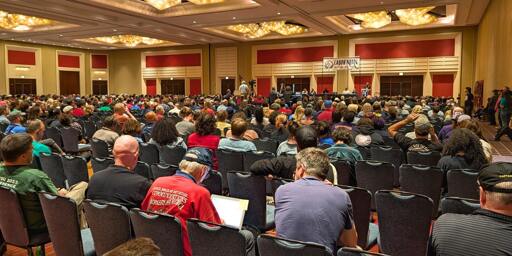
More than 4,000 workers, organizers, and self-described “troublemakers” braved brutal weather and travel changes to pack into a Chicago-area hotel this past weekend for the 2026 Labor Notes Conference, filling nearly 300 workshops, panels, and meetings over three days.
By most measures, this was the largest and most explicitly political iteration of the biennial gathering in recent years. As always, it served as a barometer of what’s animating the labor movement’s most advanced sectors. If the 2022 conference was shaped by the wave of new organizing that gripped the country after the pandemic, from Amazon to Starbucks, and 2024 carried the experience of the UAW’s stand-up strikes and Shawn Fain’s call for a 2028 general strike, this year’s was undoubtedly shaped by the second Trump administration, by the sharpening of class antagonism, and, above all, by the experience of Minneapolis, the fight against ICE, and the movement for immigrant rights.
The Long Shadow of Minneapolis
Last winter, amid its escalating attacks on immigrants, the Trump administration sent thousands of federal agents into the Twin Cities. Dubbed “Operation Metro Surge,” the crackdown was brutal: agents grabbed immigrants from workplaces, outside schools, and off the streets, dragging them from stores and cars. Minnesotans responded with strength, building rapid-response and mutual aid networks to stop their neighbors and coworkers from being taken. The operation reached a fever pitch in January, when ICE agents killed Renée Nicole Good, a legal observer, and then Alex Pretti, a VA nurse likewise protecting his immigrant neighbors. Good’s murder laid bare the violence federal immigration forces were willing to use, and activists, organizations, and unions joined for a massive day of economic blackout on January 23, dubbed a day of “no work, no school, no shopping.”
Workers and unions weren’t incidental to that shutdown but were a crucial force that built it, leveraging their power to stop the gears of production. When federal agents murdered Pretti the next day, tens of thousands mobilized almost immediately, with calls for a general strike spreading through the streets. It was this experience that colored the conference — the idea that, beyond fighting for bread-and-butter demands, workers can mobilize to protect their own ranks and their communities against any and all attacks.
From Minnesotan workers being the recipients of the Troublemakers award, to the opening plenary — where rank-and-file workers joined speakers from the Twin Cities on stage — to the workshops drawing lessons from Minneapolis for organizing against ICE, to rank-and-file workers bringing their experiences from the floor in session after session, the experience of Minneapolis was everywhere this weekend.
During the opening plenary, SEIU Local 26’s Eva Lopez plainly stated that, in the run-up to January 23, rank-and-file workers were already on the move, mobilizing in their communities and were eager to act. It mattered, she emphasized, that unions joined the fight to help transform the largely individual initiatives of members into collective action. In an interview with Left Voice, CWA Local 7250’s Kieran Knutson described a similar situation within his own union: when ICE took two Laotian coworkers and the union began a campaign to fight for them, workers showed their whistles, showing how they were already mobilizing. It was essential for unions to join and organize the fight.
Mara Solis, a teacher from the Saint Paul Federation of Educators, further elaborated on this in her plenary speech, outlining how her union’s experience of organizing and preparing to strike had played a role in their fight against ICE, transforming the communication structures from previous strike campaigns into those that helped to organize school patrols, grocery runs, and rides to medical and immigration appointments once ICE descended on St. Paul. Repeating the refrain “No one is coming to save us / We keep us safe,” Solis emphasized how the long legacy of organizing at the heart of the labor movement must serve as a blueprint to fight back against every attack we face.
During the conference, it became clear that, in Minneapolis, Trump was forced to back down thanks to class struggle. We all learned that when rank-and-file members organize from the bottom up, they can compel ossified union and social movement leaderships to take unified action. Minneapolis also revealed a labor movement aware that immigrants are the most vulnerable segment of our class and that workers cannot fight solely for our livelihoods. This is an example also set by the labor movement fighting for Palestine since 2023. If the Minneapolis revolt did not spread and intensify, it was thanks to the coordinated action of Homeland Security and the local government to de-escalate the situation — and, of course, thanks to the intervention of the Democratic Party, which controls many of the state police departments collaborating with ICE — to channel discontent against Trump toward the November election. The Labor Notes conference this year could not ignore this strategic dilemma facing the labor movement in the United States: of whether to follow the recipe of relying and voting for Democrats, or to take the path of class struggle and the political organization of the working class on its own terms, with class independence.
A Growing Tension with the Democratic Party
Not far from this experience, in fact, sits the working class’s own contentious relationship with the Democratic Party. Trump’s return has exposed the deep crisis for the party. Simply positioning itself as the bulwark against the Right has not been enough, especially when it has offered no real answers to the working class’s structural crises. Not only has the Democratic party done little to stop the anti-immigrant offensive, it has backed Israel’s genocide in Gaza and done little to defend even the most basic democratic rights under attack, such as trans rights, voting rights, and free speech. The party has been steadily hemorrhaging support: nearly 60 percent of Americans say they distrust both parties, and almost four in 10 wish there were an option beyond them entirely. It is inside that vacuum that sectors of the working class are beginning to imagine a political horizon that doesn’t run through the Democrats at all.
At Labor Notes, this expressed itself through the impatience with union leaderships proposing to organize around “stop the steal” come November. For rank-and-file workers, the fight against the Right couldn’t wait for an election timeline geared toward reviving a party that had nothing to offer working people. The attacks on democratic rights, including the right to vote, as many emphasized, were already underway.
But this dissatisfaction went further, extending to labor’s whole relationship to the Democratic Party — and to politics — as such. It’s no accident that beyond the question of Minneapolis, some of the best-attended sessions of the weekend were built to give space to this sentiment: on building independent political power, on running for office, on how to win back working-class people, and on how to even start talking politics with coworkers. Clearly, for a sector of rank-and-file workers, the question of labor’s power is intrinsically tied to its ability to intervene as a force of its own.
This is a debate that stretches well beyond Labor Notes. Over the last months, Jacobin alone has run a string of pieces arguing for Left, labor-backed candidates — even third-party or independent candidacies — as the way to rebuild a working-class presence in electoral politics. The debate played out at the conference with the same urgency. For much of the union leadership, despite plenty of rhetoric about extricating unions from the Democratic Party, the actual proposals on offer had little to do with class independence. Seth Ackerman’s “blueprint for a new party,” or party building by “hijacking” an existing ballot line, loomed large, alongside the case for independent political structures that, in practice, still end up electing Democrats. Far from class independence, they are both strategies to revive a Democratic Party in crisis.
Zohran Mamdani’s mayoral win in New York is the clearest case in point. Despite the enthusiasm over his victory, he has so far done little to implement the program that energized the Left in the first place, and just as little to build independent working-class power. Mamdani, instead, has spent his early months in office negotiating with Governor Hochul and other sectors of the same Democratic Party machine his campaign was supposed to confront. His defenders, at the conference and beyond, seek to absolve him of any responsibility, insisting that’s an unfair standard since he’s “just a politician,” but that argument gets it backward. A working class coming back to political life, determined to fight not only against Trump and the Right but also for its own demands and program, deserves a political expression that is wholly its own — something more than a seat riding shotgun on political projects that aim to administer the capitalist state with a nicer face.
Notable exceptions stood out against that backdrop: members of the American Postal Workers Union, across sessions, pointed to the fight inside their own union to sever its relationship with the Democratic Party and explore the possibilities of independent political representation. Among those raising similar questions was Les Leopold, whose recent book, The Billionaires Have Two Parties, We Need a Party of Our Own, was made available for free to attendees, in the hopes of bringing the fight for an independent political force to this sector of the labor movement on the move.
Leopold’s own research underscored the point: a YouGov survey of 3,000 Rust Belt voters, which he brought into conversations across the weekend, found 57 percent in favor of a new organization (posed in the survey as the Independent Workers Political Association) to run working-class candidates independent of both parties. It is but a snapshot of a shift that is underway, but one that can’t be left in the tactical realm, hemmed in by just the questions of electoral viability or the undemocratic structures of the ballot line. Instead, it is a force that has to be unleashed to reshape the future of the working class, one that doesn’t just aspire to manage the affairs of the capitalist state from the left, but can actually organize our class to fight for its interests with every tool at its disposal.
Which Way Forward?
Labor Notes 2026 highlighted the vitality of the left wing of the labor movement and the strategic tasks and challenges ahead. Federal workers, many of whom got their start organizing at previous Labor Notes conferences, described an administration that has stripped more than 1 million workers of their collective bargaining rights through executive orders alone. Paul Osadebe of the Federal Unionists Network — formed at the 2022 conference when federal workers from different agencies first organized together — described how the rank and file are fighting back through whistleblower networks that document Trump’s attacks in real time. “The attack on federal workers is an attack on all working people,” he stressed. “They’re doing it to us so that they can get to all of you.”
Sessions on militarism carried the same charge. Panels on dismantling the war machine and fighting imperialism from the shop floor directly linked Trump’s foreign policy — from the current war in Iran to his attacks against Venezuela and the U.S.’s complicity in the ongoing genocide in Palestine — to broader imperialist practices. These discussions drew inspiration from global labor movements that have played a role in stopping arms shipments and mobilizing for Palestine, such as the general strike in Italy.
Alongside the rejection of Trump’s policies, discussions focused on the ongoing attacks by the bosses who continue to make workers pay for the crises they create. A central debate revolved around AI and how employers are spearheading this “technological revolution” to reshape warehouses, hospitals, and newsrooms. Workshops on data centers, the semiconductor supply chain, and algorithmic surveillance raised questions about how capital is deploying AI to control and shape the pace of work and our commons.
Towards a fighting labor movement, Minneapolis has shown us the way: when faced with ICE’s presence, workers and their communities came together in assemblies to discuss and decide, together, on the way forward to fight back. Knutson, of CWA, directly addressed the significance of that experience: “We don’t want a labor movement where the big decisions are just being made by a few leaders who are separated off from the rest of the rank and file,” he said. “I think we want a movement just like we want a society that’s controlled by regular working-class people. The movements that we build for have to be that way too.”
Indeed, Minneapolis is further proof that the future of the labor movement is inextricably linked to organizing the fight against every attack. The same political mobilizations that came out in solidarity with immigrants, culminating in the January 23 shutdown, injected new organizing energy straight into the shop floor in its aftermath. In the Twin Cities, for example, the experience of organizing for the day of action directly fueled unionization efforts in previously unorganized Starbucks stores.
In her opening remarks at Friday’s plenary, Labor Notes’ Barbara Madeloni noted that the conference exists to help build “the world that bosses and capital try to deny us” — one where working people are finally free to run their own affairs. Taken seriously, that vision means building a labor movement willing to act independently of the Democratic Party, not only defending against Trump’s attacks but fighting for a program and a party of its own.
It means, immediately, using labor’s full strength to fight the federal charges against the 15 Minneapolis activists, including several teachers, charged for their part in the anti-ICE mobilizations. It means fighting every attack on democratic rights, including the right to vote, which disproportionately affects Black working-class people, and tying that fight to full rights and citizenship for the millions of immigrants who live, work, and pay taxes in this country without ever having a political voice in it. It means standing in solidarity with working people across the world to bring the imperialist war machine to a halt, sending oil to Cuba, and cutting off aid to Israel’s continuing genocide of the Palestinian people. And it means setting labor’s political horizon higher than choosing the next set of managers for the capitalist state. It means using our power to build, instead, a party of combat capable of organizing our class here and now, and for the battles still to come.
The post The Shadow of Minneapolis Hung Over the 2026 Labor Notes Conference appeared first on Left Voice.
From Left Voice via This RSS Feed.