

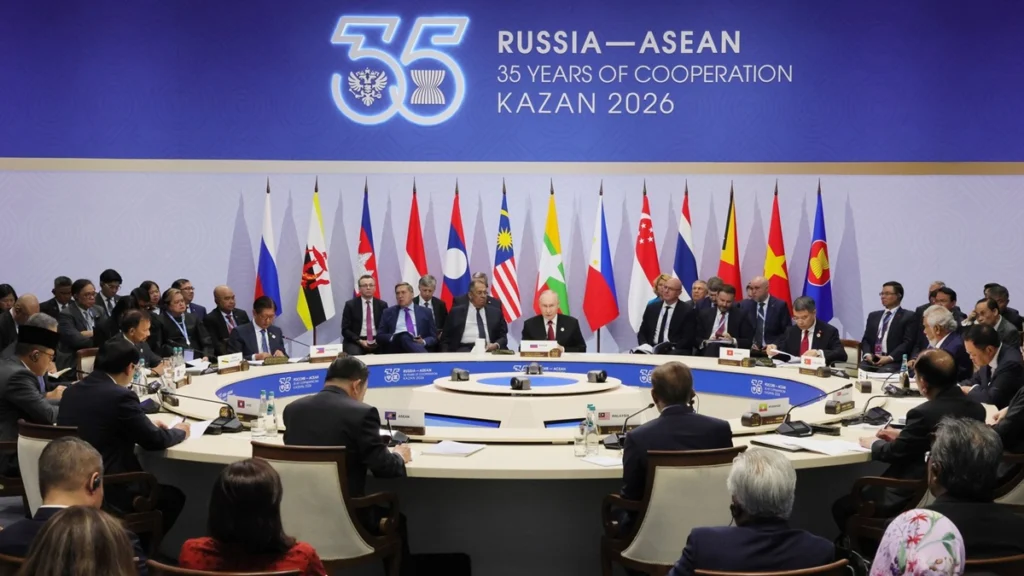
The document expands collaboration in security, trade, energy, and regional connectivity through 2030.
On Thursday, the member countries of the Association of Southeast Asian Nations (ASEAN) concluded a two-day summit held in Kazan.
RELATED:
Russia Pledges Energy and Nuclear Cooperation With ASEAN Countries
The Russian city hosted delegations from Singapore, Laos, Thailand, Vietnam, East Timor, Malaysia, the Philippines, Brunei, Indonesia, Cambodia, Myanmar and Russia.
ASEAN nations discussed various issues aimed at strengthening integration processes in the Eurasian space amid a geopolitical context marked by the consolidation of a multipolar world.
During the first session on Thursday morning, participants discussed four joint documents framed around concrete efforts to deepen ties between Russia and ASEAN countries through 2030.
PUTIN TOUTS ASEAN PARTNERSHIP
Russian President Vladimir Putin said Moscow’s partnership with ASEAN has become an important source of stability in the Asia-Pacific region, as leaders gathered in Kazan for a landmark summit.
Speaking at the plenary session, Putin praised the… pic.twitter.com/RzqjI1ETtW
— Global South World (@g_s_world) June 18, 2026
At the conclusion of the summit, participants announced the Kazan Declaration, whose main agreements are as follows:
-
Reaffirm friendship, mutual trust and respect, as well as a shared vision for a peaceful, stable and secure future in the broader Asia-Pacific, Indian Ocean and Eurasian regions;
-
Promote shared interests in ensuring that an open, inclusive and ASEAN-centered regional architecture continues to foster peace, security, stability and prosperity;
-
Uphold high-level engagements, including ASEAN-Russia summits and ASEAN Post-Ministerial Conferences with the Russian Federation, to further advance the ASEAN-Russia Strategic Partnership;
-
Strengthen dialogue on security matters to better address traditional and nontraditional security challenges;
-
Promote closer cooperation and joint practical initiatives through ASEAN-led mechanisms such as the East Asia Summit (EAS), ASEAN Regional Forum (ARF), ASEAN Defense Ministers’ Meeting-Plus (ADMM-Plus) and the Expanded ASEAN Maritime Forum (EAMF);
-
Foster maritime cooperation and promote security, safety and stability, peaceful resolution of disputes, freedom of navigation and overflight, and unimpeded commerce in accordance with international law, particularly the 1982 United Nations Convention on the Law of the Sea (UNCLOS); enhance research on biodiversity and sustainable use of marine resources; address challenges such as piracy, armed robbery against ships and threats to critical underwater infrastructure; and explore establishing a dialogue mechanism;
-
Strengthen regional biological safety and security to prevent and reduce public health hazards caused by infectious diseases and pandemics, climate change, urbanization, ecological shifts and potential bioterrorism, and explore establishing a dialogue between ASEAN and Russia to coordinate responses to biosecurity threats;
-
Strengthen capacity-building and the sharing of best practices, and explore further cooperation on combating transnational crime, including crimes involving information and communication technologies, based on mutual interest;
-
Intensify efforts to enhance trade and investment, including in services, in accordance with the 2005 Agreement between the Governments of ASEAN Member States and the Government of the Russian Federation on Economic and Development Cooperation, to benefit the peoples of ASEAN member states and the Russian Federation;
-
Deepen cooperation in key sectors including energy and food security, transport and logistics, agriculture, digitalization, science and technology, including artificial intelligence, tourism and creative industries;
-
Promote and implement practical cooperation in the four priority areas identified in the ASEAN Outlook on the Indo-Pacific: maritime cooperation, connectivity, the U.N. Sustainable Development Goals for 2030, and economic cooperation, as well as other possible areas, to complement ASEAN community-building and strengthen strategic trust and mutually beneficial cooperation between ASEAN and Russia;
-
Emphasize the practical value of connecting the wider Asia-Pacific, Indian Ocean and Eurasian regions by fostering cooperation for mutually reinforcing development and expanding infrastructure and people-to-people connectivity;
-
Support strengthening partnerships between ASEAN and the Eurasian Economic Union (EAEU), and ASEAN and the Shanghai Cooperation Organization (SCO), as mutually agreed;
-
Enhance cooperation in education by expanding professional training programs, scholarships, academic and student exchanges, language courses, and vocational training programs;
-
Facilitate people-to-people and youth exchanges and promote youth empowerment, recognizing the importance of youth participation in shaping future generations, including by working toward the establishment of ASEAN-Russia Senior Officials’ Meetings on Youth;
-
Strengthen cultural cooperation in accordance with the 2010 Agreement on Cultural Cooperation between ASEAN member states and the Government of the Russian Federation, focusing on traditional culture, customs, ecotourism, and the preservation of cultural heritage, arts and sports.
From the ground at one of the world’s most influential economic events, #Venezuela continues to strengthen its strategic ties, foster international cooperation, and build new economic bridges for the future. #teleSUREnglish #Russia #newtechnology pic.twitter.com/0jwweKgKZW
— teleSUR English (@telesurenglish) June 5, 2026
teleSUR/ JF
Sources: EFE – ASEAN
From teleSUR English via This RSS Feed.