

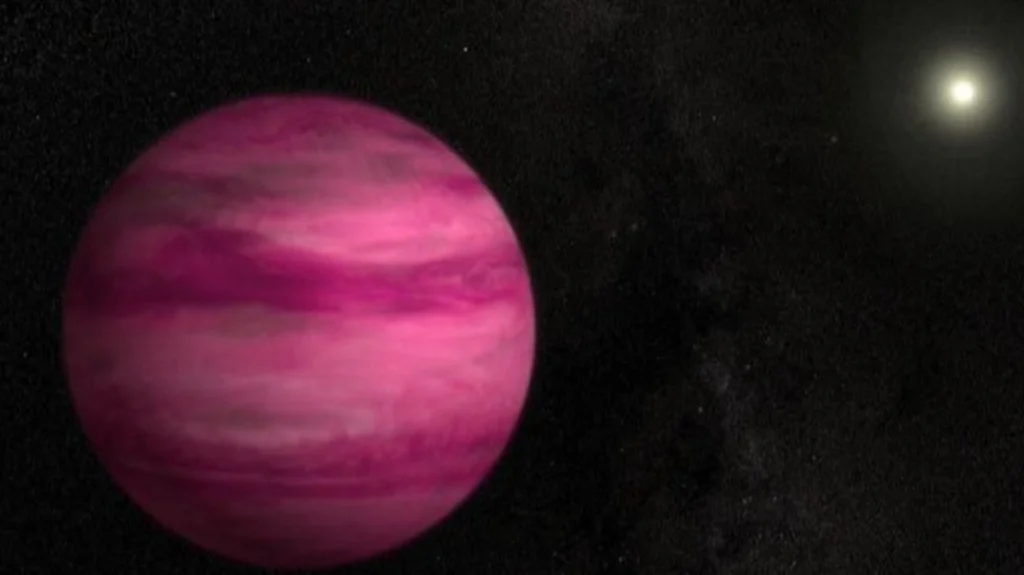
Scientists detect possible salty clouds and complex chemistry around distant object GJ504b.
The so-called “pink planet” was discovered in 2013 and orbits a Sun-like star located 57 light-years from Earth. Now, astronomers have discovered “salty skies” surrounding it, thanks to the James Webb Space Telescope.
RELATED:
Svalbard Vault Stores Over 1.4 Million Seed Samples
This data appears in a study carried out by scientists from Northwestern University in the United States in collaboration with the Space Telescope Science Institute (STScI).
Despite its nickname, astronomers are not sure it is truly a planet. With a mass approximately 25 times greater than Jupiter, GJ504b, or the “pink planet,” lies near the diffuse boundary between giant planets and brown dwarfs. For this reason, experts refer to it as a “planetary-mass companion,” meaning it is a planet-sized object that orbits a star.
To complicate the mystery further, repeated attempts to study it with ground-based telescopes have failed. While most directly imaged exoplanets have temperatures ranging from 1,000 to 2,000 degrees Fahrenheit, GJ504b barely reaches 550 degrees, roughly the temperature of a bread oven.
NASA’s James Webb Space Telescope has done it again! In one jaw-dropping frame, the cosmic powerhouse has captured thousands of galaxies blazing across the darkness — a single image so rich it feels like staring into infinity itself.This isn’t just a stunning photo. It’s a… pic.twitter.com/rCXygIOOpD
— Black Hole (@konstructivizm) June 18, 2026
Its age is responsible for its low temperature—the new work estimates it is between 2.5 billion and 4 billion years old. It is one of the coldest planetary-mass companions ever directly imaged; the elusive object, the university details, is too faint for its light to be analyzed from Earth.
However, new observations from the James Webb Space Telescope reveal an atmosphere filled with exotic chemical compounds and salt-based clouds unlike anything seen before.
These also provide some of the first direct evidence of salt clouds in the atmosphere of a cold object, a phenomenon scientists theorized more than 15 years ago. The discovery also marks an important step toward studying increasingly cold objects that are too faint to be examined with ground-based telescopes.
To reach their conclusions, Aneesh Baburaj and his team captured, with the help of the James Webb Space Telescope, the faint light of GJ504b. They then used advanced data-processing techniques to remove the glare of its much brighter host star.
This combination ultimately revealed the spectrum—the decomposition of light into all its colors to extract data. The results showed a rich mixture of substances, including water vapor, methane, carbon dioxide, ammonia and other molecules.
The spectrum also suggested that GJ504b is unusually rich in heavy elements or metals, the study notes, which also used an astrophysical model and simulations. Despite these findings, the mystery of how the object formed persists, as current data suggest it could have formed either as a planet or a small star.
#FromTheSouth News Bits | Clashes broke out between protesters and police near the United Nations headquarters in Geneva, Switzerland, a day before the G7 summit opens in the resort town of Evian-les-Bains, France. pic.twitter.com/uM1TxefiML
— teleSUR English (@telesurenglish) June 17, 2026
teleSUR/ JF
Source – EFE
From teleSUR English via This RSS Feed.