


By MAURICE
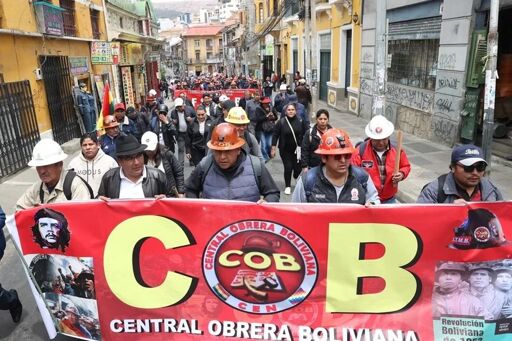
After six weeks of protests, workers, peasants, and popular organizations continue to maintain blockades across Bolivia and to challenge the rule of Rodrigo Paz’s government. Repression has intensified, with trade-union leaders kidnapped in the streets, and at least 360 people still detained by police. What began as a severe economic crisis has turned into a political crisis that brings back an old question in Bolivian history: who should hold power in the country?
*****
For many weeks, Bolivia has been experiencing a national wave of mobilizations that combines road blockades, strikes, popular assemblies, and cabildos—open meetings in which unions, communities, and social organizations discuss and vote on the direction of the struggle.
The trigger was the shortage of fuel, long lines at gas stations, rising food prices, and the deterioration of living conditions. Very quickly, however, economic demands gave way to an open political crisis. In May, peasant and Indigenous activists marched to La Paz, successfully raising demands for the repeal of Law 1720, which would have increased the commodification of small land parcels—to the benefit of large agribusiness. Since then, demonstrators have raised the slogan “Out with Paz.”
Well over 100 blockades were raised in different regions of the country; close to 50 reportedly remain active as this article is being written. There are also mass demonstrations, especially in the major cities of El Alto and La Paz, the seat of the Bolivian government. Despite arrests, repression, and the recent enactment of the repressive State of Exception law, demonstrators have not retreated. Three ministers have already left the government amid the deepening crisis.
What is at stake is not only Rodrigo Paz’s continuation in the presidency. The crisis calls into question the ability of the political regime to contain or neutralize a mobilization that continues to grow.
Who is in the streets?
For workers and activists in the United States, the Bolivian experience offers an important example of how a mass movement led by organizations connected to the working class can gain a real capacity to influence the direction of national politics. The strength of the mobilizations lies both in their breadth and in their level of organization.
Workers organized in the Bolivian Workers’ Center (COB), miners, peasants (i.e., the La Paz Campesino Federation and other groups), Indigenous communities, neighborhood organizations such as FEJUVE (the Federation of Neighborhood Councils of El Alto), transport workers, and teachers make up the core of the movement. Standing out among them is the Túpac Katari Federation, one of the main organizations of the Aymara Indigenous peasantry and historically influential in mobilizations across the Bolivian highlands. Among the most active and prominent sectors are the Ponchos Rojos, an Aymara Indigenous organization historically linked to peasant struggles and community self-defense in the highlands.
The mobilizations have raised demands that focus on the fight against the effects of the economic crisis and the defense of democratic freedoms, including the right to protest. Among Indigenous and peasant organizations, opposition is also gaining weight against the conversion of small agrarian property into medium-sized property and against the advance of the commodification of land and the country’s strategic resources.
Assemblies and cabildos bring together hundreds and, in some cases, thousands of participants. The blockades operate in rotating shifts, and important decisions are submitted to votes at the rank-and-file level. This grassroots democracy is decisive toward preventing negotiations from above the organizations from emptying the movement of its strength. According to reports from leaders and activists in Bolivia, who were interviewed by Workers’ Voice last week, proposals to negotiate with the government were even rejected by the demonstrators themselves.
Nevertheless, on June 17, the COB entered direct negotiations with President Paz and other government officials. The union federation presented a list of eight demands, including a commitment not to privatize nationalized industry and to safeguard the “right to mobilize.” At the same time, the COB dropped from its demands the call for Paz to resign. After about four hours of talks, the meeting adjourned with no deal—and the blockades remained in place.
The memory of 1952 and the role of the blockades
The authority of the COB has deep roots in the Bolivian Revolution of 1952. In that process, workers, and especially miners, defeated sectors of the old army, organized workers’ militias, and pushed forward the nationalization of the mines. For a period, the COB came to function as an embryo of workers’ power as an alternative to the military junta that was in power.
The revolution was eventually contained after the reformist Movimiento Nacionalista Revolucionario (MNR) took power, the army was reorganized, and the militias were disarmed. Even so, the memory of that process remains alive and helps explain the political weight the federation still holds today.
The current crisis has also brought back into focus the role of El Alto, a working-class and majority-Indigenous city of nearly one million inhabitants, located above La Paz. Some of the most important blockades are taking place on the routes between the two cities. Others are spread throughout the interior, interrupting the circulation of fuel, food, and goods.
By conditioning the supply and daily functioning of the country, these mobilizations bring back an old question in Bolivian politics: The capacity of popular organizations to directly influence national economic life reopens the dispute over who exercises real authority in the country.
The dynamics of the mobilizations also appear to be moving beyond the influence of MAS (Movement Toward Socialism), the party led by Evo Morales. Although he remains an influential figure, Evo has defended an institutional and negotiated solution to the crisis (see his position in this YouTube interview).
This position expresses the historical limits of the MAS project, which administered the Bolivian capitalist state for nearly two decades without breaking with the national bourgeoisie, multinational corporations, or the country’s economic dependency, and which today seeks a negotiated solution to the crisis within the framework of the regime.
The United States, lithium, and inter-imperialist rivalry
Bolivia is part of the Lithium Triangle, alongside Argentina and Chile, a region that concentrates some of the world’s largest resources of this strategic mineral, as well as other resources coveted by the great powers.
Control over these resources has become an object of dispute between the United States, China, and Russia. Under MAS governments, especially under Luis Arce, Bolivia deepened lithium agreements with Chinese and Russian companies. The Rodrigo Paz government, meanwhile, seeks to strengthen relations with Washington and expand openness to foreign capital.
Among union leaders and activists, there is strong distrust regarding the role of the United States in Bolivia, reinforced by a recent statement (see link) of support from Washington for the Rodrigo Paz government and by the long history of U.S. influence in Bolivian politics.
Elon Musk’s statements in 2020, when he said that the United States could “coup whoever we want” during a discussion about Bolivia and its lithium resources, illustrate the tensions and interests involved in the international dispute over the country’s strategic resources.
For U.S. workers and trade unionists, solidarity with the Bolivian struggle means following the situation in the country, strengthening ties with organizations such as the COB, and denouncing any attempt at U.S. intervention.
Who controls the Bolivian state?
Despite the strength of the mobilizations, the government maintains control over the main instruments of state repression. There are, for now, no public signs of relevant divisions in the armed forces or the police, despite demonstrators’ appeals for armed sectors to break with the government and support the mobilizations. This limits, at least for now, the ability of the mobilizations to transform their social strength into an effective alternative power.
Congress recently approved the repeal of Law 1341, which regulated states of exception. With this, it opened the way for the Executive to resort to exceptional measures amid the growth of the mobilizations, while arrests and persecution of union, peasant, and Indigenous leaders increase.
This is one of the main contradictions of the current situation. On one side, there is a mass movement with a strong presence of workers, peasants, and popular organizations. On the other, there is a state repressive apparatus that remains unified and under government control.
Bolivia has already gone through major crises in recent decades, from the Gas War in 2003 to the 2019 coup. The current mobilization is part of this tradition of intense class struggle. What remains open is whether this energy will be channeled into an institutional solution or whether it will open space for alternative forms of power.
In any scenario, the question of power has returned to the center of Bolivian politics.
Who should govern the country?
From the standpoint of workers and popular sectors, a way out of the crisis depends on strengthening and centralizing the forces that today sustain the Bolivian struggle. Given its historical weight, national presence, and mobilizing capacity, the COB should take up the task of unifying workers, peasants, Indigenous peoples, and popular organizations around an independent political alternative, based on mass mobilization, grassroots democracy, and no confidence in the Rodrigo Paz government, the traditional right wing, or the limits of the project represented by MAS.
The answer to the crisis will not come from agreements among sectors of the political and economic elite, but from the ability of mass organizations to dispute power in the country. For this reason, one of the central tasks posed by the current situation is to strengthen the COB and the popular organizations as the embryo of an alternative power of Bolivia’s workers, peasants, and Indigenous peoples.
The post Bolivia: Who should hold power? first appeared on Workers’ Voice/La Voz de los Trabajadores.
From Workers’ Voice/La Voz de los Trabajadores via This RSS Feed.