

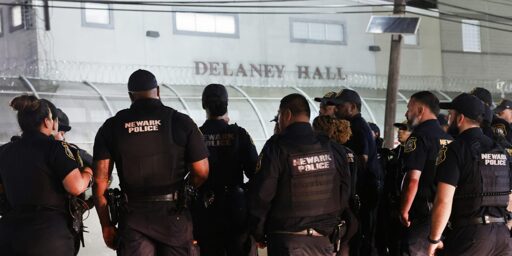
Detectives with the Newark Police Division of the city’s Department of Public Safety went undercover to infiltrate protests outside U.S. Immigration and Customs Enforcement’s Delaney Hall detention facility earlier this month, according to court records obtained by The Intercept.
At the June 3 protests outside the detention center sparked by a hunger strike inside, detectives in plainclothes worked alongside uniformed officers to arrest Samuel Becker, a protester alleged to have thrown items into a fire days earlier, according to a criminal complaint.
The protests had taken place for nearly a month outside Delaney Hall, a privately run ICE facility located on an industrial corridor in Newark, New Jersey, where detainees and their families have complained of poor conditions and retaliation by staff.
“The use of plainclothes officers presents the concern of people constantly being surveilled when they are engaging in First Amendment-protected activity.”
The operation was strictly aimed at arresting Becker, 30, who is accused of dragging a tarp into a fire during a raucous protest several days earlier, according to the complaint filed in Newark Municipal Court by police officer Elddy Torres.
“A PLAN WAS DEVISED TO DEPLOY TWO UNDERCOVER NEWARK POLICE DETECTIVES TO MONITOR AND REPORT REAL TIME INFORMATION TO SURVEILLANCE UNITS,” Torres wrote, describing what happened after Becker was identified. “AS THE UNDERCOVER DETECTIVES REMAINED WITHIN THE CROWD, BECKER WAS OBSERVED COORDINATING PROTESTERS PAST THE BARRICADED PROTEST ZONE.”
Law enforcement presence at protests can have a chilling effect, said Amol Sinha, the executive director of the New Jersey chapter of the American Civil Liberties Union, who declined to discuss the specifics of the arrest, with which he was not familiar. The psychological effect of undercover officers — and the fear of undercovers — stands out as especially problematic.
“The use of plainclothes officers presents the concern of people constantly being surveilled when they are engaging in First Amendment-protected activity,” Sinha told The Intercept. “These are moments that should be celebrated as part of democracy and not viewed through the lens of suspicion.”
While the use of undercover officers at protests is not unusual, advocates said the tactic could raise questions about suppression of speech if the aim goes beyond keeping the peace, according to Aedan Neary, a defense attorney in Kearny, who is not involved in the case.
“The concern arises out of the question of, at what point do the actions of these undercover agents become a pressure tactic as opposed to a law enforcement tactic?” Neary told The Intercept. “Is this being used to ensure that things remain peaceful? Or is this more about gathering intelligence?”
ICE Role Unmentioned
The arrest and police report also raise thorny questions about cooperation between ICE and local authorities, which is prohibited for immigration matters by a New Jersey state law passed in March.
According to Becker and two eyewitnesses to the arrest, ICE agents led the ambush that led to Becker’s detention and initially took him into custody.
“An ICE agent chased and grabbed me and quickly handed me over to an NPD officer,” Becker told The Intercept in a written statement. “The NPD officer brought me back over to the other side of the street and sat me down on the side of the ICE minivan that led the ambush.”
“An ICE agent chased and grabbed me and quickly handed me over to an NPD officer.”
While Newark police and Becker’s accounts align on basic details — such as the time and location of the arrest behind Delaney Hall, where protesters had gone to monitor vehicle traffic in and out of the facility — the complaint by Torres, the officer, says the arrest was the work of Newark police with the support of Essex County Police, omitting ICE’s role.
“ONE OF THE NPD UNDERCOVER DETECTIVES ADVISED US THAT THE GROUP WAS PLANNING TO LIGHT THE DUMPSTER ON FIRE AND PUSH IT IN THE REAR FENCE EXIT. A PLAN WAS DEVISED TO INTERRUPT THE GROUPS CONDUCT AND DISPERSE THEM BEFORE THEY COULD HURT ANYONE OR CAUSE ANY DAMAGE,” said Torres’s complaint. “NUMEROUS NPD DETECTIVES AND ESSEX COUNTY SHERIFF’S OFFICE SWAT PERSONNEL RESPONDED TO THE AREA TO MOVE THE GROUP ALONG.”
At least one of the vehicles that arrived in the convoy to make the arrest, Becker told The Intercept, was driven by ICE agents, converging on the group at the rear of Delaney Hall.
According to Becker, his interaction with that initial ICE agent making the arrest indicated some degree of intelligence sharing between federal authorities and local police.
[
Related
The FBI Used an Undercover Cop With Pink Hair to Spy on Activists and Manufacture Crimes](https://theintercept.com/2023/03/21/fbi-colorado-springs-surveillance/)
“As I was surrounded by ICE agents and the arresting officer, one of the ICE agents accused me of [setting a] fire a different night,” Becker told The Intercept in a statement. “The ICE agent’s words matched the language NPD used when it put out a statement about my arrest the next day.”
In a statement made in a Facebook post announcing Becker’s arrest, Newark Public Safety Director Emanuel Miranda said, “He was identified by Newark Police as the individual responsible for setting a dumpster fire during the weekend protest at Delaney Hall and also attempting to start a second fire there on Wednesday night.”
The two eyewitnesses, who asked for anonymity for fear of retribution, confirmed Becker’s account of the arrest in interviews with The Intercept.
No Sanctuary
While no law in New Jersey prohibits local police from cooperating with ICE on non-immigration matters, such collaboration has become a hot button for Newark Mayor Ras Baraka, who oversaw a zealous crackdown on protests outside the facility despite publicly opposing President Donald Trump’s deportation blitz.
The recent sanctuary law prohibits New Jersey police from assisting immigration agents in enforcement of federal immigration law, but leaves room for exceptions, including the enforcement of state criminal law.
[
Related
How Did the Feds Get Into Anti-ICE Activists’ Signal Messages?](https://theintercept.com/2026/06/17/signal-messages-minneapolis-ice-protests/)
The ACLU’s Sinha said that his organization had pushed for a broader version of the law that would have prohibited any collaboration between police and ICE.
“This is why we were advocating for an end to collaboration, period,” said Sinha. “We wanted to make sure that there was no instance of collaboration between immigration enforcement and law enforcement, and the fuller version of the law that did not ultimately make its way through the legislature would have prevented that sort of collaboration.”
Catherine Adams, a spokesperson for Miranda, the public safety director, told The Intercept, “To ensure that public safety is provided to peaceful protesters in accordance with their First Amendment rights, and for the safety of other members of the public, as well as the Officers at Delaney Hall, we deploy plainclothes officers, cameras, drones, etc., to identify those at the protest site who unlawfully damage property, start fires, or commit other crimes.”
Lifeline for ICE Operations
Demonstrations outside Delaney Hall were relatively small but attracted attention due to the ferocious responses from ICE agents and employees of GEO Group, the private prison firm that operates the jail.
Over the course of several weeks, ICE agents repeatedly charged protesters in an effort to clear protesters from the entrance to allow vehicles to move in and out of the facility, often deploying batons, pepper spray, and pepper balls against demonstrators, as well as taking some protesters into custody.
Becker suffered an injury during a charge by ICE agents, when one agent swung a baton so hard that it fractured Becker’s shoulder, according to his account. On the night of his arrest, Becker’s arm was in a sling.
[
Read our complete coverage
Chilling Dissent ----------------](https://theintercept.com/collections/chilling-dissent/)
After initially keeping a wide berth from the clashes, state and local police operating under orders from Baraka and New Jersey Gov. Mikie Sherrill— both of whom are Democrats who have spoken out against ICE crackdowns — involved themselves in policing the protesters in late May. The scene immediately became even more volatile, with police firing tear-gas canisters, charging protesters on horseback, and kettling dozens of protesters for mass arrest.
On May 31, Baraka instituted a curfew in the vicinity of Delaney Hall, and Newark police set up barricades to keep protesters more than half a mile away from the facility for several days. In the weeks since the curfew ended, protests have continued sporadically, but with less intensity or energy as in the initial weeks.
Baraka has repeatedly sought to minimize the city’s role in policing the protests, claiming he was trying to “bring down the temperature,” not bring an end to protests. That posture eventually shifted.
“It is not the responsibility of the Newark Police Division to secure a private facility,” Baraka said in a June 4 statement. “Our intention was never to protect Delaney Hall or HSI” — ICE’s Homeland Security Investigations division — “but to bring calm. It is a clear contradiction to the city’s position with GEO group to remain there.”
For Becker and many other protesters, the presence of police from various agencies in New Jersey were a godsend to ICE and GEO Group — not to public safety.
“State and local police ramped up their repression of the protestors because ICE agents were having an increasingly difficult time carrying out their daily operations at Delaney Hall by themselves,” Becker said. “Without the ramped-up support of the state and local police, ICE and GEO would have continued to encounter growing difficulty suppressing the strike and operating the concentration camp.”
The post Undercover Cops Infiltrated Delaney Hall ICE Protest to Spy and Make Arrest appeared first on The Intercept.
From The Intercept via This RSS Feed.