

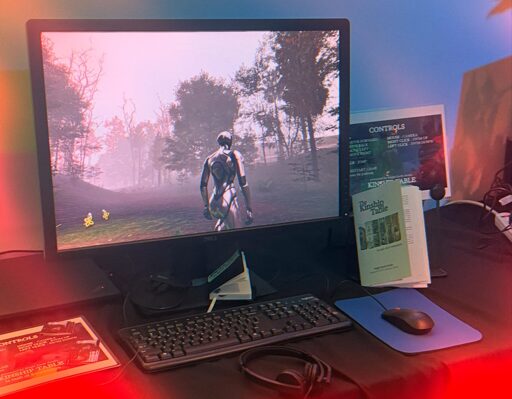
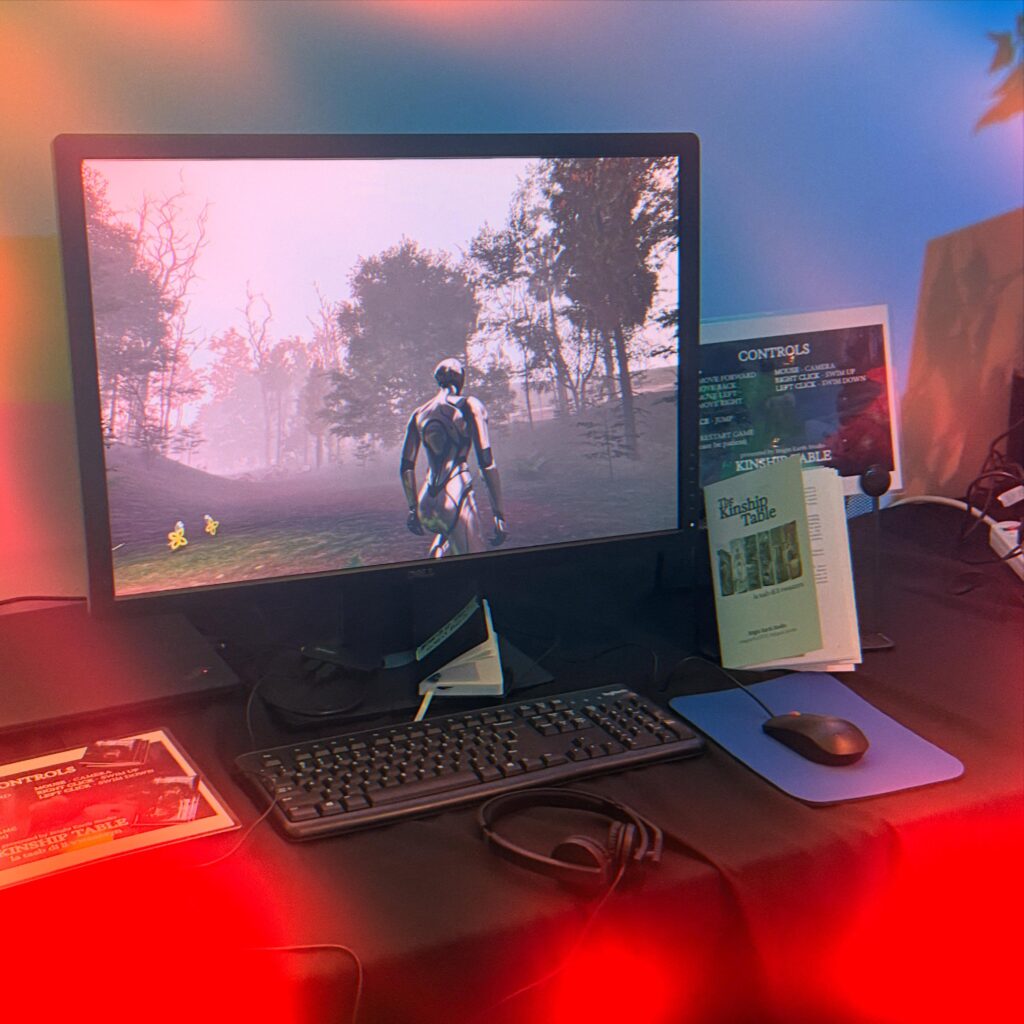
A scene from Robyn Adams’s video game Kinship Table — or la taab di li vwaazayn in the MIchif language — which folklore, language, and architecture to explore kinship through an interactive world inspired by Métis stories and teachings. Photo courtesy Robyn Adams
A new online video game explores kinship through an interactive world inspired by Métis folklore and teachings.
The first being players encounter in Kinship Table is the Rougarou, a shape-shifting figure often featured in stories told to children before bed.
A small church rises on the horizon, its steeple cutting into the dusk. The Lord’s Prayer drifts across the woods in Michif, layering a faint unease over the scene.
Yet by the end of the game, every being players meet will be seated around the same supper table.
Created by Métis and Ukrainian artist and scholar Robyn Adams, Kinship Table, or la taab di li vwaazayn, is a video game developed by Adams, who uses folklore, language, and architecture to delve into the concept of kinship.
Adams, who is based in “Vancouver,” was born and raised in Winnipeg. Her Métis family comes from the Rat River Settlement in Manitoba.
“The premise of the game is the player walks through the world and invites each being to a supper party, and then they all share a meal in the final level of the game,” Adams told IndigiNews in an interview ahead of the game’s release.
Developed at her Bright Earth Studio, Kinship Table is Adams’s first video game, a project rooted in the Métis and Cree teaching that all beings are connected — “we are all relatives,” a scene from the gameplay notes.
Earlier this month, Kinship Table premiered at the 2026 imagineNATIVE Film + Media Arts Festival, where Adams received the New Artist in Digital + Interactive Award. Adams said that the game will soon launch on Steam.
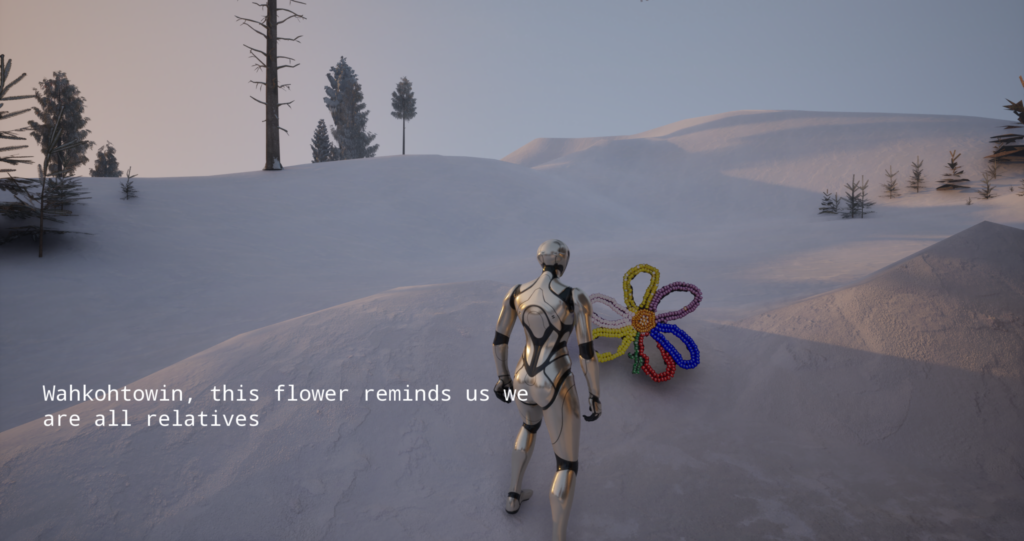
A scene from Robyn Adams’s game Kinship Table — or la taab di li vwaazayn in the Michif language — depicts the protagonist encountering a beadwork flower representing kinship or interconnectedness. Screencap courtesy Robyn Adams
Beginning with the Rougarou
Kinship Table unfolds across five levels, each built around a different being from Métis folklore.
The first level centres on the Rougarou, a shape-shifting creature portrayed as either a dog or a horse, which can shift into a human form.
Folklore stories and their origins vary from community to community, but in Métis communities, the Rougarou story is often used to scare children and get them to pray before bedtime.
The dusk-lit churchyard described earlier is the gateway to the Rougarou world.

READ MORE: Cree-Métis teaching nurse Leanne Poitras-Kelly’s work honours community connections
Adams said her friend Julien Tétrault, who is also from the Rat River Settlement, provided the voice narration and translation for the Lord’s Prayer you hear in this level. The version heard on the game is not an exact translation, she said, but it is more land-based.
“So it really starts out spooky,” Adams said with a smile.
“But the other levels are not all scary,” she said. “Some of them are very magical and exciting. There’s a world with the little people, which is very fun. There is a content warning for the game too, because sometimes folklore is really sensitive to people.”
The game’s final level brings all the beings together at a Métis kitchen party. Adams said her friend Brent Peekeekoot composed and fiddled for the scene’s score.
From architecture to building game words
The idea for Kinship Table began while Adams was in the final year of her master’s degrees in Architecture and Landscape Architecture at the University of British Columbia.
“I was doing research on historic Métis architecture, specifically the Red River frame joinery,” Adams said, referring to the 19th-century log cabin-building technique that uses squared timbers notched tightly at the corners and chinked with clay and moss, a method fast to build and easy to repair on the prairie.
She was also studying Métis settlement patterns, beadwork, and the Red River frame buildings that grew out of that joinery. Rectangular, low-slung and often whitewashed, these structures served as homes, post offices, churches and general stores in many early Métis communities.
As she spent more time with that research, Adams said some of the architecture began to feel almost fantastical to her.
“In my family, we have this really old farm silo from one of my relatives in Manitoba, and it’s done in that same joinery technique, but it looks like this super tall silo,” she said.
“It really felt like something from a fantasy film to me. So that’s where I think it first started, seeing that building.”

READ MORE: Métis Elder promotes resiliency through physical activity
From there, Adams began using the free software Unreal Engine to recreate Métis architecture in a virtual world.
Over time, she started weaving in folklore beings she had been thinking about for years, pairing each being with a different housing type and architectural setting.
“The idea of Kinship Table comes from the idea of a kitchen party,” Adams said.
The title nods to the kitchen table, the centre of many prairie homes and a place where families gather to share food and knowledge.
“In Métis scholarship and community, I started to see a lot of kitchen table methodology and the idea of gathering, visiting, sharing, eating, intergenerational knowledge sharing and beading all around the kitchen table,” Adams said.
“That was kind of my inspiration for the game.”
For her, the beings in the game are also part of that web of relationships.
“All of the folklore beings in the game are also our relatives and us,” she said. “I wanted to highlight that.”
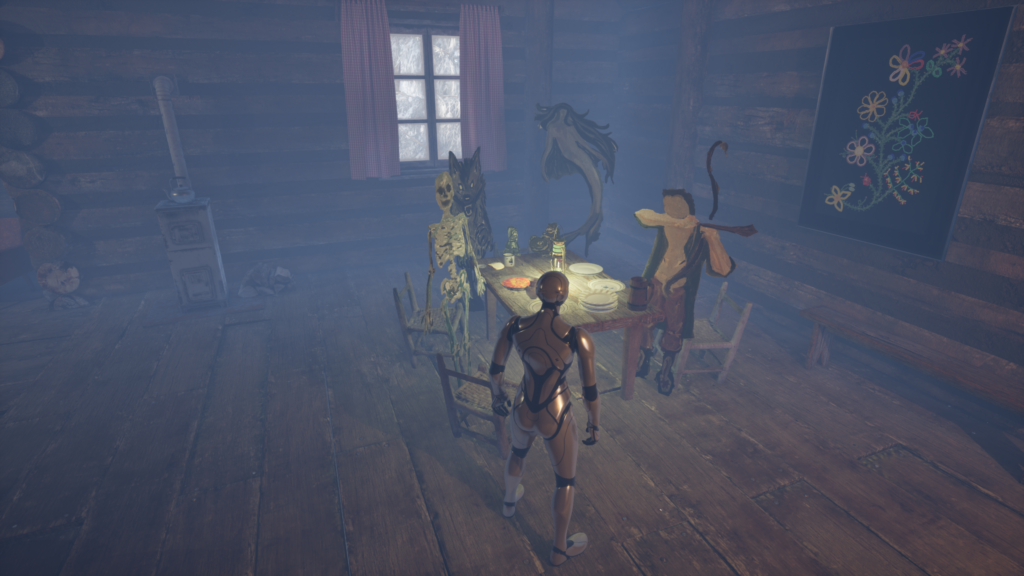
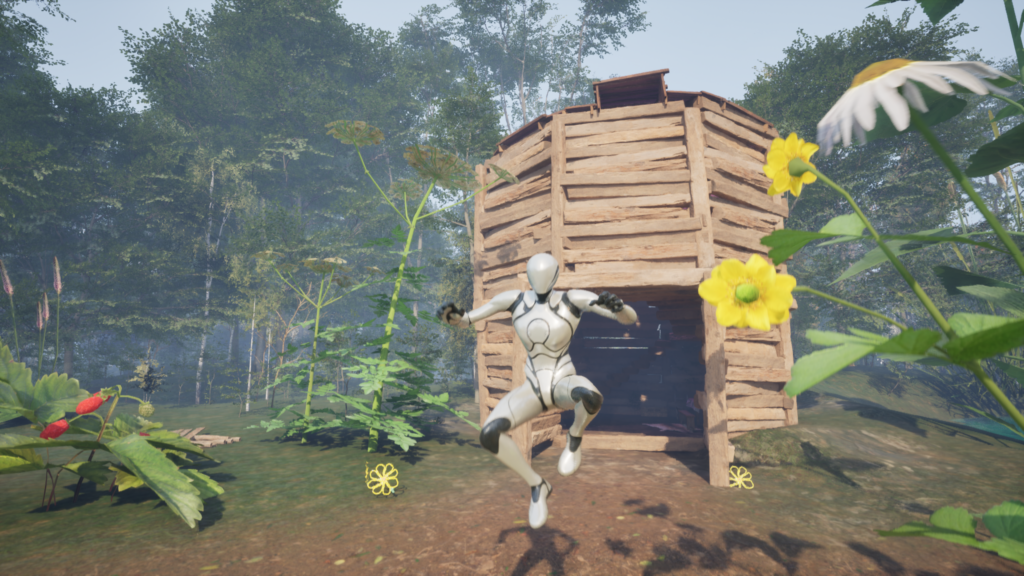
Log cabin kitchen scenes from the Kinship Table video game.
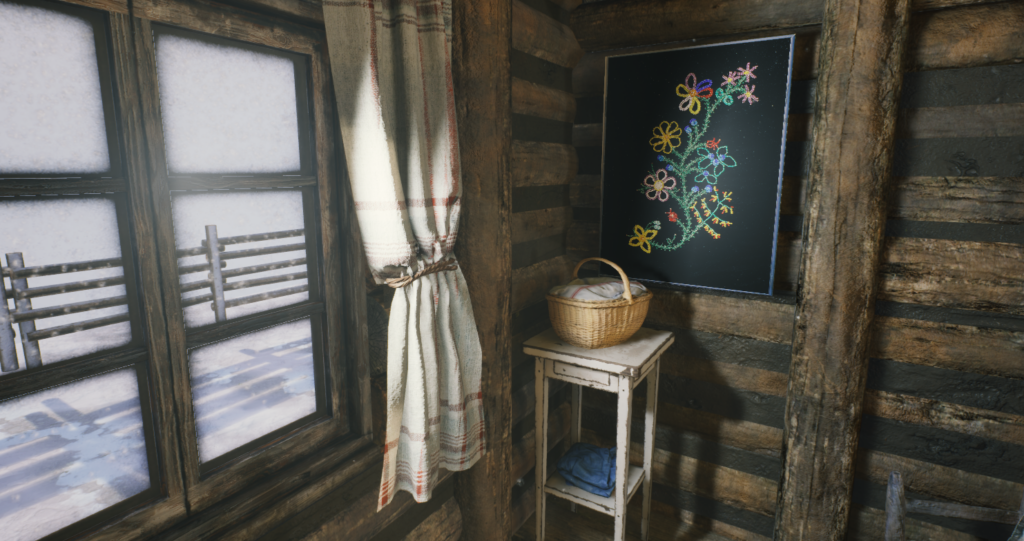
Illustrations courtesy Robyn Adams
Building the game
Adams first encountered Unreal Engine — Epic Games’ real-time 3-D creation tool best known for powering Fortnite and Hollywood virtual sets — while studying architecture, where classmates used it to visualize design projects.
She taught herself the basics through YouTube tutorials, then sharpened her skills at the kinosêw Lab: Unreal Engine Foundations Program, hosted by Indigenous Futures Film Academy.
Although she began the project as a solo experiment, Adams said the game grew stronger and more fun to make after she assembled a small team under her Bright Earth Studio banner.
She handled the early 3-D modelling herself while still at UBC, then brought in a friend and fellow designer, Narita Reyes Ico, to help with the project.

READ MORE: Métis jigging educator teaches dance steps and self-esteem
Adams supplied Reyes Ico with photo references of Saint James Anglican Church, a 1883 landmark near Winnipeg’s Polo Park. Reyes Ico then created the 3-D model of the church based on those photos. The church was built using Red River frame construction.
“I had gone and taken photos all around it recently,” Adams said. “It’s still standing today. It’s right by a graveyard. And then Narita modelled that for me based on the historic building. So that was really cool.”
Adams said she can do modelling herself, but Reyes Ico brought another level of skill to the project.
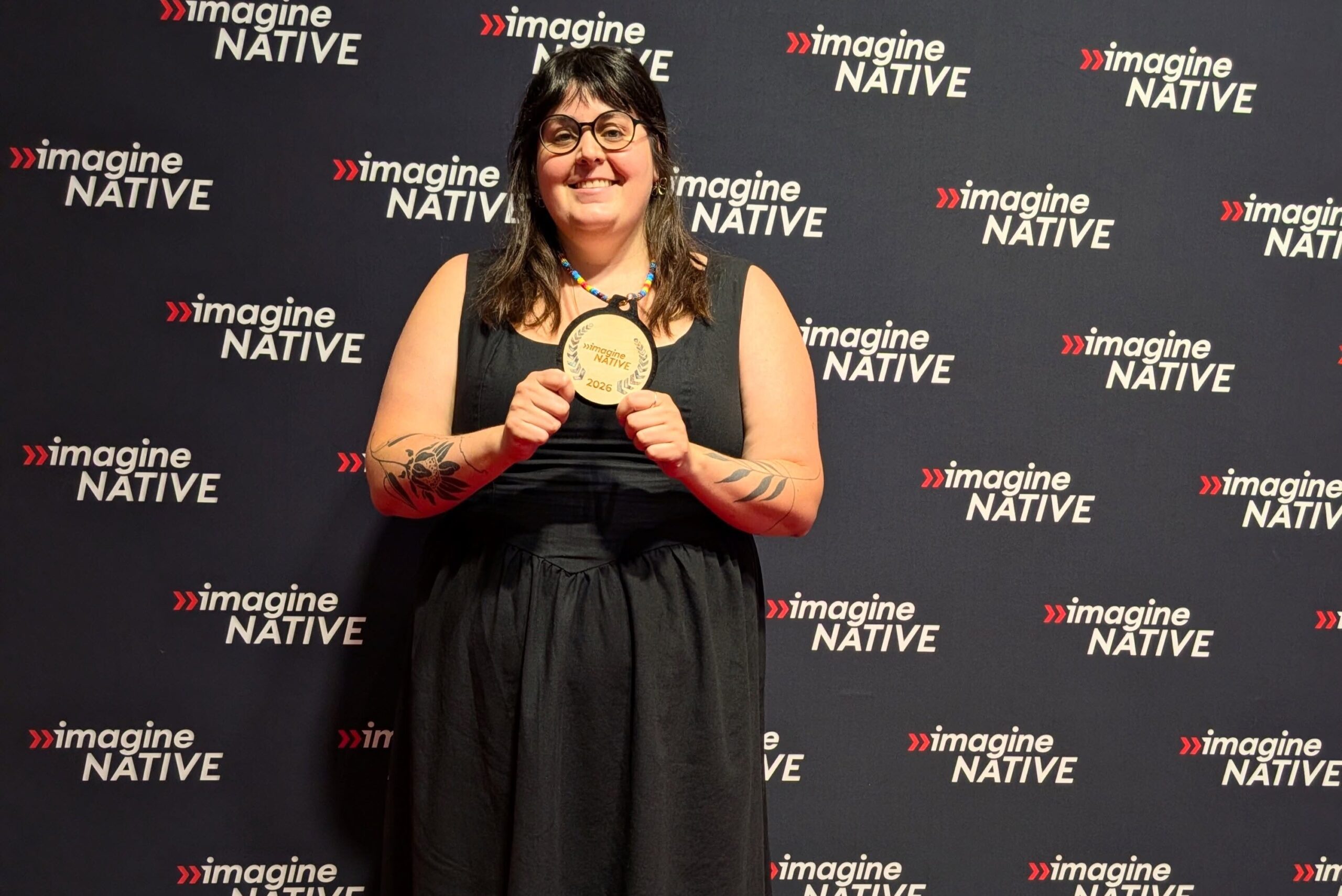
Vancouver-based Métis and Ukrainian video-game creator Robyn Adams holds her award for new digital and interactive artist from the imagineNATIVE festival. Photo courtesy Robyn Adams
Bringing Michif into the game
Michif language is woven throughout Kinship Table.
Adams is not yet fluent in Michif, but she is learning. The written words in the game come from the Little Yellow Michif Dictionary and the Michif Dictionary by the Gabriel Dumont Institute of Native Studies and Applied Research.
“My granny spoke Michif, but she passed away,” Adams said. “We would speak French with her. But I didn’t realize some of the words she was saying were actually Michif until I started learning now as an adult.”
Adams said including Michif in films, games and other creative work is one way to help keep the language present and audible.
“I would say the Michif language is at risk, and it’s really important to have the Michif language in our films and in our work so that we can keep hearing it,” she said. “I think it’s really important being connected to these stories of folklore to have the language included too.”
She said one of her goals with Kinship Table is to help share Métis culture and language.

READ MORE: ‘Letting healing happen’: Métis Nation B.C. creates space for Métis involvement in mental wellness programs
There are several dialects of the Michif language, including Heritage Michif, Northern Michif and French Michif. The version woven into Kinship Table is the latter, a blend that marries Plains Cree verbs with French nouns and adjectives.
Linguists call Michif a “mixed language” akin to a creole in that it fuses two parent tongues, yet unusual because it preserves the full grammatical complexity of both rather than simplifying them.
Born in 19th-century Métis bison-hunting camps where Cree and French speakers shared kitchens, wagons and kinship ties, it is quite literally a language the Métis created for themselves. UNESCO now lists Michif as critically endangered, and Canada’s 2021 census counted fewer than 1,500 people who can hold a conversation in the language.
The game builds language learning into play. When a player clicks on an object such as a Red River cart, the object’s name appears in Michif. That flash of vocabulary, anchored in a visual cue, mimics real-world immersion and helps words stick longer than rote memorization.
She said video games offer a way to reach younger generations, many of whom are already learning about the world through gaming. Even her nieces, she said, have learned how to make video games in school.
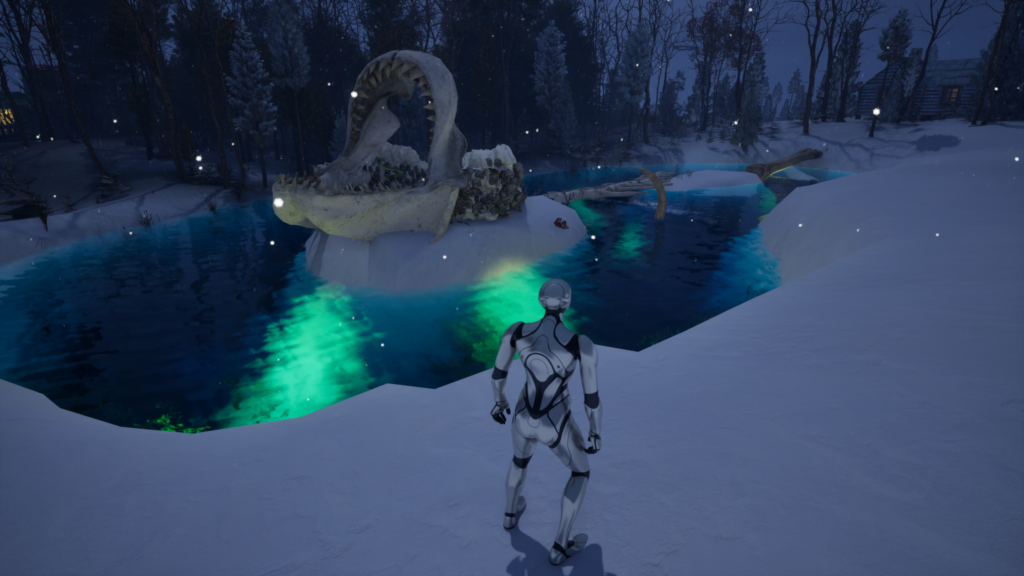
Twonight scenes including a poster for Kinship Table.
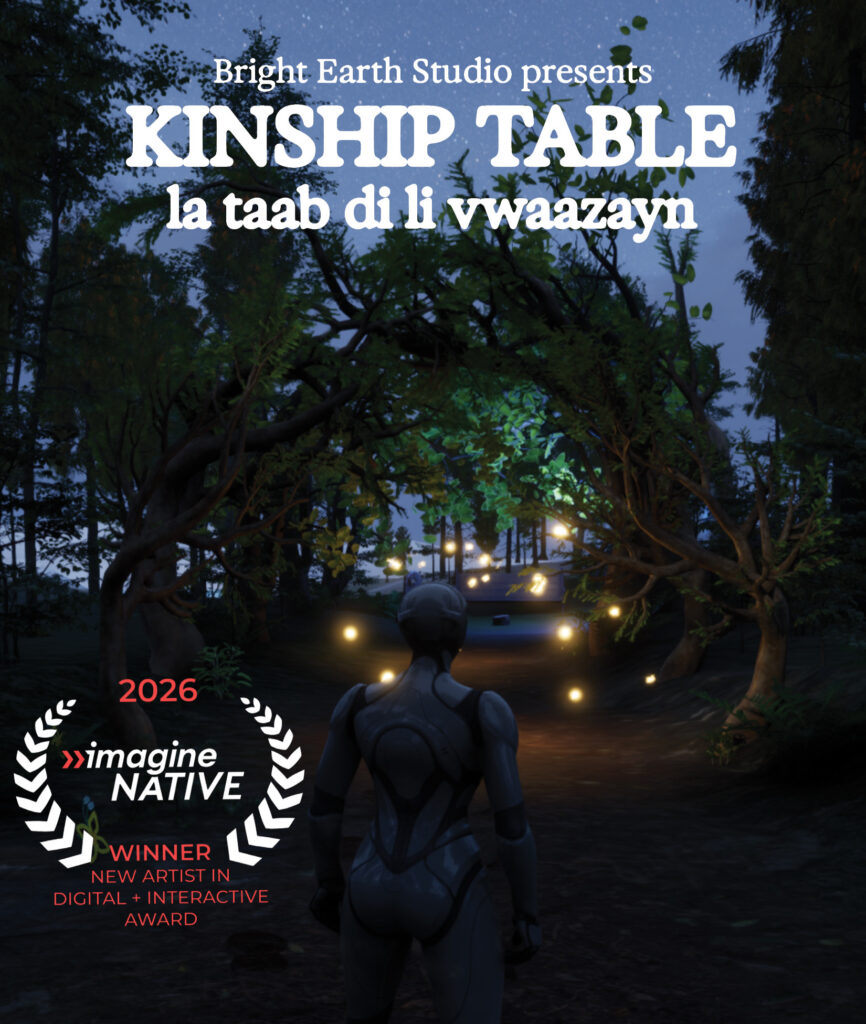
Illustrations courtesy Robyn Adams
Making space for Indigenous stories
Asked what she would say to Indigenous creators who feel intimidated by the video game-making process, Adams said it is more possible than people might think.
“Unreal Engine is a free program and software that you can download and do some tutorials on YouTube,” Robyn said.
When she first started, Adams said she spent about 30 hours watching YouTube tutorials and learning as she went.
“It can be very overwhelming when you don’t know anything yet,” she said.
“But I would say just download Unreal Engine, start tutorials.”
She said a game can begin with almost any idea, including something first imagined in the physical world.

READ MORE: How this Métis woman built her own wine tour company
“Everything can be a game, from something that you’re building in real life, like with cards, or coming up with a board-game concept, and it can be brought into the virtual world,” Adams said.
Adams still considers herself a newcomer to game design, which is why she thinks the field is wide open.
“I think that’s our strong suit as Indigenous people and dreamers, we have amazing stories,” she said.
“Video games are just one platform to share those stories, just like filmmaking or writing or artwork.”
What began as sketches of Red River frame buildings has grown into a playable world where Michif words ring out, and folklore travels beside the player. The invitation stays the same: pull up a chair, and join the table.
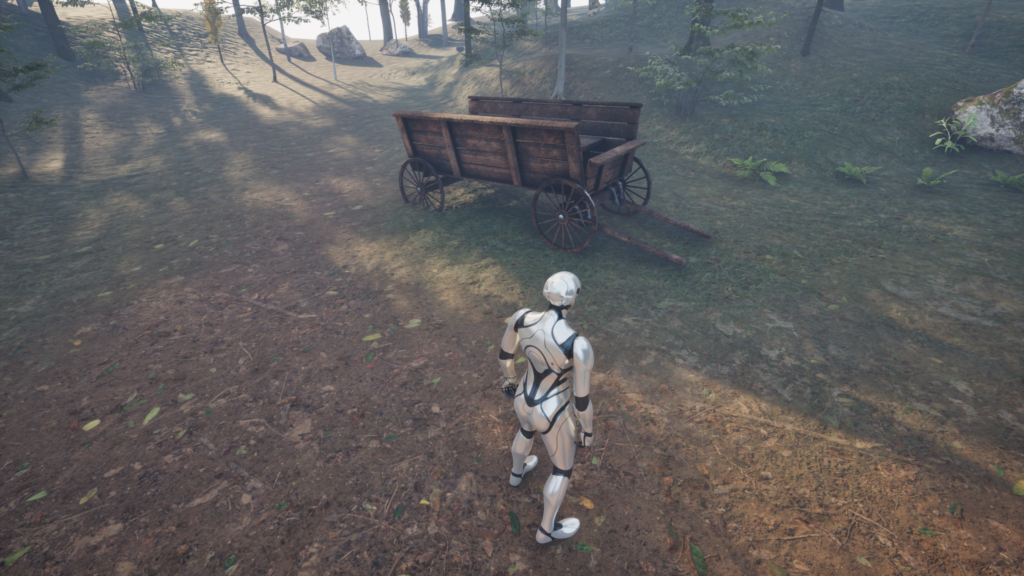
A traditional wood cart in Kinship Table. Illustration courtesy Robyn Adams
The post Métis folklore comes alive in five-level video game ‘Kinship Table’ appeared first on Indiginews.
From Indiginews via This RSS Feed.