

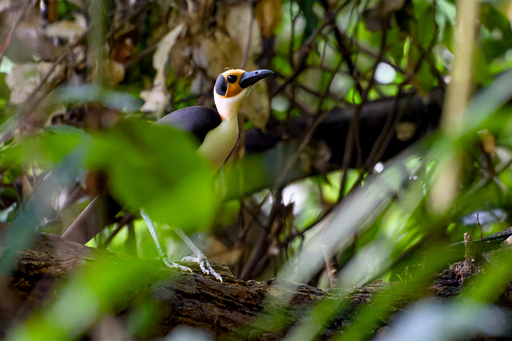
TAÏ NATIONAL PARK, Côte d’Ivoire — The path that leads through the rainforest towards a nesting site for one of its most curious inhabitants is not made by humans but by animals. “It might be half a million years old, this animal path,” says Michele Menegon, a herpetologist and regular visitor to Taï National Park, in southwestern Côte d’Ivoire. It could of course be younger, he adds, but such a clear trail through the forest, following the contour of a ridge, is likely to be an ancient one — maintained by the passage of both Taï’s great and small, from forest elephants (Loxodonta cyclotis) to diminutive antelopes like the Maxwell’s duiker (Philantomba maxwellii), whose piles of tiny black droppings are visible beside the path. The forest floor here is relatively clear of undergrowth. Dominant trees, supported by huge buttress roots, hold their canopies out of sight above; they restrict the sunlight and curtail the growth below. “I’ve never been in a forest with this density of giant forest trees,” Menegon says. The guide, Gliman Hyacinthe, a ranger with the Ivorian Office of Parks and Reserves (OIPR), identifies one of the tree giants as kosipo — Entandrophragma candollei — one of the mahoganies. This part of the forest is boulder-strewn, situated as it is on the slope beneath a large dome of granite whose summit breaks through the canopy of trees but is barely visible from within the forest. OIPR ranger Gliman Hyachinthe, University of Pavia student Caterina Danielon and herpetologist Michele…This article was originally published on Mongabay
From Conservation news via This RSS Feed.