

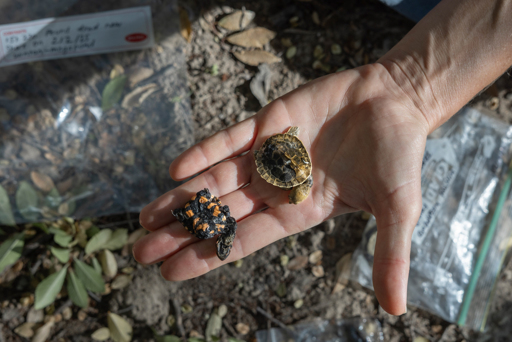
Researcher Ligia Pizzatto dug a small hole in the ground on the sloping banks of Ryan’s Lagoon in southeast Australia. She carefully placed an egg inside the hollow before covering it with soil, then reached for a large spray bottle and doused the area with a fine mist. The scent of vanilla filled the air, oddly sweet against the smell of damp earth and eucalyptus trees. While looking for another spot to repeat the process, Pizzatto came across a scattering of small bones, flat and almost geometrical in shape. “Turtle bones,” Pizzatto said. “Probably eaten by a fox.” These bones are a small sign of a much larger crisis. Freshwater turtle species that are native to Australia’s Murray-Darling River Basin are increasingly under threat, their populations collapsing under pressure from introduced predators. Not only do foxes kill turtles that venture onto land — typically nesting females — but they also dig up their nests to eat their eggs. Pizzatto, a biologist at La Trobe University in Victoria, is testing an innovative approach to intervene — one that doesn’t require killing a single fox. Young broad-shelled turtle found by Ligia Pizzatto during fieldwork. Broad-shelled turtles are classified as endangered in Victoria. Image by Ligia Pizzatto. Freshwater turtles under threat The Murray River is the longest in Australia; its course marks the boundary between the states of Victoria and New South Wales in the country’s southeast. This river and its basin are a major biodiversity hotspot and home to three native turtle…This article was originally published on Mongabay
From Conservation news via This RSS Feed.