

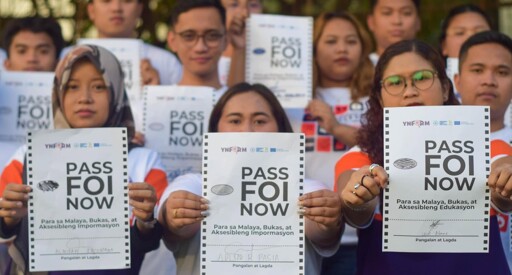
“The current FOI framework lacks the permanence, enforcement mechanisms, and institutional reach that only legislation can provide.”
MANILA — Since the establishment of the electronic Freedom of Information (e-FOI) portal in November 2016, getting data through the platform remains a challenge, noting delays and inconsistent implementation.
A report released by the Right to Know Right Now (R2KRN) Coalition on June 15 showed that 27.3 percent of the 240,000 e-FOI requests in the last 10 years were denied, although the number could be higher considering that other requests were tagged pending action, awaiting clarification, processing, referred, or closed.
Based on the FOI website, several requests made from the e-FOI portal—managed by the FOI Program Management Office (FOI-PMO) of the Presidential Communications Office (PCO)—way back in 2022 were still tagged as “processing.”

An e-FOI request made in March 2022 remains pending. Screenshot from the FOI website
Of the total requests, 55 percent were marked “successful” or “partially successful” as of March 2026.
Kamz Deligente, executive director of the Center for Trade Union and Human Rights (CTUHR), said that they rarely use e-FOI portal to request government data and records, recalling the last instance where they requested data on contractualization from the Department of Labor and Employment (DOLE) through the portal but got no response.
For them, the e-FOI portal is an additional layer to the bureaucratic system of requesting government information.
“A better way is to proceed directly to the agency where the DOLE is responsive,” Deligente said in Filipino during the round table discussion organized by the National Union of Journalists of the Philippines on June 15.
Deligente and Andrea Jobelle Adan, a journalist of Pinoy Weekly who also participated in the discussion, raised privacy concerns since the names of the requesting parties have remained visible in the FOI website.
Executive Order (EO) No. 2, an order operationalizing the people’s right to information, issued by former president Rodrigo Duterte in July 2016 requires a government agency to respond to a request within 15 working days from receipt.
The order only covered the executive branch, including national government agencies, government-owned or -controlled corporations, and state universities and colleges. A total of 737 government agencies are covered.
The R2KRN Coalition’s report showed that 12.9 percent of the denied requests under the Duterte administration were due to filing with the incorrect agencies while 14.4 percent of the denied requests under the Marcos Jr. administration were classified as not valid FOI requests.
The legislative and judicial branches were not included in EO 2 (2016). For local government units, they were only encouraged to observe and be guided by the order.
According to the coalition’s report, only 19 of 82 provinces, 36 of 149 cities, 49 of 1,493 municipalities, and 37 of 42,011 barangays have passed FOI ordinances or executive issuances as of March 2026.
These limitations prompted pro-transparency advocates to push for FOI legislation.
“As an executive order, the current FOI framework lacks the permanence, enforcement mechanisms, and institutional reach that only legislation can provide,” R2KRN Coalition said in its report.
Problematic provisions
The Senate and the House of Representatives approved their respective versions of the FOI bill, namely Senate Bill No. 1432 or the proposed People’s Freedom of Information and House Bill No. 9397 or the proposed Right to Information Act. Both bills pushed for a wider coverage, including other branches of government and constitutional bodies.
These proposed measures also have almost similar provisions when it comes to procedures in requesting information and the list of exceptions, but HB 9397 proposed the establishment of the Right to Information Commission, which shall implement the law once enacted.
In a policy statement submitted by the Center for People Empowerment in Governance (CenPEG) to Congress in December 2014, one of the provisions in previous FOI bills it questioned was exempting a requesting party from accessing information relating to national defense, law enforcement, and border control that would compromise or interfere with law enforcement operations.
CenPEG stressed that it may be used to prevent access to information on abuses, considering the arbitrary arrests, abductions, and even extrajudicial killings have been attributed to the police and the military.
It also questioned the exception of information that may deprive a person of his/her right to a fair trial and the power of government agencies to redact information on the personal life of an individual.
Citing journalists’ criticism, it stated that these provisions might be used to prevent disclosing corruption and other forms of wrongdoing. It also pointed out that information on the private lives of officials, including the number and the names of family members, could be relevant to the way they exercise official functions and to corruption.
The problematic provisions cited by CenPEG remained present in the approved versions of FOI bills in both chambers under the 20th Congress.
They are specified under Sections 7©(1) and ©6 of SB 1432 and Sections 32(b)(i) and (b)(ii) of HB 9397. The redaction of sensitive information shall be applicable to statements of assets, liabilities, and net worth (SALNs) of officials and employees, which was specified in Section 8(a) of SB 1432 and Section 26 of HB 9397.
On the other hand, the Center for Law and Democracy (CLD) also raised a concern on Section 32© of HB 9397, which shall cover information pertaining to testimony, reports, documents, or discussions obtained during an executive session in Congress.
It pointed out that executive sessions are closed for “good reasons,” but it does not necessarily apply to all testimony, discussions, reports, and documents made available to such sessions.
CenPEG also recommended a “sunshine” clause, which aims to make withheld information available after a specific time.
Under Section 32 of HB 9397, it specified that the exceptions shall only apply for the “period strictly necessary to prevent such specific, demonstrable, and substantial harm.” Section 7 of SB 1432, on the other hand, also states that the list of exceptions shall be reviewed by the head of office every three years.
SB 1432 was approved by the Senate on third and final reading on May 4, while the lower chamber passed HB 9397 on June 2. The House version was transmitted to the upper chamber on June 8. A bicameral conference committee is set to be established to reconcile the conflicting provisions. (DAA)
Disclosure: Bulatlat’s editor-in-chief, Ronalyn Olea, is the secretary general of the National Union of Journalists of the Philippines
The post After 10 years, obtaining gov’t data via e-FOI portal remains a challenge appeared first on Bulatlat.
From Bulatlat via This RSS Feed.