

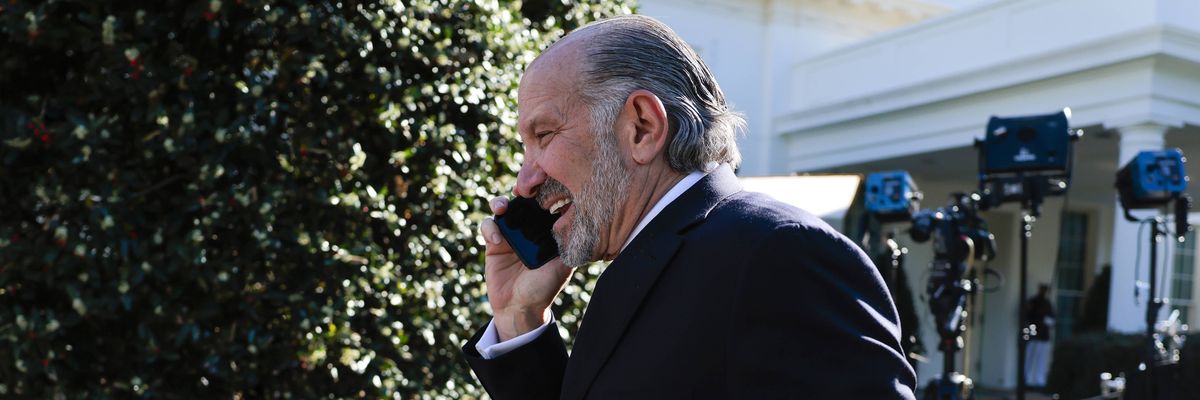
More than 1-in-4 senior appointees in President Donald Trump’s Department of Commerce have significant “conflicts of interest,” according to a report published on Wednesday, pointing to the same sort of corporate capture that is rampant across the administration.
The watchdog group Public Citizen reviewed financial disclosure forms for 112 senior officials in the department, which is dedicated to overseeing industry and economic growth. It found that at least 30 of them have substantial ties to the very industries that the department is tasked with regulating.
It’s a pattern seen across the Trump administration, where fossil fuel lobbyists and insiders dominate the Energy and Interior departments, as well as the Environmental Protection Agency.
But as the new report, written by journalist Zach Everson and researcher Douglas S. Pasternak, explains, the Commerce Department is “unique in its active engagement in the economy to benefit particular companies, including those for whom its current officials once worked.”
“The conflicts of interest identified in this report put Americans at risk,” said Pasternak, the research director for Public Citizen’s Trump Accountability Project.
The entanglements start at the top, with the billionaire Commerce Secretary Howard Lutnick, who has ties to more than 800 different businesses from his decades as the CEO of the Wall Street financial services firm Cantor Fitzgerald, with interests spanning finance, real estate, crypto, AI, tech, satellites, energy, and gaming—many of which could be affected by Commerce policy.
While Lutnick promised to sell his business interests within 90 days of being confirmed at the department, he missed that deadline by more than four months. And instead of putting his financial stake into a blind trust, he sold his interest in the fund to trusts benefiting his four children.
As Commerce Secretary, Lutnick has engaged in actions that the report says “have a clear conflict with his family’s financial interests and appear to violate ethical norms for government employees.”
In particular, it highlights his role in pushing for the dramatic expansion of artificial intelligence data centers across the US, and pressured other governments, including that of the United Arab Emirates, to invest in them.
At the same time, his former company, Newmark, where his son now sits on the board of directors, has facilitated more than $25 billion in AI-data center deals.
Similarly, Commerce invested over $1.6 billion in the mineral company USA Rare Earth Inc. while Cantor was leading the company’s private fundraising.
Lutnick has also been at the center of the Trump administration’s efforts to promote cryptocurrency and develop regulatory policy around it. This could impact the blockchain platform Tether, which hosts the world’s largest stablecoin, for which Cantor acts as the primary custodian for more than $180 billion worth of reserves.
Beyond Lutnick, the department is crawling with ex-industry employees, lobbyists, and corporate lawyers now embedded in the regulation of their former clients.
Joyce Meyer, formerly a top lobbyist for the life insurance industry, now serves as undersecretary for economic affairs, where she oversees the Bureau of Economic Analysis and the US Census Bureau, which produce economic reports that shape federal tax, interest, and spending policy.
The current undersecretary for industry and security, Jeffrey Kessler—who oversees export controls on technology, software, commodities, and other equipment—previously worked as an attorney for the law firm WilmerHale, where he represented dozens of clients across industries he now regulates, including Boeing, Meta, and Eli Lilly.
One of the people in charge of regulating the sale of defense technology abroad, Joe Bartlett, who serves as deputy undersecretary at the Bureau of Industry and Security, came from one of the US military’s biggest drone makers, Skydio, which is subject to BIS export controls.
The report also identifies multiple other employees who have worked for weather data companies that have pushed to privatize forecasts now provided for free by the National Oceanic and Atmospheric Administration.
“It is unclear if these officials are serving the American public as their positions require or attempting to enrich their former employers or potential future employers, and ultimately themselves,” Pasternak said. "These seeming conflicts raise serious questions about whether these federal employees are beholden to the American people or to the interests of private for-profit corporations.”
Everson added that the department "is meant to work in the interest of the people, not in the interest of a few select billionaires.”
He said, "Political appointees within the Trump administration need to be subject to standards of ethical and financial conduct which prevent them from using their positions of power to skim off the top.”
From Common Dreams via This RSS Feed.