

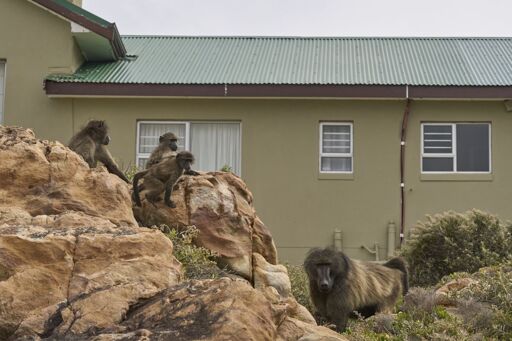
ROOIELS, South Africa — Baboons aren’t exactly punctual, but Gavin Lundie still expected them to appear in the village around 9 a.m. “They’re coming!” his wife Leslie called. Members of the Rooiels baboon troop had begun to make their way down. Leslie made her way to the sliding doors on their patio and secured it with two shoelaces attached to a hook. She remained on the balcony and watched as the troop entered into the village a few properties away. The Lundies live in Rooiels, a small, affluent village on False Bay, approximately 80 kilometers (50 miles) from Cape Town’s city center. The village, scattered from the coastal flats up the slopes of the Klein Hangklip mountain, is part of the Kogelberg Biosphere Reserve. The mountain’s cliff faces offer sleeping baboons (Papio ursinus) protection from leopards, their natural predator, but the sparse vegetation doesn’t offer enough for them to eat or drink. In contrast, the lower slopes, where the village has grown up, is still covered with dense fynbos scrub on undeveloped plots, in gardens and along unpaved verges. The baboons forage on a range of flowers, seeds and berries in the warmer months; in winter, when the fynbos is dormant, the baboons eat kikuyu grass from lawns in the village. They also eat limpets in the intertidal zone, and the Rooiels River is a year-round source of freshwater. A juvenile baboon clings to its mother’s back as she forages in fynbos on the roadside in Rooi Els. Image by…This article was originally published on Mongabay
From Conservation news via This RSS Feed.