


Bullets:
Scientists and researchers in China are developing cutting-edge tools for the deployment of 6G telecom networks.
6G is thousands of times faster than 5G, with near-zero latency, and will completely transform almost all industries.
China has monopolies on the key raw materials inputs for 6G systems, including gallium compounds.
The same rare earth materials and components that are in high demand by the Pentagon and NATO militaries, also have profound uses in civilian applications.
Inside China / Business is a reader-supported publication. To receive new posts and support my work, consider becoming a free or paid subscriber.
Report:
Good morning.
The supply chains for the most important technologies run through China. The materials for the key industries, which today make modern life possible, as well as the hardware and systems that will power the rest of the century.
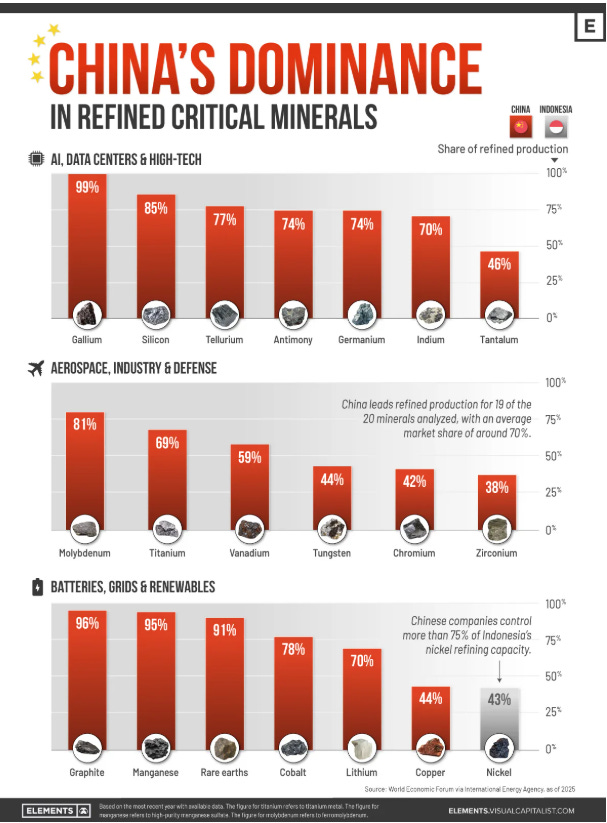
It’s already a crisis at the Pentagon. It doesn’t matter how much the United States plans to spend on defense; they need Chinese companies to mine and refine the raw materials that go into all their strategic weapons platforms, and even to build the semiconductors for them.
And China is cutting off exports of those materials and components to Pentagon contractors, and to weapons makers outside China.

Over 300 new F-35 jets have been delivered without radars, because of China’s export bans on gallium. Gallium nitride is used for the radars on advanced aircraft, and in those giant radar systems that Iran blew up in the Persian Gulf. Gallium nitride makes smaller and lighter systems possible. That has profound implications for militaries, but gallium is also critical, for that same reason, in civilian telecom systems.
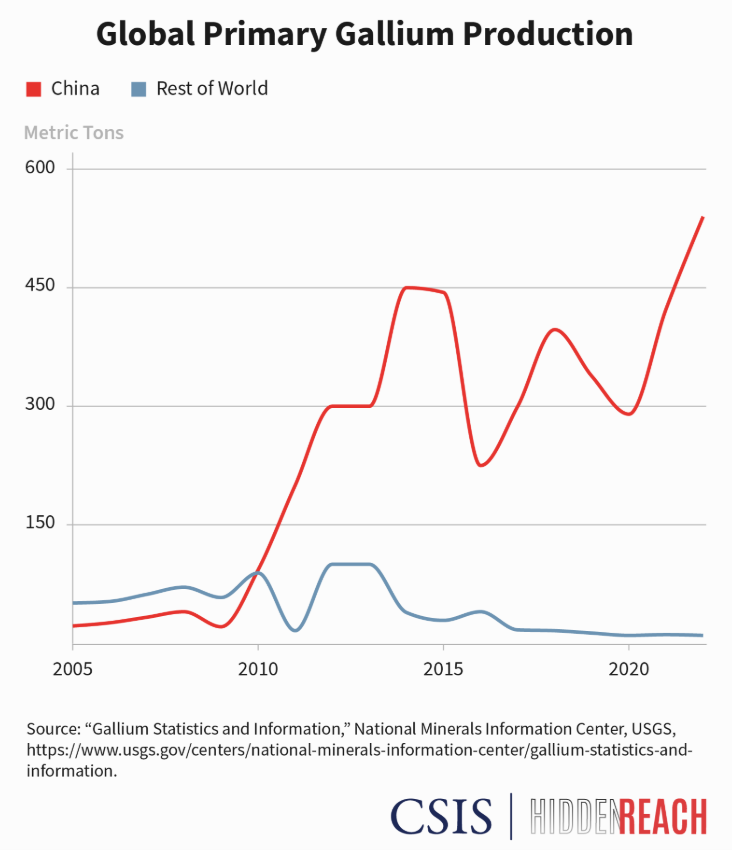
The United States doesn’t make any gallium at all, and China makes 99 times more than the rest of the world, combined. The Pentagon needs gallium for over 11,000 components, while 85% of the Pentagon’s supply chains are dependent on Chinese suppliers to get weapons built.
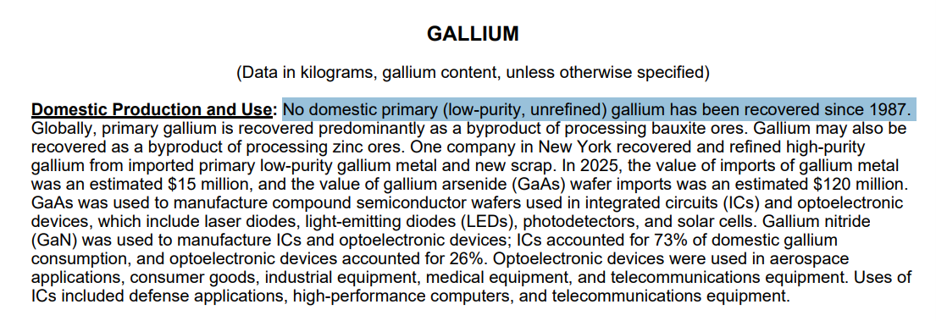
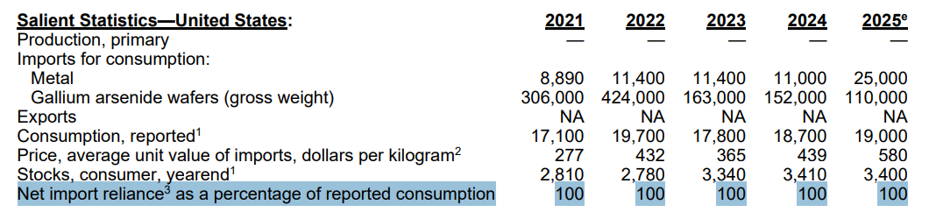
This is from the US Geological Survey, with the most painful parts highlighted: no domestic production of gallium in the United States for forty years. That’s the top line. Bottom line: net import reliance, 100%. China is 99% of global production:

China has gallium, so their most advanced jets have the most advanced radars. Pentagon suppliers, in the meantime, are shipping planes out with ballast where the radars are supposed to go. Lockheed Martin hopes one day to find some gallium and build some radars, but until then they need to put barbells on the planes, so they don’t somersault in-flight.
At the time of China’s export ban on gallium, the US National Defense Stockpile didn’t have any gallium, which makes us wonder what those guys are doing, exactly. Do they understand what their job is?
No reason to be pessimistic, though: the United States needs a “hard pivot” and develop and a full gallium supply chain that includes gallium extraction and wafer fab and packaging, with production lines for military and civilian customers. Simple enough. Except that the gallium industry is a by-product of the aluminum mining and smelting industries, and the United States needs to build one of those, first:
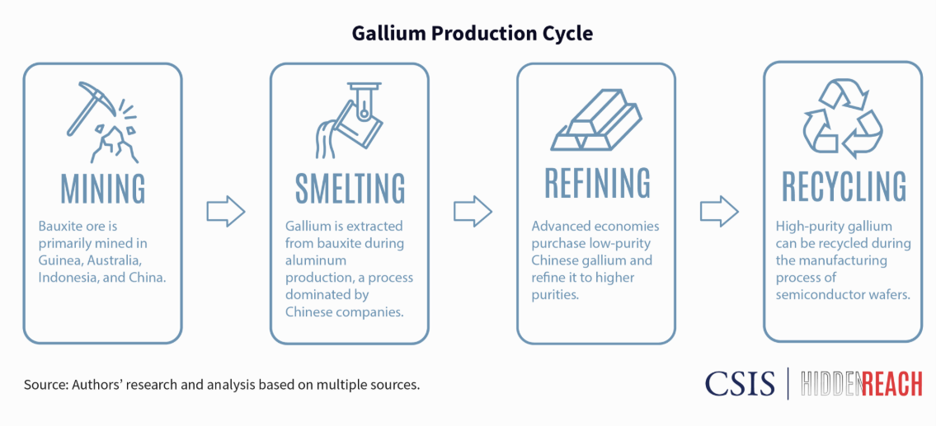

Let’s assume that not much is likely to happen in NATO countries anytime soon, to dislodge China and its total monopolies on gallium. Obviously, that’s a problem for the Pentagon, and those Air Force pilots who are flying planes with no radars on them.
But those monopolies also mean that Chinese researchers can get busy on 6G telecom, before anyone else. The Number 55 Research Institute is under US sanction. They just developed a revolutionary gallium semiconductor for 6G, and is producing 5 million of them to build smart terminals for a space-air-ground integrated network.
These chips are for industrial applications: 6G communications, commercial space launches and satellites, emergency response. The low-altitude economy is heavy drones, used for everything—air cargo, mining, construction, passenger transport. The chips will also be used in high-end phones, especially in areas where land-based cellular signals haven’t yet been built, and now there is no hurry to be. Users can simply be direct to 6G satellite.
The commercial and industrial applications are the most important difference, between 5G and 6G. 5G is adequate for household and personal users. 6G presents a quantum leap in speed and latency over 5G, which is a boon to industry, especially the industries that China also has major advantages in.
Chinese companies are way ahead in local, industrial-level deployment of private 5G systems. This is a huge industry here: private telecom networks for warehouses, logistics nodes, mines, and factories. The differences in speed are at orders of magnitude higher for 6G, thousands of times faster, and 6G allows for rollouts to areas that are not being served at all, currently.
This is very important: 6G networks have not been standardized. Global protocols have not yet been established, because the systems have not yet been built. But China is building them, and so China will define those standards:

This research asks and answers some important questions: 5G seems to be just fine for doing what users need, so why bother building 6G? And here again, it is in business and industry where the demand will be. Breakthroughs in sensing, imaging, and precision positioning, which is an industry China recently took over. Precision in robots and advanced manufacturing. 6G operates in the terahertz frequency bands, and so 6G data centers will run faster and cost less.
This is to say that 6G are technologies where the demand will be heavily weighted on the industrial side, and far less so for individual users. To download a 21 terabyte-sized file will take 5 hours on a 5G network, and just 18 seconds on a 6G. Going back to this, 6G systems allow for downloading 200 films a second, and there is little demand for that speed, today at least, from individual consumers. The demand is from industry, where money is no object to building data centers, for example.
Capital Expenditures for 6G are already ramping up, but Ericsson is going to hit the same ceiling they’re already at for 5G: they need gallium from China, and the commercial success of 6G will depend on “tangible use cases” on the industrial side. And those run through China too.
Boston Consulting Group estimates that 5G has generated over $1 trillion in new economic output, which will grow to $18 trillion by 2035. But 6G will create completely new enterprise models and large-scale AI. 6G will transform manufacturing, smart cities, healthcare, and public safety. BCG urges that governments and industry come together and establish standards for radio frequency spectra and infrastructure planning and buildouts.
The Trump Administration acknowledges that 6G is “foundational to the national security” of the United States, foreign policy, and economic prosperity, and it is the policy of the United States to lead the world in 6G. President Trump ordered consultations and research to figure out the radio spectrum problem and get busy on commercial applications. Also, to get the State Department working with friendly countries that support the US position, that the United States should be in charge of 6G.
The problem is that the United States cannot do any of that, because it cannot build anything for 6G until the mining and refining problems are solved to get the raw materials, and then thousands of scientists and engineers are trained to apply the technology to build out 6G.
Chinese scientists and engineers are doing exactly that already. This is from Matter, a Cell Press Journal, and we’ll turn to Interesting Engineering for more help understanding it: It’s a photonic engine that uses white light to transmit data, which can power intelligent 6G networks. Conventional light communications can operate only in small areas, but this new technology works over 1 kilometer:

Here’s another one, and once again we needed IE to translate it for us. This Chinese group built the world’s first all-frequency 6G chip. The entire radio spectrum from 0.5 to 115 Gigahertz is now on a single chip; previously they needed nine different radio systems:

This chip then can be used in systems everywhere, and establishes a foundation for AI networks and used in phones, base stations, drones, and IoT devices. Phones, drones, and Internet of Things devices.
And suddenly here are applications that WILL have high consumer demand, from non-commercial users.
And that’s the point for all these technologies; all these advances. Supply chains are everything, and so are hundreds of thousands of top STEM researchers and engineers who are busy building applications for them, and new markets for them.
Right now, the Pentagon can’t put radars on their hundred-million-dollar planes or replace billion-dollar radar systems, because the Chinese won’t sell to them. And those chips, and those gallium semiconductors—mass-produced–mean that ten years from now anyone who wants the best phones or the best drones or the best robots will need China to sell to them.
Be Good.
Resources and links:
Reports Suggest F-35s Are Being Delivered Without Radar Amid APG-85 Delays
https://theaviationist.com/2026/02/12/reports-suggest-f-35s-delivered-without-radar/
Ballast Instead of Radar: Lockheed Martin Delivers F-35 Without AN/APG-85 Due to Delays
https://militarnyi.com/en/news/lockheed-martin-delivers-f-35-without-an-apg-85-due-to-delays/
China’s newest air force jets have next-generation radars. New USAF F-35’s have no radars at all.
China begins large-scale delivery of gallium chips for space-ground 6G network
https://www.scmp.com/news/china/science/article/3356321/china-begins-large-scale-delivery-gallium-chips-space-ground-6g-network
Why America’s best fighter jets are being made with deadweight
https://www.washingtonpost.com/opinions/2026/04/27/pentagon-fighter-jets-are-being-delivered-without-radar/
US Geological Survey, Gallium
https://pubs.usgs.gov/periodicals/mcs2026/mcs2026-gallium.pdf
The United States Is Repeating Its Silicon Mistake with Gallium Nitride
https://warontherocks.com/cogs-of-war/the-united-states-is-repeating-its-silicon-mistake-with-gallium-nitride/
What are the key differences between 5G and 6G?
https://www.raconteur.net/technology/key-differences-5g-6g
Why Do We Need 6G and What Are the Challenges?
https://www.idtechex.com/en/research-article/why-do-we-need-6g-and-what-are-the-challenges/28805
What is 6G? How is it different from 5G?
https://www.rantcell.com/how-is-6g-mobile-network-different-from-5g.html
5G vs 6G spectrum comparison
https://electronics360.globalspec.com/article/18760/5g-vs-6g-spectrum-comparison
6G: The Network for the Future of AI and Immersive Connectivity
https://web-assets.bcg.com/9c/73/4ac7634848a0b0bb31cf8dae40cb/6g-the-network-for-the-future-of-ai-and-immersive-connectivity-report-feb-2026-edit-03-web.pdf
Tailoring quasi-transparent ceramic as a laser-driven photonic engine for kilometer-level white light communication
https://www.cell.com/matter/abstract/S2590-2385(26)00185-2
Numbers Matter: Defense Acquisition, U.S. Production Capacity, and Deterring China
https://www.govini.com/blog/numbers-matter-defense-acquisition-u-s-production-capacity-and-deterring-china
Ultrabroadband on-chip photonics for full-spectrum wireless communications
https://www.nature.com/articles/s41586-025-09451-8
How Much Control China Has Over the World’s Critical Minerals
https://elements.visualcapitalist.com/how-much-control-china-has-over-the-worlds-critical-minerals/
Charted: China’s Grip on Critical Mineral Refining
https://www.visualcapitalist.com/charted-chinas-grip-on-critical-mineral-refining/
China’s New Rare Earth and Magnet Restrictions Threaten U.S. Defense Supply Chains
https://www.csis.org/analysis/chinas-new-rare-earth-and-magnet-restrictions-threaten-us-defense-supply-chains
De-risking Gallium Supply Chains: The National Security Case for Eroding China’s Critical Mineral Dominance
https://www.csis.org/analysis/de-risking-gallium-supply-chains-national-security-case-eroding-chinas-critical-mineral
China Leads the Way With Private 5G Networks at Industrial Facilities
https://www.wsj.com/business/telecom/china-leads-the-way-with-private-5g-networks-at-industrial-facilities-11647163802
Inside China / Business is a reader-supported publication. To receive new posts and support my work, consider becoming a free or paid subscriber.
From Inside China / Business via This RSS Feed.