

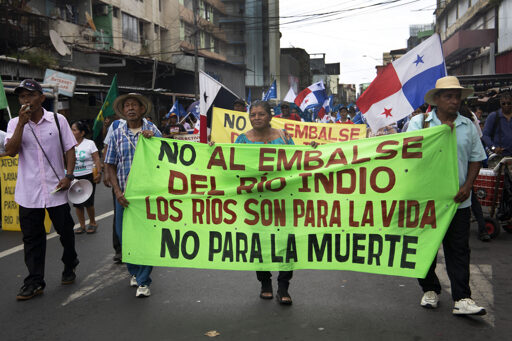
LIMÓN DE CHAGRES, Panama — In Panama’s Rio Indio Basin, a $1.5 billion reservoir project aims to meet water demand for the next 50 years. But the project would displace dozens of farming communities, sparking widespread opposition to the reservoir’s construction. “We will give our lives to save Rio Indio! I came from Limón de Chagres, the first community that could be flooded to make space for the dam,” shouts Maricel Sanchéz at the microphone from a stage during a May 1 march in Panama City. “Today, I’m so proud to see how united we are in our resistance.” Sanchéz, 25, is the spokesperson for the Rio Indio farmers’ assembly, which is part of Coordinadora Campesina por la Vida (Peasant Coordinator for Life), a grassroots social and community organization of farmers, Indigenous communities and civic groups in Panama. During the march, she spoke out about their mobilization against the Río Indio reservoir: a $1.5 billion project by the Panama Canal Authority (ACP), Panama’s government agency responsible for managing the canal. Rio Indio is a 98-kilometer (about 61-mile) river in central Panama, flowing through the Costa Abajo area (home to 231 farming communities) to the Caribbean Sea. Here, the ACP plans to create a reservoir to provide water to nearby Gatun Lake (the northern entrance of the Panama Canal in the Atlantic Ocean) to meet water demand for the next 50 years for human consumption and for canal operations, especially during droughts. The construction is expected to begin in 2027 and…This article was originally published on Mongabay
From Conservation news via This RSS Feed.