


Sandra Hale Schulman
Special to ICT
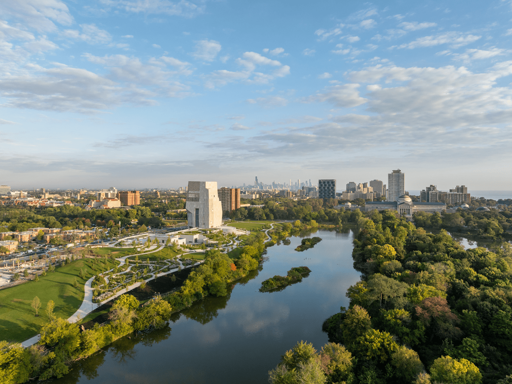
Former President Barack Obama is unveiling his multi-purpose Obama Presidential Center in Chicago June 19 that features gardens, programming, a library, a 19-acre basketball court, and newly commissioned art by a couple of Indigenous artists.
The Native artwork will be figured prominently in the main tower and outside in the gardens, asserting their rightful place in Obama’s story of how he sees the America he presided over for eight years. Solo artworks and collaborations make powerful statements about race, culture, and the shared natural world.
“The arts have always been central to the American experience. They provoke thought, challenge our assumptions, and shape how we define our narrative as a country,” Obama said on the center’s website.
It’s an important cultural venue and statement for the first Black president of the United States who was born in Honolulu, Hawai’i and raised primarily by his mother and maternal grandparents, in a rich diversity of Indigenous cultures. His early years there shaped his worldview, empathy, and awareness of cultural identity.
Across the US, there are 16 official presidential libraries, not all are multi-use compounds. The libraries are administered by the National Archives and Records Administration that houses the documents and artifacts of presidents from Herbert Hoover through the current president.
The Jimmy Carter Presidential Library and Museum in Atlanta is similar to Obama as a federal institution with official archives, presidential documents, a public museum, walking paths, ponds and wildlife on a 37-acre campus.
One difference in the Barack Obama Presidential Library is that in keeping with the times it operates as a fully digital archive rather than a physical building.
At the visual center of the Museum Tower, the 225 foot-tall main building, an ambitious group of artists was assembled by Virginia Shore, who served for 20 years as chief curator and acting director of the U.S. Department of State’s Office of Art in Embassies. Shore has a sharp eye and affinity for Indigenous art.
There are original works of art from 28 world-renowned artists throughout the campus. Almost all of the artwork pieces are outside or areas that are open and free to the public.
Shared visions

Marie Watt (Courtesy The Obama Foundation)
“This site and this project inspired a lot of people to try new things,” Shore told the New York Times, pointing out how African American artist Nick Cave, and Marie Watt, Seneca, collaborated on a large textile wall work, This Land, Shared Sky, hanging in the museum’s main lobby.
This work brings together Indigenous and Black traditions using beaded nets and Watt’s sculptural jingle cloud like creations. Watt has been creating works to bridge Indigenous history, culture, and community using traditional regalia elements of sewing and jingle cones.
“I want to make tactile and interactive work that invites people to engage with it in a way that reflects the way art really is in the world,” Watt said in an interview with Voca Network.

This Land, Shared Sky in the Hope and Change Lobby at The Obama Presidential Center (Courtesty The Obama Foundation)
Watt is fascinated with the history and story embedded in tin jingles that come from commodity tobacco can lids shaped into cones. The jingle dress dance began as a healing ceremony in the Ojibwe cultures, and jingles are now used in a variety of innovative ways.
“I was really struck by the story of the jingle dress…a grandfather who was a medicine person, had this dream where he was instructed to attach tin jingles to a dress that was to be danced around a sick child. And it was the sound of the jingles that helped this young girl heal,” Watt said. “Having active physical engagement is, in a way, how we experience art in the spaces where we live, the spaces where we dance, or the spaces where we listen to music.”
Cave is best known for his wildly embellished sound suits and soundscapes, in this piece he incorporated textiles with elements of movement and sound constructed of hand-strung, beaded shoelaces, woven with “memory-steeped” patterns and colors.
“Nick Cave’s work is very impactful in so many different ways,” Watt said. “I’m really struck by the stories that he tells, his use of materials, and the way he engages community through movement and dance and music and working with other creatives. It’s an ‘I trust you; you trust me’ thing.”
Watt sees the work as creating a cacophony of light and sound at the center, she’s struck by how jingles shine and reflect the light, drawing people to them and that the significance of having a Native American, and an African American sharing a space on the Obama Presidential Center campus is designed to encourage visitors to bring change home.
“Historically, at least for Native communities, our work has been positioned in anthropology museums and collections and shown in a way that doesn’t reflect the innovation, dynamism, evolution, and change that is inherent to being creative,” Watt said.
“I think it’s important to have work at the Obama Presidential Center and reach a broader audience. I mean the work has always existed, right? It’s just the doors haven’t always been open.”
“I’m really interested in the intersection of art and life,” she said. “I want people to be able to sit with what Nick and I have made and feel a connection to it and how the story changes the longer one stays with it. But truthfully, I’m interested in the stories that people will share after being in that space.”

Jeffrey Gibson (Photo by Brian Barlow, Courtesy The Obama Foundation)
Buttons and drum heads
Jeffrey Gibson, Choctaw and Cherokee, who was the first Native American to have a solo show at the Venice Biennale two years ago, said he admired Barack Obama’ s spirit of “inclusivity.”
Gibson’s work is featured in the museum’s “More Inclusive America” exhibit, a wall installation called Yet With a Steady Beat, made of 17 circular prints in vibrant colors with political button slogans and Native American hand drums with messages saying, “I’ve got the power” and “I am the proud child of an immigrant.”

Yet With a Steady Beat by Jeff Gibson installed (Courtesy The Obama Foundation)

Yet With a Steady Beat by Jeff Gibson installed (Courtesy The Obama Foundation)
Working with paintings, installations, video, and performance, Gibson often uses Native American hand-drums, which he sees as a means of summoning power that calls forth ancestors, while sending vibrations into the world.
“There is a social aspect to the way that they are promoting the arts,” Gibson said in the New York Times of the Obamas. “The canon could expand. That felt really promising.”
The Obama Presidential Center opens June 19, 2026, at 6001 S. Stony Island Avenue in Chicago.
The post Indigenous art shapes the narrative at Obama Presidential Center appeared first on ICT.
From ICT via This RSS Feed.