

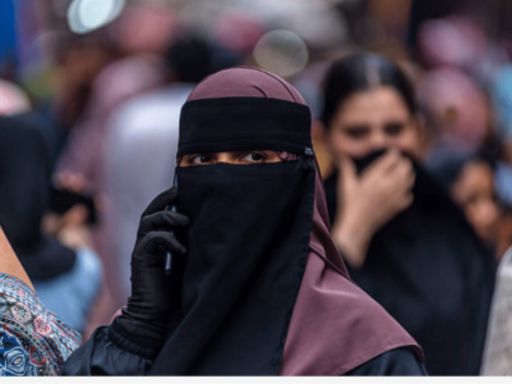
In its newest avatar, Islamophobia in India is being accelerated by using AI to produce sexualised propaganda, deepfake harassment and “digital lynching” to target Muslim women.
A recent investigation by Al Jazeera reveals that Muslim women’s bodies in India have become battlegrounds for communal dominance.
Al Jazeera spoke with multiple Muslim women who have experienced such attacks, including a freelance model named Samreen Ayoub, whose deepfake video falsely labeled her brother as her ‘pimp’.
Ayoub called it a “digital lynching”.
Most other women contacted declined to speak on the record.
This dynamic was already present, most visible in the Sulli Deals and Bulli Bai controversies, mock-auction apps that targeted Muslim women in India.
Citing researchers, Soma Basu and Sahana Udupa, the investigation shows that Basu links these apps to support from BJP officials and their digital volunteers.
At the same time, Udupa argues that right-wing digital cultures use humour, memes, and sexualised imagery to normalise abuse.
Fascism and Hindu supremacy are on the rise in India, led by Modi’s BJP, whose loyalties lie with US-backed Israel.
Muslim women face misogynist violence
In 2018, Indian Muslim journalist, Rana Ayyub, was targeted with a deepfake porn video that aimed to stifle her.
Ayyub’s crime was being a persistent critic of the Modi government and a Muslim woman.
The right wing in India frequently targets her. In 2022, the UN called on the Indian government to “stop the relentless misogynistic and sectarian attacks” against Ayyub, including death and rape threats.
In 2024, the Committee to Protect Journalists called upon Indian police to ensure her safety and take immediate action against the perpetrators.
#India: CPJ condemns the escalating harassment of journalist @RanaAyyub, who has received death and sexually-explicit threats, and was targeted by deepfake content since being recently doxxed by a right-wing account. The journalist said her social media and email passwords were… pic.twitter.com/7Us4yIAkkr
— CPJ Asia (@CPJAsia) November 16, 2024
But Ayyub is far from alone. Between 2021 and 2022, two explicitly Islamophobic mobile apps — Sulli Deals and Bulli Bai — allowed users to upload photos of Muslim women, list them for “auction” or “sale”, and add derogatory captions.
Hundreds of Muslim women, including journalists, activists, and students, found their images scraped from social media and posted on these platforms without their consent.
AI boosts sexual harassment
Last year, an investigation by India’s Quint found:
The emergence of Artificial Intelligence (AI)-powered image generation tools in the recent past, has led to a massive proliferation of pages posting semi-pornographic images of Muslim women on the internet.
Such pages have been around for some time now on platforms like Facebook and Instagram, posting memes and crudely photoshopped images containing such fantasies. However, AI tools have made these images more sophisticated and easy to produce, thereby helping increase the volume of such content manifolds.
Similarly, the Center for the Study of Organized Hate (CSOH)’s Zenith Khan told Al Jazeera:
Generative AI has made the transformation of sexual fantasy into imagery possible at speed and at no cost. Image generators and deepfakes allow individuals to convert hostile narratives into highly realistic visual material with minimal technical expertise.
A CSOH report also quantifies this trend.
Researchers analysed 1,326 AI-generated images and videos from 297 public accounts on X, Facebook, and Instagram in India for two years, between May 2023 – 2025. The analysis found that sexualised depictions of Muslim women generated the highest engagement — more than 6.7 million interactions across the platforms.
Digital violence to real violence
The CSOH report also draws a direct line between AI-generated hate content and the potential for real-world violence.
Anti-Muslim sentiments have manifested themselves in various forms, including targeted sectarian violence, mob lynchings, inflammatory hate speeches, forced evictions of Muslims, destruction of Muslim properties and places of worship, economic exclusion and marginalization, and the normalization of conspiratorial rhetoric that depicts Muslims as outsiders, security threats, or a demographic danger to the Indian nation.
Rising mob lynching in India is alarming.
Maktoob’s editor, Aslah Kayyalakkath, calls it the cruelest form of violence, ripping the person of their faith and dignity. He shared many of Maktoob’s stories covering Indian men being lynched.
Mob lynching is one of the cruellest forms of violence because it strips a person of everything before taking their life. It begins by asking their name. Then they are forced to chant the slogans of those attacking them, words that deny their faith and dignity. Their money is… pic.twitter.com/9cR9VwllZr
— Aslah Kayyalakkath (@aslahtweets) January 16, 2026
Kayyalakkath said:
What is happening to Muslims in India through Hindutva mob violence is not just crime; it is the normalisation of public cruelty. It shows how easily a society can be trained to look away while human beings are humiliated, broken, and erased.
AI-powered hate is having real-world consequences and benefiting the fascists ruling India at the expense of minorities like Muslims.
Featured image via Yawar Nazir/ Getty Images
By The Canary
From Canary via This RSS Feed.