

Bullets:
Chinese exports of the highest-value products are rocketing higher.
Semiconductors, power equipment, cars, and ADP gear are hitting all-time records, despite over a decade of trade policies designed to protect domestic companies in North America and Europe.
The trade surpluses from China are at the highest absolute levels in history, and are over 2x previous records set by Germany and Japan, at their industrial peaks.
Inside China / Business is a reader-supported publication. To receive new posts and support my work, consider becoming a free or paid subscriber.
Report:
Good morning.
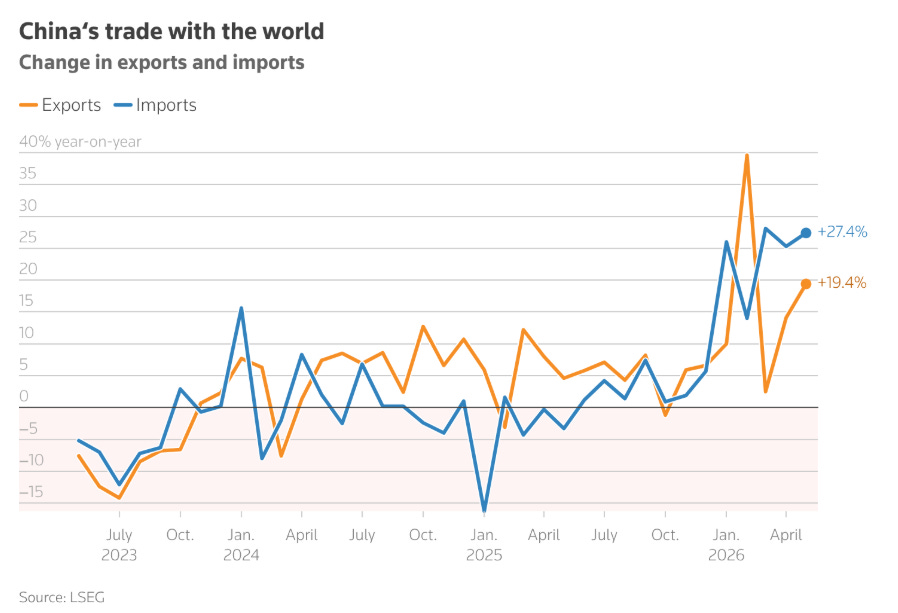
This is a chart of China’s balance of trade, over the past three years. Orange is exports, the percent change from the previous year. Blue is imports.
Can you please point out where the trade war happened? The objective of the new Trump Administration tariffs on China, was to push that orange line, below zero. The EU enacted policies to do the same in European markets: to contain China’s export growth, and thereby protect domestic industry.
But these data through April—two months ago, demonstrate pretty forcefully that the tariffs didn’t work, against China at least, and the CHIPS Act didn’t work, to slow down China in semiconductors, and whatever strategy there was in Venezuela or Iran to damage China’s energy supply chains—that blew up too.
China’s exports of high-tech products rose 51%, ADP equipment up by two thirds, and car exports up 39. The AI boom needs semiconductors, and China builds most of the legacy chips used in electronics.
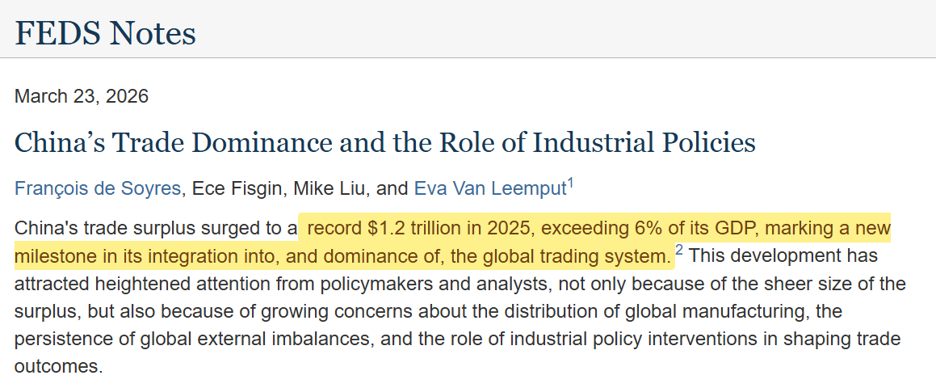
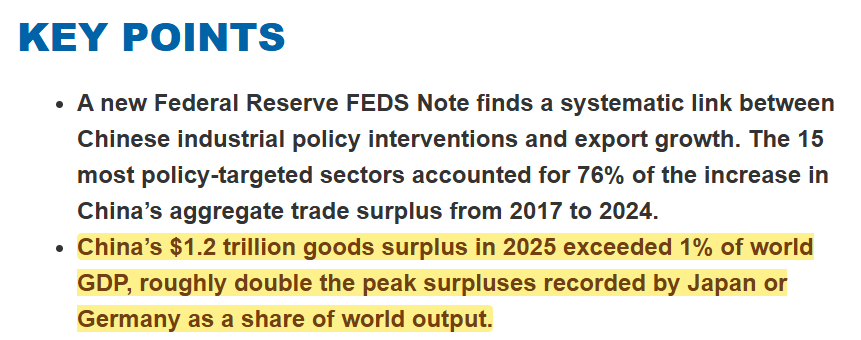
This obviously wasn’t supposed to happen either. From the Federal Reserve: China’s trade surplus was $1.2 trillion in 2025. A “new milestone in China’s integration into, and dominance of, the global trading system.” That was over 1% of world GDP, which is two times the previous record highs, set by Japan and Germany.
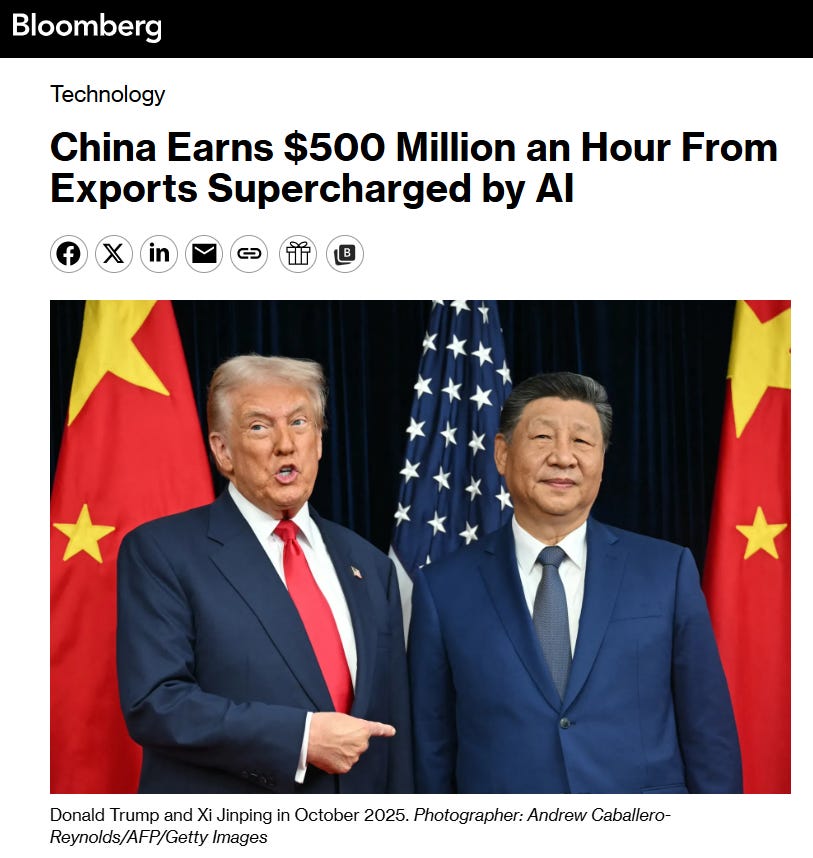
So in April it worked out to $500 million per hour to Chinese manufacturers. Every hour, $500 million move from banks across the world, to banks in Hong Kong and on the Mainland. And that is driven by the high-end, the most expensive products. Integrated circuits, more than doubling since a year ago. Tariffs were zigzagging all over the place, and reached a high at one point of 145%. But the tariffs are irrelevant. In the US, an unhealthy amount of economic growth comes from the investment into new data centers, and they need China to build the equipment for them.
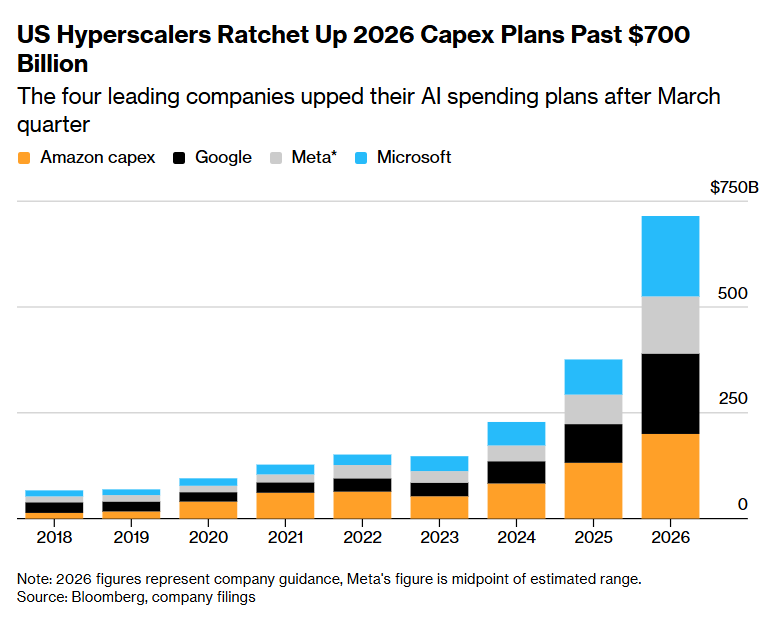
Just those four companies – Amazon, Google, Facebook, and Microsoft – have budgeted over $700 billion in Capital Expenditure for 2026; most of that is for data centers. Chinese companies build the hardware and power systems. And China also makes semiconductors that are in high demand.
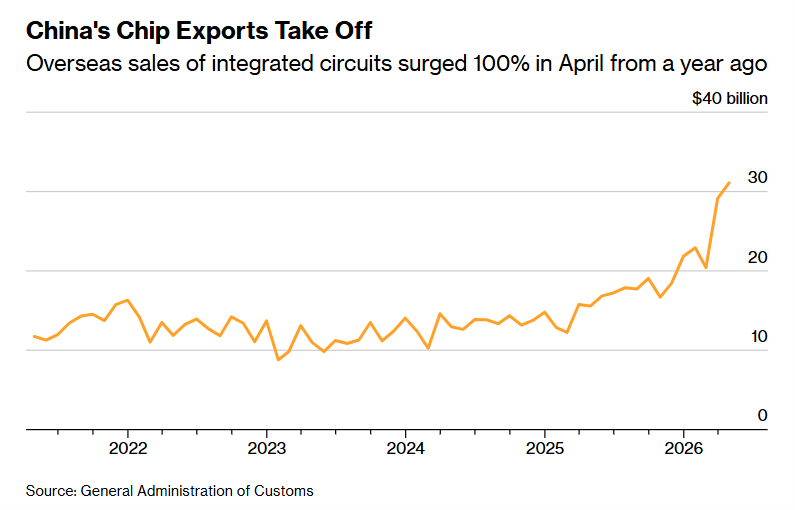
Chips exports more than doubled. Computer equipment parts up 47%. China is also importing a lot of that gear, up 42%.
So Silicon Valley wants to build a lot of data centers, and they’re already falling behind schedule, and need Chinese equipment to bring the few data centers online in the first place.
In 2022, Congress and President Biden signed the CHIPS Act into law. The objective of the CHIPS Act was to prevent China from building semiconductors that can be used even in Chinese AI, let alone for data centers in the US. And it also provided $53 billion in subsidies and incentives to impel manufacturing of semiconductors in the United States.
This is a 14-page PDF from the Congressional Research Service, chronicling the efforts of policymakers in the United States with respect to Chinese semiconductors. For almost a decade, the US government sought to tighten exports of advanced chips; the express purpose is to restrict Chinese access to the technology, and the ability to manufacture it here. And curtailing access to computing and AI applications. Policymakers in both parties have “concerns about China’s efforts to build a home grown and self-sufficient semiconductor” industry.
Here is how that is going:
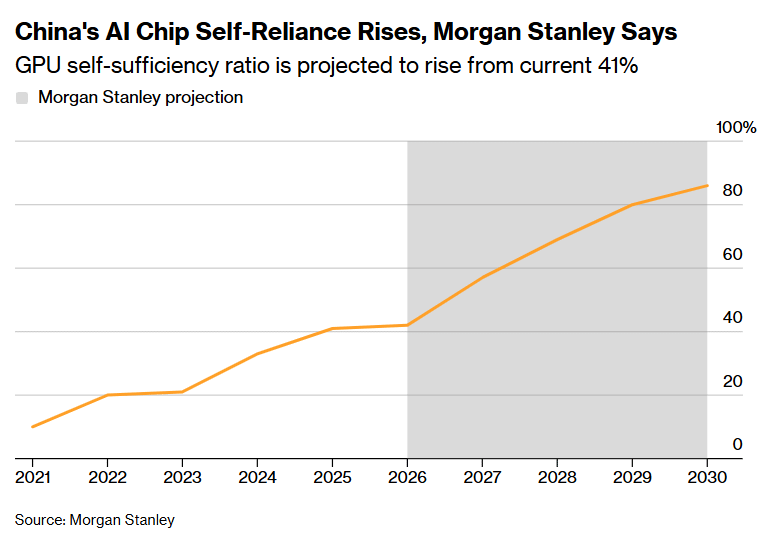
GPU’s are Graphics Processing Units. The most sophisticated semiconductors, powering large language models. When the CHIPS Act was signed, China’s self-reliance in that industry was 20%. Now it’s 41%; more than doubling, and Morgan Stanley projects that will double, again, by 2030.
China is the world’s top supplier of AI products—this report runs 457 pages, and breaks down the artificial intelligence industry into subsectors. Chinese firms are highly competitive in every industry segment, or have already taken it over completely.
Summing up: the objective of all those acts was to prevent China from building an AI industry, at all. The thinking was that China was dependent on Silicon Valley’s top hardware in order to turn their computers on, and they were so far behind on chip design they could never catch up. Even the top people from Silicon Valley were saying that, just two years ago.
But now it’s all the other way around: Silicon Valley can’t build their new data centers without Chinese gear, and it’s Chinese large-language models that are taking over, not just here, but across the world.
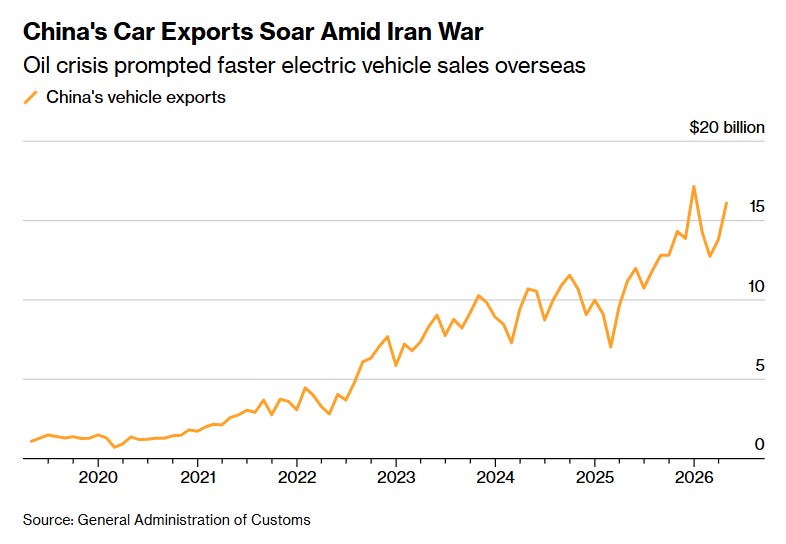
Also in April: China is importing less oil, and exporting a lot more cars.
Then we got the numbers from May. Export growth is accelerating; faster than April. Semiconductors more than doubled again; fastest growth in 13 years.
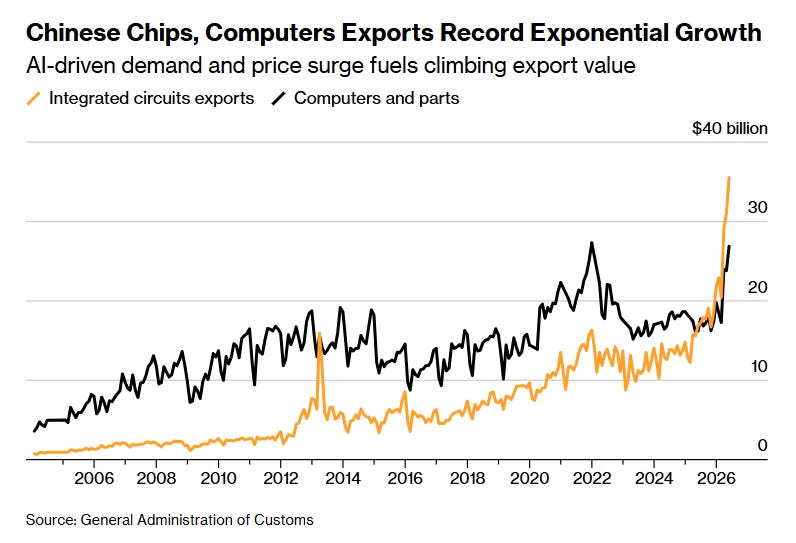
Exports to the US rose 36%, the most since 2021. Makes us wonder what all the trouble was about: 2021 was Joe Biden’s first year in the White House. All the tariffs and trade restrictions from Biden and Trump II, and nothing mattered. Chinese integrated circuits exports were $36 billion. That is three times higher than in 2021 in dollar value terms, and by percentage growth up 36%, also the highest since 2021.
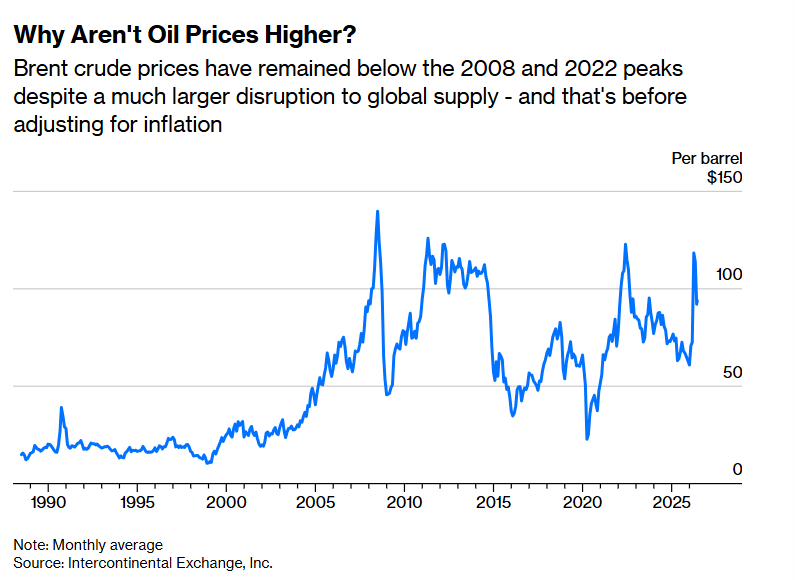
Here is another strange wrinkle. China is importing less oil than anyone predicted. And this is ironically keeping energy prices LOWER everywhere else, than anyone predicted. That’s to say that were China’s oil imports maintained at regular levels, oil prices would be much higher today.
So Venezuela didn’t matter. The war on Iran didn’t matter. Chinese planners knew all along that fossil fuel dependency was a national security issue for them; that reliance was a true vulnerability for them, and that informed their diplomatic efforts with Russia, and their building out of an energy mix that was powered by domestic sources, and renewables. What’s more, they encouraged the electrification of their transportation fleets, and the manufacturing of electric vehicles.
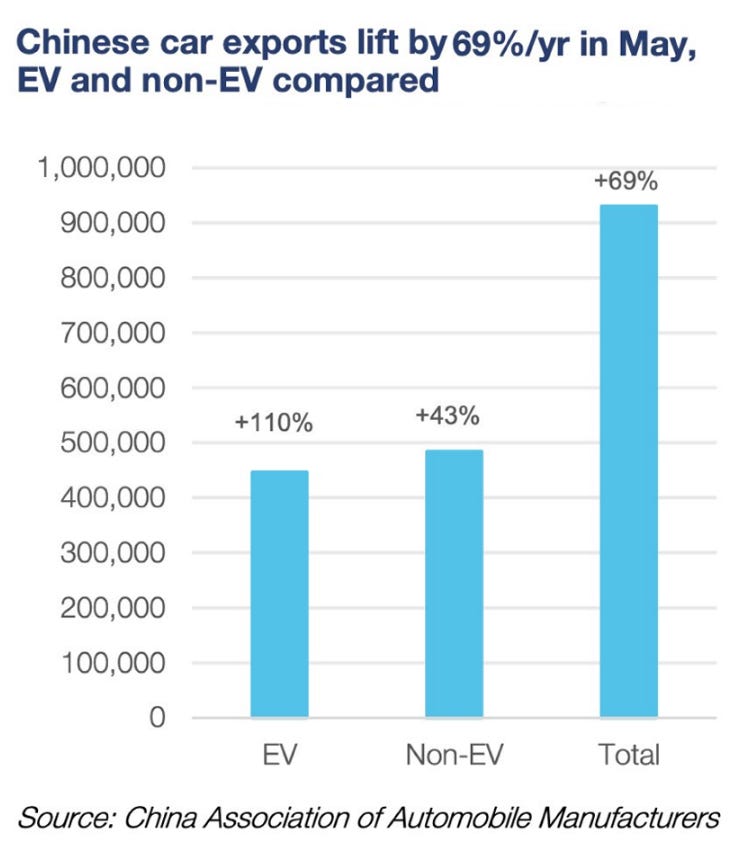
Now the entire world is waking up to those same vulnerabilities. Just a small handful of countries are self-sufficient in energy; ironically the United States is NOT one of the countries. But that means the push now, is global, to do what China did for their energy supply chains, and that means everyone is buying renewable power equipment from China, and electric vehicles from China:
Be Good.
Resources and links:
China rides AI wave as exports surge past forecast
https://www.reuters.com/world/china/chinas-may-trade-data-beat-forecasts-exporters-rush-orders-ride-ai-wave-2026-06-09
AI Supercycle Propels China’s Trade With 111% Boom in Chip Sales
https://www.bloomberg.com/news/articles/2026-06-09/china-s-exports-imports-extend-rapid-growth-as-ai-propels-trade
China Earns $500 Million an Hour From Exports Supercharged by AI
https://www.bloomberg.com/news/articles/2026-05-12/china-earns-500-million-per-hour-from-export-supercharged-by-ai
Artificial Intelligence Index Report 2025
https://hai-production.s3.amazonaws.com/files/hai/_ai/_index/_report/_2025.pdf
China’s Trade Dominance and the Role of Industrial Policies
https://www.federalreserve.gov/econres/notes/feds-notes/chinas-trade-dominance-and-the-role-of-industrial-policies-20260323.html
Congressional Research Services, U.S. Export Controls and China: Advanced Semiconductors
file:///C:/Users/dell/Downloads/R48642.6.pdf
FACT SHEET: President Biden Signs Executive Order to Implement the CHIPS and Science Act of 2022
https://www.presidency.ucsb.edu/documents/fact-sheet-president-biden-signs-executive-order-implement-the-chips-and-science-act-2022
The CHIPS and Sciences ACT of 2022 - The Impact on China
https://www.dorsey.com/newsresources/publications/client-alerts/2022/09/the-chips-and-sciences-act-of-2022
Biden signs order on $52 billion chips law implementation
https://www.reuters.com/markets/us/biden-sign-order-52-billion-chips-law-implementation-2022-08-25/
U.S. Export Controls and China: Advanced Semiconductors
https://www.congress.gov/crs-product/R48642
Chinese EV exports surge as carmakers look offshore
https://www.commbank.com.au/articles/newsroom/2026/06/chinese-ev-exports-surge-as-carmakers-look-offshore.html
Higher Tariffs Here to Stay Despite Trade War De-Escalation?
https://www.statista.com/chart/34447/additional-tariffs-by-the-us-on-china-and-vice-versa-2025
America’s Data-Center Build-Out Is Falling Way Behind Schedule
https://www.wsj.com/tech/ai/americas-data-center-build-out-is-falling-way-behind-schedule-e408a9a8
Eric Schmidt says China can’t catch up to US in AI for 4 reasons
https://www.businessinsider.com/eric-schmidt-comments-china-behind-united-states-ai-2024-5
Silicon Valley is quietly running on Chinese open source models and almost nobody is talking about it
https://www.reddit.com/r/Futurology/comments/1siea6z/silicon/_valley/_is/_quietly/_running/_on/_chinese/_open/
Ten Reasons Oil Is Still Below $100 a Barrel
https://www.bloomberg.com/opinion/articles/2026-06-11/oil-prices-10-reasons-why-oil-is-still-below-100-a-barrel
Inside China / Business is a reader-supported publication. To receive new posts and support my work, consider becoming a free or paid subscriber.
From Inside China / Business via This RSS Feed.