

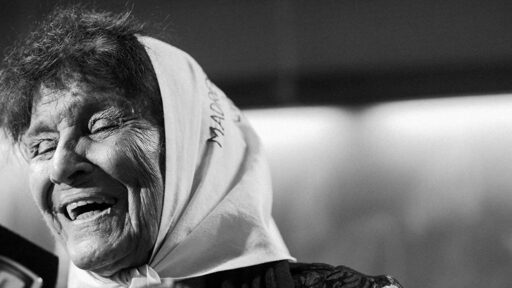
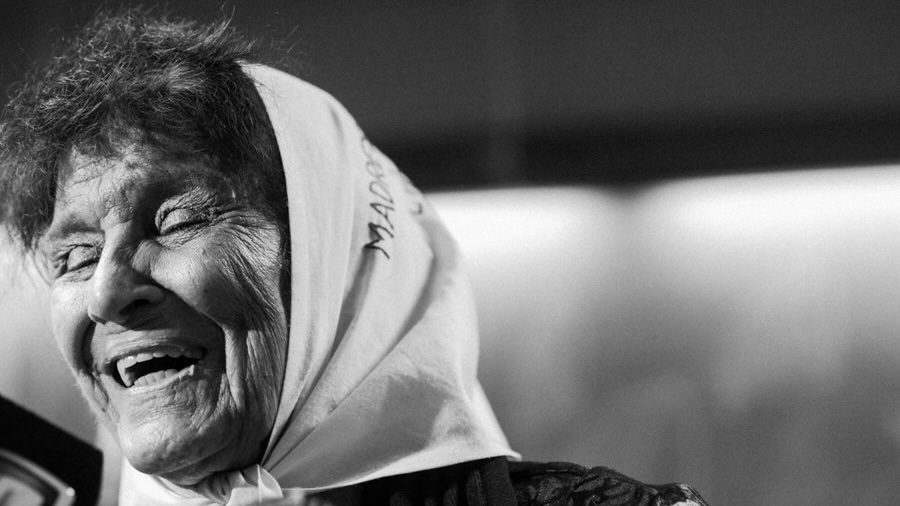
Lidia Estela Mercedes Miy Uranga, popularly known as Taty, president of the Mothers of the Plaza de Mayo – Founding Line, passed away this Sunday at the age of 95. The activist dedicated her life to human rights and to the search for her son Alejandro, who was kidnapped by the Argentine Anticommunist Alliance (AAA) in 1975 at the age of 20 and has been missing ever since. This event made her one of the firmest and most tireless voices in the struggle for memory, truth, and justice in Argentina.
“With profound sadness, we share the saddest news: today, our beloved Taty Almeida, president of the Mothers of the Plaza de Mayo – Founding Line,” the association announced this Sunday. Born in the midst of the Argentine dictatorship, the organization rose up against state terrorism and impunity.
“Thank you for teaching us that to love is to resist, that the only struggle that is lost is the one that is abandoned, and that there is no greater force than love. Thank you for your commitment, your activism, your tenderness, and for every word that will always be a refuge and an embrace … For that unique capacity of yours to make difficult moments lighter without ever losing the depth of your convictions,” the Mothers said in tribute to the movement’s undisputed leader.
“You taught us that the struggle can also be embraced with joy. You also had the enormous wisdom and ability to walk alongside younger generations, always accompanying and listening … We promise to cherish your memory and Alejandro’s, carrying your legacy to every corner. And every time we raise our voices for the 30,000, we will also remember you,” they added in a statement published on social media.
“The search of Lydia Estela Mercedes Miy Uranga began on June 17, 1975, when her son Alejandro disappeared. She never found his remains. An undisputed leader of the human rights movement, she will be remembered as a defender of life,” the newspaper Página 12 published shortly after news of her death.
Taty Almeida was born in 1930 in Buenos Aires and trained as a teacher, a profession she practiced for only a few years. Married to Jorge Almeida, she had three children: Jorge, Alejandro, and María Fabiana.
Four years after her son’s kidnapping, in 1979, she joined the group of women who formed the Mothers of the Plaza de Mayo, and from that point on her search became intertwined with the struggle for memory, truth, and justice. When the Mothers of the Plaza de Mayo split in 1986, she joined the Mothers of the Plaza de Mayo – Founding Line, where she carried out the bulk of her activism.
Unlike some of the other mothers who formed the nucleus of the Plaza de Mayo movement in the early years of the dictatorship, she was born into a military family: her father had been an army officer, and other relatives also had ties to that sector. The kidnapping and disappearance of Alejandro – who worked at Telam and the Military Geographic Institute and was a first-year medical student at the University of Buenos Aires – transformed her understanding of Argentine reality and set her on a lifelong search.
In March of this year, during the inauguration of a permanent exhibition at the General Confederation of Labor (CGT) marking the 50th anniversary of the 1976 coup, Taty Almeida expressed her conviction in the legacy of the Mothers of the Plaza de Mayo Association, thanked the Argentine Forensic Anthropology Team (EAAF) for their work identifying the remains of victims of the genocide, and was moved to tears recalling her son Alejandro. “May God not take me before I can touch his bones,” she said on that occasion.
That day, she also said: “Only three mothers remain,” but declared herself certain that the struggle for memory, truth, and justice would continue in new generations. In February, she had already expressed the same wish to Página 12. “I always say I don’t want to leave without being able to touch even Alejandro’s bones,” she confessed, seated in her apartment in Palermo, just meters from the bed where her son used to sleep.
To Página 12, she also recalled the day that forever changed the life of Lidia Estela Mercedes Miy Uranga, when Alejandro left home at dusk and never returned. “The last thing she heard him say was: ‘Mom, I’ll be right back.’ She looked at the clock and grew annoyed because she was about to serve dinner. Alejandro left. And never came back. That June 17, 1975 marked the beginning of a desperate search for the son who had been taken from her – a search that lasted nearly 51 years and led her to knock on the doors of the most powerful military officials and demand ‘legal justice,’ as she liked to say.”
After joining the Mothers of the Plaza de Mayo in 1979, Taty became, over the years, one of the most recognized and influential voices of the human rights movement in Argentina – a model for the movement and for younger generations.
“Only three mothers and two grandmothers remain,” she said this past April, smiling, as she sat in her wheelchair with her white headscarf, during the honorary doctorate ceremony at the University of Buenos Aires (UBA).
Before hundreds of students and faculty members, friends, family, human rights activists, and social fighters, Taty Almeida declared: “You are the ones who will continue to struggle for memory, truth, and justice.”
That day, amid applause and admiration, she also reaffirmed a love she herself had devoted and never lost. “In me are all the mothers. The mothers who are still here, those who are no longer here, but who will always continue to be here.”
“We must not be afraid of the word militancy. To be a militant is to have commitment. The commitment that the 30,000 disappeared took on, the commitment that so many young people – and not so young people – who are our hope, have already taken on,” declared Taty Almeida that day at the UBA.
“The struggle is not over, the struggle continues,” she emphasized. “Remember what we mothers said and do: the only struggle that is lost is the one that is abandoned.”
teleSUR , June 15, 2026
From BT News via This RSS Feed.