

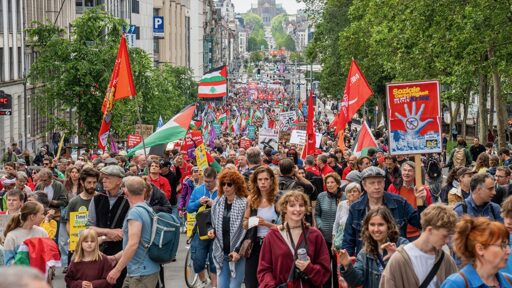
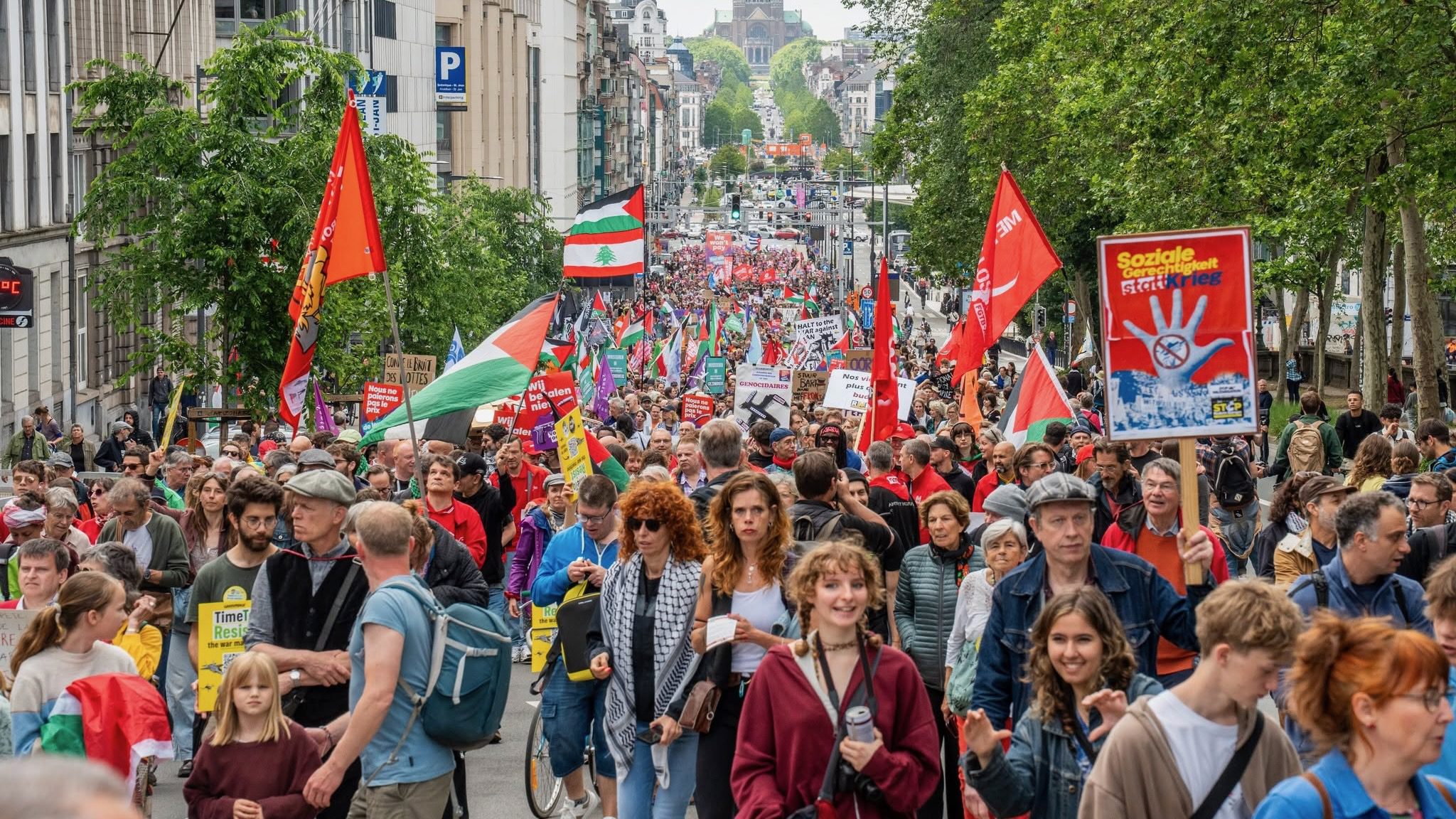
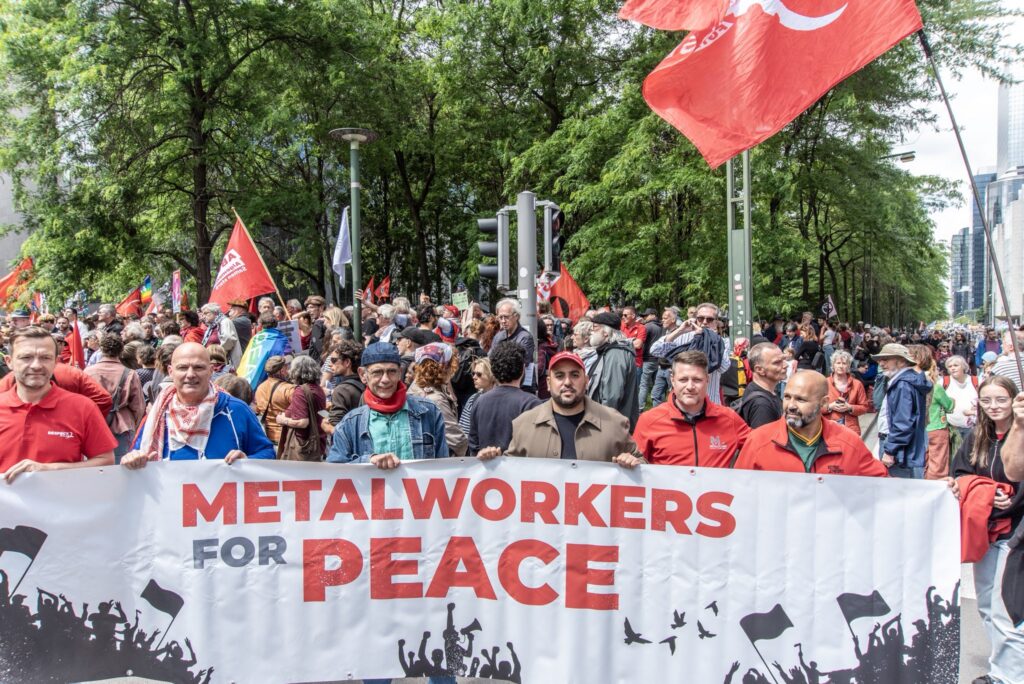
On Sunday, June 14, over 12,000 people joined the “Welfare Not Warfare” protest in Brussels, organized by more than 800 civil society organizations, trade unions, and movements to oppose EU and NATO rearmament. “The coalition rejects the idea that Europe’s security can be bought through a massive rearmament project that starves social budgets and escalates confrontation,” the Stop ReArm Europe platform wrote in the protest announcement.
“Ongoing wars, occupation, genocide, and military violence are shaping lives around the world – from Palestine, Iran, and Lebanon to Yemen, Sudan, and the Democratic Republic of Congo,” Juliette Mattijsen from the People’s Health Movement (PHM) Europe told BreakThrough News following the protest, contextualizing the region’s rearmament drive. “These conflicts are fueled by global systems of militarization, including Western military alliances, arms flows, and direct interventions.”
Earlier this year, PHM Europe dedicated its World Health Day campaign to anti-militarization, calculating how health services could be strengthened by redirecting a fraction of the funds allocated for new fighter jets and tanks. The network highlighted that for the price of just one F-35 plane, 100,000 people in Germany could have access to dental care. The same amount could cover the basic salary of over 5,000 nurses in Spain, or the purchase of 170 PET/CT machines in the Netherlands.
“Right now, EU institutions are shifting public resources toward defense, embedding military priorities across policy areas,” Mattijsen added. “This is reinforced by expanding NATO spending targets, which are rising toward up to 5% of GDP by 2035, and it diverts resources away from health systems, social protection, and climate action,” Mattijsen added.
Expected €100 billion increase to defense budget
“We refuse to accept that young people are cannon fodder and the elderly are budgetary line items,” commented Peter Mertens, general secretary of the Workers’ Party of Belgium (PTB-PVDA), at the protest. “We refuse a future that consists of more weapons and more war, paid for by longer working hours, less health care, and higher bills.”
Mertens joined protesters’ demands that instead of allocating more funds to weapons, the European Union and European governments invest in welfare, including health, education, and housing. This demand is particularly timely given the upcoming European Council meeting on June 18-19, whose agenda includes the EU’s new seven-year budget. Stop ReArm Europe warns that this budget is being shaped to channel tens of billions of euros into the arms industry.
Among other things, the budget aims to increase the space for defense, security, and space under the European Competitiveness Fund to €131 billion. “The jump to €131 billion (152 billion USD) is a net increase of at least €100 billion ($116 billion) over seven years on the current defense and space envelope,” Stop ReArm Europe stated. “That sum could instead fund the salaries of around 300,000 nurses, or build roughly half a million social homes – a quarter of the 2.25 million-unit housing shortfall the European Investment Bank identified for 2025 alone.”
Additionally, the organizations coordinating Sunday’s protest warned that European research programs could be opened to military use, essentially introducing the arms industry into all aspects of life. “Campaigners warn that Europe is embarking on a permanent war economy that deepens conflict rather than resolving them, will further fuel a global arms race, and increasingly embed militarization into everyday life – from renewed conscription and expanded reserves to surveillance and the shrinking of democratic space,” Stop ReArm Europe wrote.
Read more: German students expand their strike against conscription and militarization to 150 cities
Plans to reintroduce conscription or other forms of military service have been floated across the region, meeting resistance from below. Over the past months, students in Germany organized school strikes against conscription, joined by tens of thousands, while trade unions and students in Italy joined forces to oppose the militarization of learning spaces. Unsurprisingly, the topic figured during Sunday’s mobilizations – not only in Brussels, but also in decentralized actions across Europe. “It is a transfer of wealth from life to destruction,” the network Working Class Antimilitarists stated ahead of a protest in Helsinki on Sunday. “It also targets the next generation. A rearming Europe requires soldiers. Young people are asked to fight and die in wars they did not choose. It also leaves an even greater debt to future generations.”
The armament race is largely being funded by taking on additional debt by EU members – debts that will have to be repaid, likely through additional cuts to social services. “Borrowing for arms is also a poor economic decision,” Stop ReArm Europe warned. “Military spending is capital- and import-heavy, so it creates fewer jobs per euro than almost any civilian alternative: studies of military vs. civilian spending consistently find that money invested in care, education, or housing generates 30-50% more jobs than the same sum spent on weapons.”
Read more: Students and teachers in Italy strike against right-wing reforms and militarization
In addition to demanding more investment in welfare, the protest called for the upholding of international law, the prioritization of diplomacy, and investment in international solidarity as an alternative to policies of confrontation. It also proposed pursuing arms control and nuclear disarmament, while pushing Members of the European Parliament to refuse proposed military budget increases at every chance.
“Rearmament is sold to us as security, but the only thing it really secures are the profits of the weapon industries,” Katerina Anastasiou of Stop ReArm Europe emphasized. “A society with crumbling hospitals and a destabilized climate is not secure. Spending billions on arms while squeezing care, education, and cohesion makes Europe poorer and more dangerous, not safer.”
People’s Health Dispatch is a fortnightly bulletin published by the People’s Health Movement and Peoples Dispatch*. For more articles and to subscribe to People’s Health Dispatch, click* here.
Ana Vračar , June 15, 2026
From BT News via This RSS Feed.