

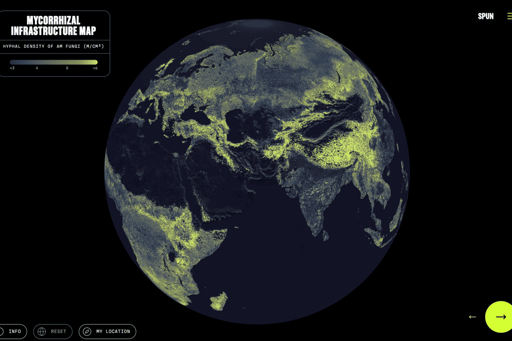
Fungi are living below your feet. Roughly 110 quadrillion kilometers of living fungal threads are woven through the world’s soils. Stretched end-to-end they would cover a distance nearly a billion times that from Earth to the sun. Now, scientists have mapped where those networks are, how dense they are, and what threatens them. Last year, researchers published global analyses in Nature about the diversity patterns of underground mycorrhizal fungal communities along with the Underground Atlas to help decision makers visualize where to prioritize conservation. Now, they ask the question: How much fungal infrastructure exists, and where? A new study published in Science by researchers with the Society for the Protection of Underground Networks (SPUN) and collaborators produced the first global maps of arbuscular mycorrhizal (AM) fungal network density and biomass. “There could be up to 10 meters (32 feet) of mycorrhizal network in just a teaspoon of soil,” lead author Justin Stewart of SPUN said in a press statement. Nearly all land plants live in partnership with arbuscular mycorrhizal fungi. The fungi exchange water and nutrients for carbon made from sunlight. These underground networks act as a living circulatory system for the planet, and the new study found they move an estimated 4 billion tons of CO2 equivalent into soils annually, roughly 11% of global human-related emissions. To build the density maps, the team drew on data from more than 16,000 soil cores collected across nine biomes referenced in 322 published studies. They developed machine-learning models to predict network density…This article was originally published on Mongabay
From Conservation news via This RSS Feed.