

On Saturday night, nearly one week after the second round of Peru’s presidential elections, the National Office of Electoral Processes (ONPE) website showed that far-right candidate Keiko Fujimori was leading with 9,072,289 votes (50.051%). Meanwhile, left-wing candidate Roberto Sánchez had 9,053,801 votes (49.949%), with 98.435% of the ballots counted. This count represented a minimal difference of 18,488 votes between the candidates.
Of the total 92,766 voting station tally sheets, 91,423 were counted, and 1,343 were sent for review by the Special Electoral Jury (JEE) under the category of “flagged” or “contested” due to errors or challenges from the involved parties, Fujimori’s Fuerza Popular and Sánchez’s Juntos por el Perú.
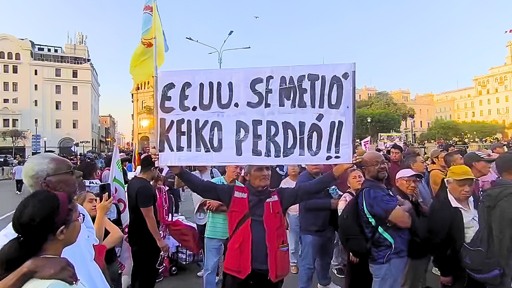
🗳️ #EleccionesPerú2026 🇵🇪 | 🔴 Tras un largo recorrido por el centro de Lima, cientos de manifestantes llegaron hasta los exteriores del Jurado Nacional de Elecciones (@JNE_Peru) en medio de un fuerte resguardo policial.
Exigen que se respete la voluntad popular expresada en el… pic.twitter.com/3Gz5bg36FK
— Ramiro Angulo Machiavello (@RamiroteleSURtv) June 14, 2026
Protests in downtown Lima
On Saturday, June 13, citizens and supporters of the leftist Juntos por el Perú from various regions of the country mobilized in downtown Lima, demanding transparency in the vote count and respect for the popular will.
The protesters marched through downtown Lima and gathered outside the National Electoral Board under a heavy police presence. There, they reiterated their demand that the sovereign will of the people be respected amid allegations of irregularities and Juntos por el Perú‘s request to annul 2,700 polling stations in the US, Argentina, and Peru.
The ONPE finished processing 100% of the outstanding ballots on Friday, leaving a difference of around 18,000 votes between the two candidates. The thousands of votes yet to be confirmed from the flagged and contested ballots will define the presidential race. This review process requires examining ballots one by one, which slows down the announcement of the final result.
On Friday, when reporting the completion of the ballot processing after six days of work, the ONPE clarified that a definitive winner cannot be proclaimed until the Special Electoral Jury finishes analyzing the pending ballots.
Recount proposal rejected
On Friday, Keiko Fujimori rejected a proposal for a complete recount of the votes. This proposal was made by Juntos por el Perú in response to allegations of serious irregularities in the vote-counting process.
Following reports of irregularities, Roberto Sánchez formally proposed to Fujimori on Friday that they jointly request a thorough review and a full recount of the second-round votes. This move aimed to guarantee absolute transparency, legitimacy, and political stability in Peru.
During a press conference, Sánchez stated that he had approached his opponent with this proposal for review, “especially in those cases where there are indications that transparency has not been properly ensured.”
He stated that this joint action would provide citizens with “stability, certainty, and total confidence” in the presidential election, regardless of who ultimately wins.
Allegations of irregularities
Sánchez also denounced that Juntos por el Perú had detected alleged irregularities in Lima and at polling stations abroad, formally challenging the votes cast in the US and Argentina. Meanwhile, Fujimori’s far-right Fuerza Popular intends to annul votes from Peru’s southern regions.
The leadership of Juntos por el Perú condemned the electoral authorities for changing the process in the middle of election day, discarding digital ballot registration in favor of a physical system. The party classified the decision as unacceptable.
Juntos por el Perú also filed an appeal to invalidate 1,751 polling stations in Lima and in the northern regions of Lambayeque, Amazonas, and Áncash. The party argues that irregularities and record manipulation in favor of Fuerza Popular occurred in these regions.
According to the document, the party identified “serious, consistent, and systematic evidence” and repetitive voting patterns directly benefiting Fuerza Popular in districts within those departments.
Financial challenges and security measures
Canceling a polling station in Peru costs 1,375 soles (US$404). On Friday, the National Elections Board (JNE) rejected Juntos por el Perú‘s request for cancellation because the party had not completed payment of 2.4 million soles (US$705,000).
Saturday, the leftist party called on its supporters to make financial donations to fund the cancellation of the polling stations. “Your support is essential to continue defending the popular vote and covering the costs of the legal proceedings before the relevant electoral authorities,” the political party stated. It emphasized that all payment information is disseminated exclusively through the party’s official accounts. They urged Sánchez’s supporters “not to be fooled by fake accounts” and to always verify information before making any contribution.
Given the razor-thin margin of the vote count and the dispute over contested ballots, Lima Mayor Renzo Reggiardo on Thursday asked Peru’s Interim President José María Balcázar and national security forces to reinforce internal order in the capital to prevent potential acts of violence amid the tense atmosphere.
Peru Presidential Elections: Fujimori Leads by Minimal Margin, Sánchez Demands Recount
In a statement through the Municipality of Lima, the mayor reminded the public that a supreme decree extending the state of emergency declared in Lima for 60 calendar days remains in effect. The president implemented this measure supposedly in response to a rise in organized crime.
(Telesur)
Translation: Orinoco Tribune
OT/JRE/SF
From Orinoco Tribune via This RSS Feed.