

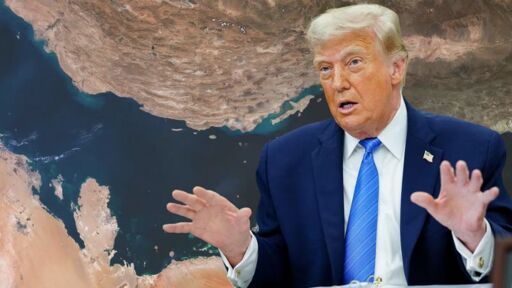
The United States and Iran announced an agreement to extend the ceasefire and reopen the Strait of Hormuz. Trump is presenting it as a victory, but he failed to achieve any of the objectives he set out at the start of the conflict. He emerges defeated from the war he himself unleashed.
The United States and Iran announced on Sunday a “memorandum of understanding” to extend the ceasefire that has nominally been in effect since April 8 by 60 days, reopen the Strait of Hormuz, and lay the groundwork for future negotiations. This is not a definitive peace agreement; for now, it freezes a conflict that began on February 28 and has left thousands dead. As is often the case with Trump’s announcements, different versions and interpretations are circulating. The only thing that is clear now is the date that the agreement will be signed — Friday, June 19, in Switzerland — and the promise of a cessation of hostilities “on all fronts.”
The announcement was first made by Pakistan, the country that has been mediating negotiations between the United States and Iran. Its prime minister, Shehbaz Sharif, wrote on X that “the Peace Deal between the United States of America and Islamic Republic of Iran has been REACHED” and that the ceremony will take place on Friday in Switzerland. Then it was Tehran’s turn: Deputy Foreign Minister Kazem Gharibabadi confirmed that the text of the memorandum “has already been finalized,” though he clarified that the signing does not mean that Tehran trusts “the enemy.” Finally, Trump, who turned 80 this Sunday, celebrated on Truth Social: “Ships of the World, start your engines. Let the oil flow!”
Trump wants to present all this as a triumph. But nothing could be further from the truth: the United States emerges defeated from the war it entered by following Israel’s lead. What it “achieved” with this agreement, according to reports, is a situation worse for the United States than the one that existed before the first bombing. The Strait of Hormuz, whose reopening Trump celebrates as a victory, was open to free international navigation before February 28. Iran promised to curb the development of nuclear weapons, with even greater controls under the 2015 agreement (JCPOA) that Trump himself tore up in 2018. In other words: after nearly four months of war, thousands of deaths, a global energy crisis, and the price of Brent crude skyrocketing to nearly $120, Washington is worse off than before it began.
None of the objectives proclaimed in the early days of the conflict were met. There was no dismantling of Iran’s nuclear program, nor was there regime change. Trump did so without having achieved any of his objectives and with “an Iranian regime that was unwilling to yield.” As Juan Chingo analyzed, the Iranian response deepened Trump’s strategic dilemma: the White House was caught between a high-risk escalation or “implicit acceptance of an agreement far removed from the initial goals of the conflict.” It was this second option that prevailed. The war was, in effect, a strategic trap for U.S. imperialism, eroding precisely what it sought to reinforce: its ability to unilaterally impose regional order.
The domestic factor is also significant: in the United States, the war is unpopular, and the November midterm elections are approaching, a fact that worries many within the Republican Party.
For its part, Iran will reap financial benefits from the potential deal: the release of some $24 to 25 billion in frozen funds (about a quarter of its blocked assets) and the lifting of sanctions on its oil.
Nothing can be taken for granted. Numerous issues remain open for “negotiation” over the next 60 days, and they are no small matters: the future of the nuclear program and the fate of highly enriched uranium; verification mechanisms and who controls them; the timeline for unfreezing funds; a potential reconstruction plan; and sovereignty over the Strait of Hormuz itself, which Iran claims and Washington does not recognize. The accounts differ point by point depending on which of the two sides presents them. Nothing guarantees that this memorandum will not be followed by a state of neither peace nor war, with the uncertainty of when hostilities will erupt again.
The Israel Factor
The interests of the Zionist state are the main source of instability in the region. The agreement was finalized just hours after an Israeli airstrike against Hezbollah in the southern suburbs of Beirut, which nearly derailed the entire process. Trump himself publicly rebuked Benjamin Netanyahu, stating that the attack “should not have happened.” Israel opposes the agreement and refuses to allow the cessation of hostilities to include Lebanon, where it wants to continue advancing. It has never stopped attacking the south of the country and has occupied territory by crossing the Litani River. Tehran, on the other hand, demands that the ceasefire in Lebanon be included in the agreement. The clash between the “ceasefire on all fronts” announced by Pakistan and Israel’s desire to continue its offensive is, today, the greatest threat to the sustainability of the agreement to be signed in Switzerland.
This article was originally published in Spanish on June 15 in La Izquierda Diario.
The post New Ceasefire Agreement in Iran Cements Trump’s Failure in the War appeared first on Left Voice.
From Left Voice via This RSS Feed.