

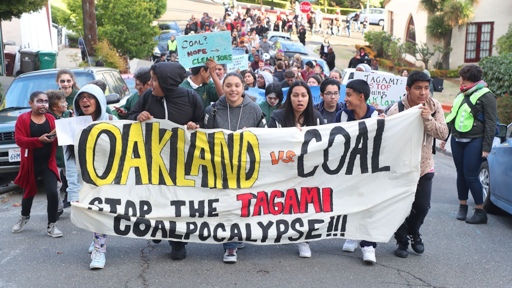
When investor Phil Tagami first proposed building an export terminal in Oakland, California, more than a decade ago, he probably didn’t anticipate the firestorm of litigation and controversy that would follow, in a saga that has now spanned three presidential administrations. There were early rumors that the terminal would export coal, much to the consternation of local residents, but Tagami said in a newsletter that the naysayers were “misinformed.” It was all downhill from there.
Tagami and others entered into a development agreement with the city of Oakland in 2013 after the city decided to redevelop a defunct army base on the city’s west side. At the time, Tagami was adamant that the developers were interested in building an all-purpose bulk terminal and capturing some of the traffic that Oakland was losing to other West Coast ports. But two years later, Oakland residents and environmental groups had their suspicions confirmed when the Salt Lake Tribune reported that the developers had quietly entered into an agreement to use the terminal to ship coal from Utah to buyers overseas. The revelation sparked intense backlash in the progressive city, and the ensuing conflict has put both the developers and the city on the hook for million-dollar losses at various times, though litigation is ongoing.
Now, in the latest twist, the U.S. Department of Energy has stepped in to provide up to $75 million for building the terminal. The funding is the latest effort by the Trump administration to prop up the country’s coal industry — the Energy Department’s announcement last week also included over $400 million in support for coal-fired power plants — even as the fossil fuel’s role in generating U.S. electricity continues to collapse. Over the last year, the administration has loosened regulations that apply to the country’s coal fleet, ordered aging plants scheduled for retirement to keep running, and shifted the responsibility of overseeing coal contamination to states.
The administration also argues that homegrown coal is still valuable abroad.
“For too long, limited West Coast export capacity has constrained America’s ability to move coal and other energy resources to global markets,” said Energy Secretary Chris Wright in a press release announcing the funding. Investing in the terminal would help in “advancing American energy dominance,” he added.
Critics counter that the federal funding is the latest attempt to prop up a dying industry.
Ben Eichenberg, an attorney with the San Francisco Baykeeper, an environmental group in the Bay Area, said that terminal construction “really hasn’t gone anywhere because there’s no money to build” the facility. “The Trump administration stepping in and saying they’re going to supply that money gives it a new lifeline,” he said. “This terminal project was drowning, and they’ve just been thrown the life preserver.”
The Energy Department’s Hail Mary is unlikely to end the embattled terminal’s long saga. After Oakland officials learned a decade ago that the developers intended to transport coal through the terminal, they held public hearings and eventually passed an ordinance and adopted a resolution that barred the storage of coal anywhere in the city. That set the stage for the first round of lawsuits against the city.
Oakland’s development agreement stated that it would provide regulatory certainty for the terminal backers by locking in the regulations that existed at the time. In other words, the city wasn’t allowed to change the rules about what the terminal could be used for after development started. The developers sued Oakland on these grounds, claiming that the city had violated the terms of the agreement by passing the new anti-coal-storage ordinance, thereby affecting the developers’ ability to proceed with their project.
The agreement did, however, make an important exception. New rules can be applied to the terminal if the city determines that the absence of those rules would put the people of Oakland in “substantial danger.” The city had held public hearings and collected evidence of the threat posed by coal dust, but the developers argued that the record was insufficient — and ultimately the judge overseeing the case agreed. He found that “the record is riddled with inaccuracies, major evidentiary gaps, erroneous assumptions, and faulty analyses, to the point that no reliable conclusion about health or safety dangers could be drawn from it.”
Crucially, the judge did not claim that the transport of coal through Oakland does not pose a threat to residents, or that the city didn’t have the right to pass an ordinance banning coal. A higher court also agreed with that decision and affirmed the ruling.
“The fight was not about whether coal is safe or dangerous, but it was about the terms of the development agreement,” said Colin O’Brien, an attorney with Earthjustice, the nonprofit that represented the San Francisco Baykeeper and the Sierra Club as an intervenor in the proceedings.
After suffering a loss in the courts, the city tried a different tack. The developers had signed a lease with the city, which required them to meet certain construction milestones. Because of the years spent litigating the terms of the development agreement, the developers hadn’t begun construction. Oakland officials cancelled the lease on these new grounds, dragging the city into its next round of legal battles. The developers sued in state court in 2018, arguing that the city’s own decisions had prevented them from meeting the construction deadlines. The court once again sided with the developers, as did a higher court on appeal last year.
By then, Insight Terminal Solutions, the company that was slated to operate the terminal, had filed for bankruptcy in Kentucky and decided to pursue claims against the city. During the bankruptcy proceedings last year, the company claimed that the protracted legal battles with Oakland were to blame for its financial woes — and that it was owed more than $650 million in damages. A sympathetic bankruptcy court judge agreed with the firm’s rationale, but on appeal in a federal district court, the ruling was vacated late last year, much to the historically cash-strapped city’s relief.
Despite the influx of federal support for the terminal, the project’s backers still have a long road ahead. The terminal needs to secure a range of permits, including air quality permits from the Bay Area Air Quality District, and local advocates have already mounted a campaign to require stringent regulations for the facility. (Tagami and another representative of California Capital & Investment Group, the lead developer of the project, did not respond to multiple requests for comment.)
For their part, environmental groups are keeping a close eye on the permitting process.
“We’re going to do everything in our power to protect the community in San Francisco Bay from the pollution that this coal terminal represents,” said Eichenberg. “We’ll be evaluating all of those permits and any additional action that we can take to protect the community and fulfill our mission.”
Editor’s note: Earthjustice is an advertiser with Grist. Advertisers have no role in Grist’s editorial decisions.
This story was originally published by Grist with the headline Even $75M from Trump may not save Oakland’s embattled coal terminal on Jun 15, 2026.
From Grist via This RSS Feed.