

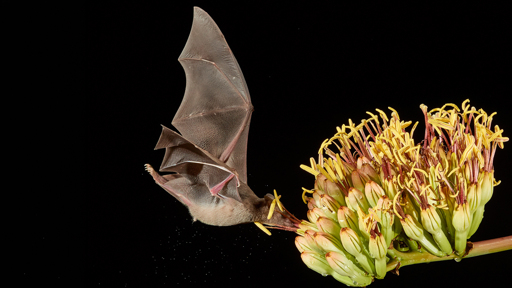
A Mexican long-tongued bat, featured above, flies into the blooms of an agave plant, a feeding and pollination technique used to reach nectar. The bats (Choeronycteris mexicana) have unusually long tongues to access nectar while their impact spreads pollen grains everywhere to pollinate nearby agave. Peter Hudson, a professor of biology at Penn State University, U.S., photographed the moment in 2019 in Arizona’s Sonoran Desert near the U.S.-Mexico border. The region is a biodiversity hotspot, home to native species including trogons and black-tailed jackrabbits (Lepus californicus). “These bats just go, like little kids on a sugar rush,” Hudson told Mongabay by phone. “They’re taking in so much of this rich sugar stuff that they’re flying about doing happy laps, as it were, in the sky.” The bats’ long tongues can extend nearly 8 centimeters (3 inches) from their body and are covered in hair-like protusions, papillae, that help it drink nectar from flowers. They primarily feed on agave nectar, cactus flowers, soft fruits and the occasional insect. Hudson used a movement trigger and flash to snap the moment. “It all happens so fast,” he said. “You have to get the bat as it’s coming into the plant and see if you can capture it as it hits the plant.” The agave plant is used to make tequila and mezcal, Mexico’s national spirit. As demand for export has increased, the country has experienced a more than 700% surge in mezcal production in the past decade. The jump in demand for Mexican…This article was originally published on Mongabay
From Conservation news via This RSS Feed.