

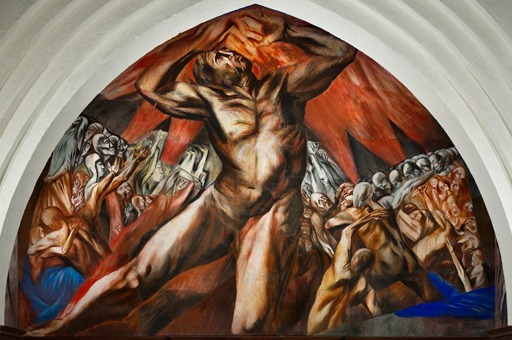
This article by Liliana García Sánchez originally appeared in the June 14, 2026 edition of La Jornada, Mexico’s premier left wing daily newspaper.
“A painting should not be a commentary, but the fact itself; not a reflection, but the light itself; not an interpretation, but the very thing to be interpreted. The only emotion it should generate and transmit is that which derives from the purely plastic phenomenon.”
Justino Fernández used to say that Orozco’s painting contains signs whose message does not leave the public at peace; it is an expression of the consciousness of his time. A body of work far from the “narcotizing” and decorative effect, Orozco’s expresses the signs of “a world burning in hatred, in a war of extermination, of tragedy and pain. An art of cultural crisis.” And although Fernández wrote these ideas in 1942, today, in the middle of the 21st century, this situation is no different. Orozco’s currentness continues to discomfort, to question, to subvert the signs of our time, placing us before a terrible, and unsettling, mirror.
A taciturn man, an enemy of exhibition and spectacle; he listens attentively, he is clear and concise in his opinion. Character traits of the artist consistent with his visual poetics.
Born in Ciudad Guzmán, Jalisco, on November 23, 1883. A child who in the capital used to stop at the windows of the Vanegas Arroyo printing house to watch Posada work, as if witnessing a revelation. From then on, he would search enthusiastically, among charcoal, paper, and color, for his own language. Working as a draftsman he paid for his studies at the Academy of Fine Arts in the time of Antonio Fabrés; the drawing classes warmed by Gerardo Murillo’s voice awakened in him ideas and motives. Orozco roamed the streets and humble neighborhoods of the city, observing prostitutes, children, dogs, cantinas. “A first step, still timid, toward a liberation from foreign tyranny.” Far from reproducing the sweet and luminous colors of the impressionism then in vogue, he would continue the search for that own language.
“I preferred black and the earthen tones excluded from the impressionist palettes. Instead of red and yellow twilights, I painted the pestilent shadows of closed rooms, and instead of indios in baggy trousers, drunken ladies and gentlemen.”
Under Victoriano Huerta’s command, Mexico City was infested with gambling houses, cantinas, and pulquerías; the nightlife of a city deformed by the recent Decena Trágica; “urban purgatories” of a Mexico convulsed by violence, where no pure line fits, nor smile without sarcasm
Images of the Anti-Ideology
Violence, anarchism, subversion, intact powers of aesthetic resistance: “No to the great modern simplifications, no to the official version of our history, no to clericalism, no to the bourgeoisie, no to the sects.”
Cardoza y Aragón affirms: “Mexico found in Orozco the artist on the scale of the drama it was living,” a terrible gaze. If the drama was of apotheotic proportions, so should be the plastic emotion expressed. Rebellious and independent of schools and pictorial traditions, an artistic mission against the cosmetics of official history; he does not glorify misery nor pain, he expresses Humanity in the broadest sense, and Emotion as one of the forgotten forms of knowledge, the “transcended emotion.”
I will comment on three examples in two lithographs and one engraving:
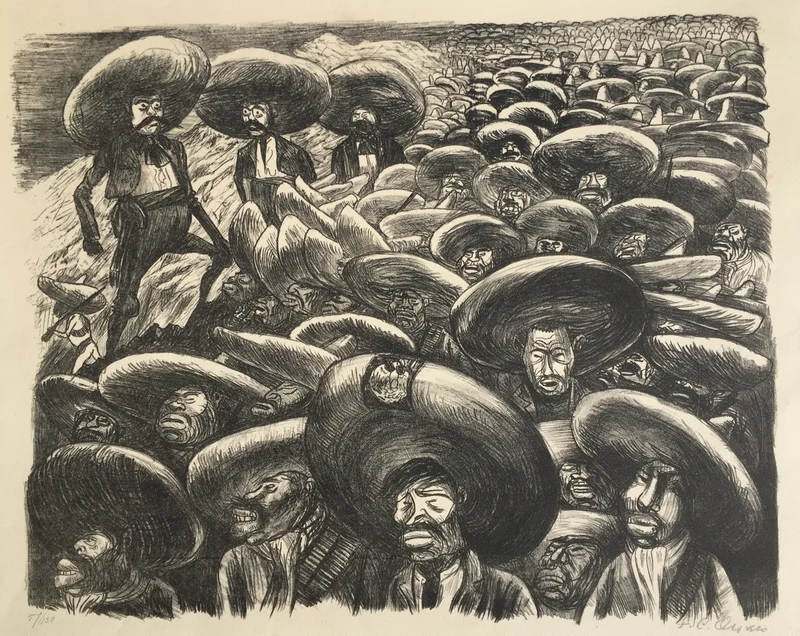
Zapatistas (1935) shows tired, exhausted, sweaty, frayed troops. A realist gaze on the Revolution from the human side: bewildered soldiers, with hungry and thirsty eyes, but also of horror, of hatred or of disbelief;
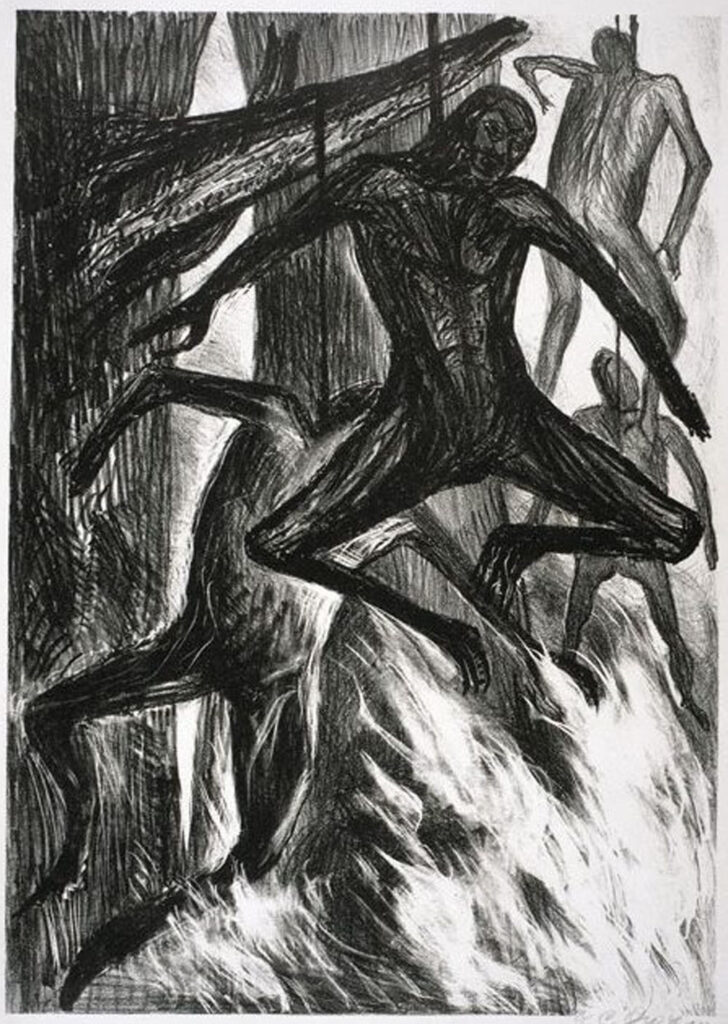
Lynching (1930), in the words of some, “the most horrifying of his images”; the drawing was tucked away in a gallery in the United States until Álvaro Carrillo Gil recovered it for his collection. A charred body that hangs from a tree, swings rigid and expressionless; almost a blackened and stiff skeleton. A grotesque but eloquent print of a violence that is not exclusive to those times.
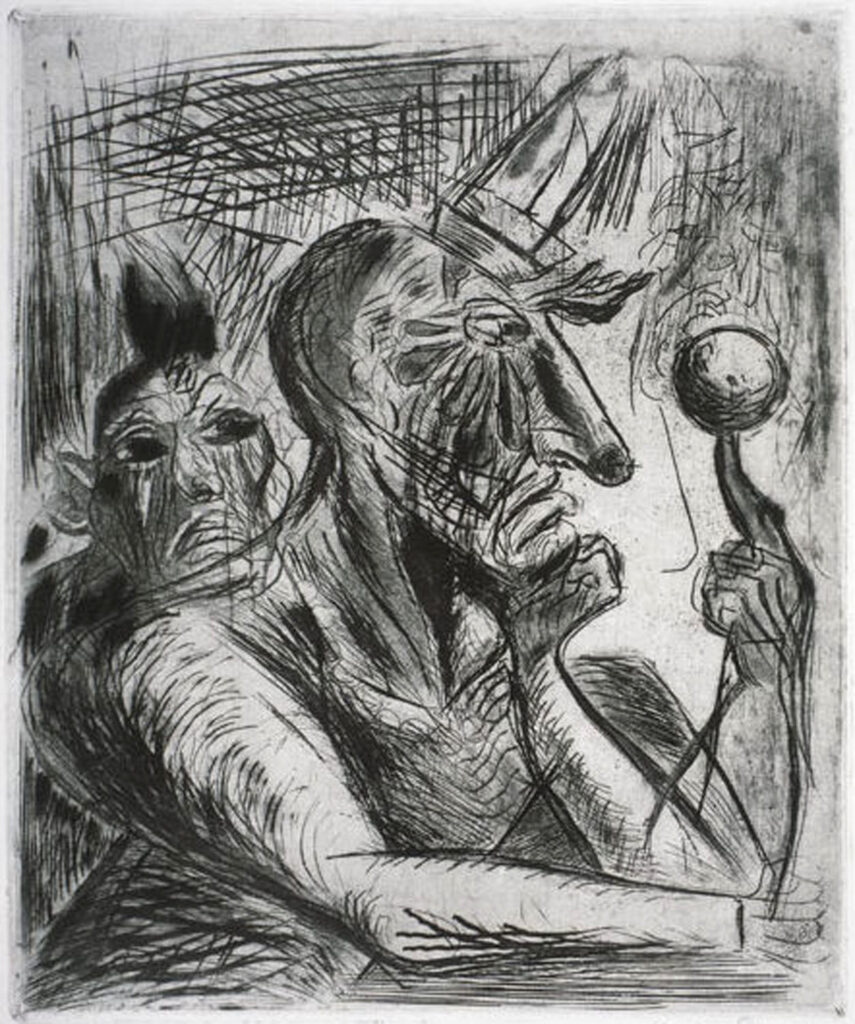
Payaso y mundo, Orozco
The Clown and the World (1944). Although Orozco’s trip to San Francisco is marked by the infamous destruction of 60 paintings at U.S. customs, there he would find a new carnival for his eyes. With the First World War as the backdrop, he travels to New York, drawn by the Harlem neighborhood and Coney Island, where freaks, tattooed sailors, and flea circuses surprise him.
The Clown and the World is an extraordinary metaphor for the human condition. In a disenchanted attitude, the circus clown observes a small planet Earth that spins on the tip of his finger. The presence of another clown in the background may be spectator humanity, watching the artist perform his arduous task of contemplating the world, making it turn under its own forces.
“What is worth is the courage to think out loud, to say things as they are felt at the moment they are said. To be daring enough to proclaim what one believes is the truth, regardless of the consequences and let the chips fall where they may. If one were to wait to have the absolute truth in hand, one would either be a fool or one would become mute forever. The world would stop in its march.”
-
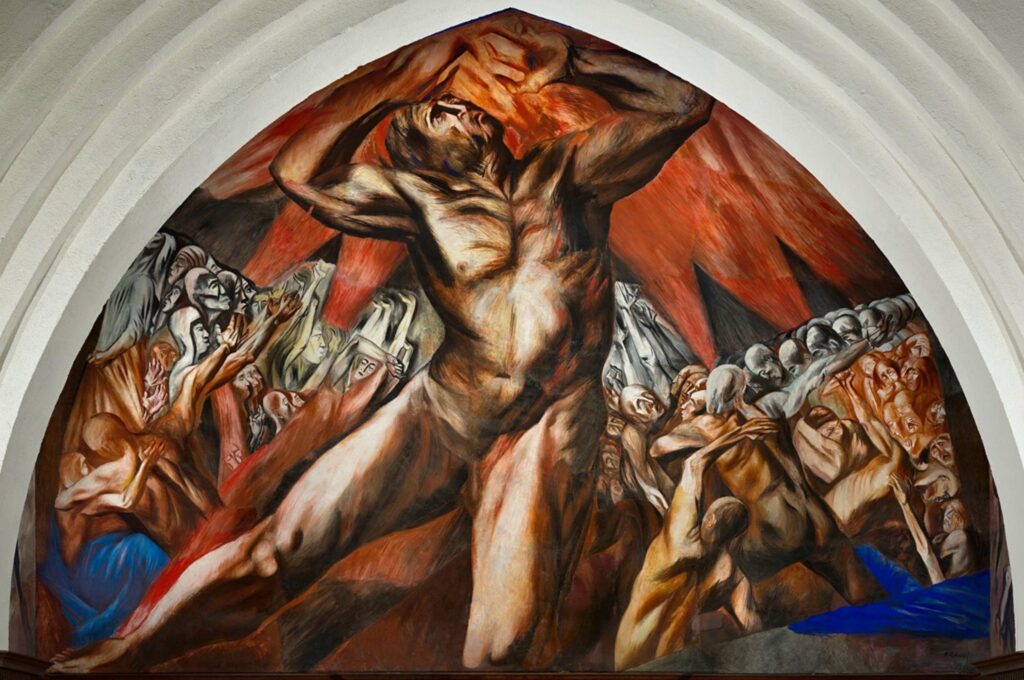
José Clemente Orozco. The Terrible Gaze
June 14, 2026June 14, 2026
Justino Fernández used to say that Orozco’s painting contains signs whose message does not leave the public at peace; it is an expression of the consciousness of his time.
-

Sheinbaum Delivers Power Plant; Without the CFE There Would Be No Sovereignty, She Stresses
June 14, 2026June 14, 2026
This is the fifth plant installed in the country to generate cleaner energy, adding 357 megawatts to the General Manuel Álvarez Moreno thermoelectric complex.
-
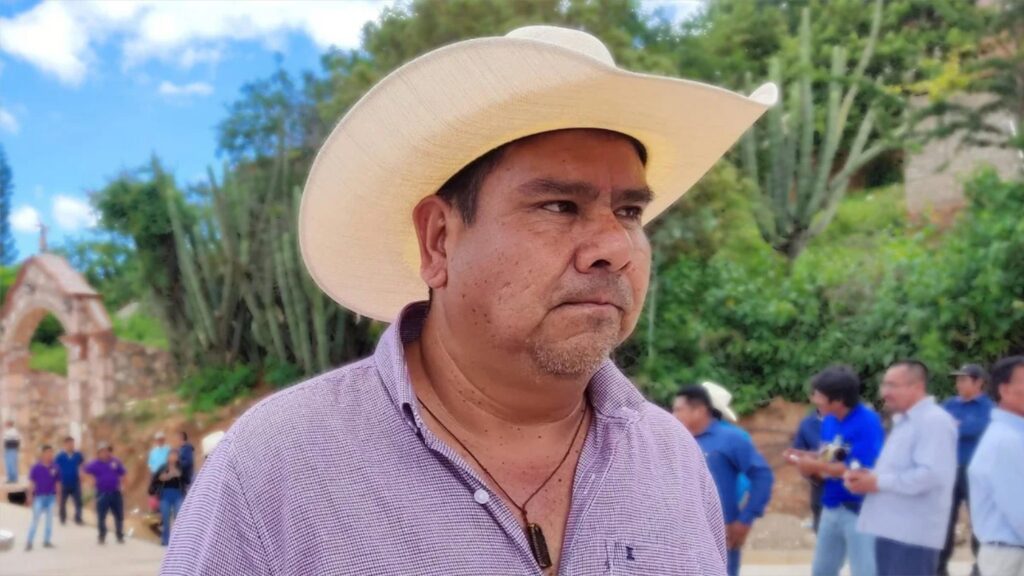
Mayor of San Miguel Amatitlán, Oaxaca, Shot Dead; He Was Attacked Upon Leaving His House
June 13, 2026June 13, 2026
Joel Ángel Bravo Martínez, mayor of San Miguel Amatitlán in Oaxaca’s Mixteca region, was shot dead leaving his home.
The post José Clemente Orozco. The Terrible Gaze appeared first on Mexico Solidarity Media.
From Mexico Solidarity Media via This RSS Feed.