

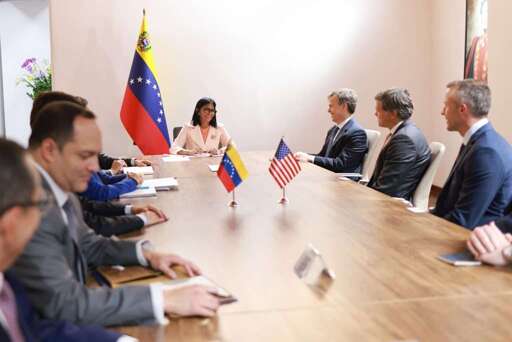
The acting president of Venezuela, Delcy Rodríguez, held a review meeting on the bilateral energy agenda with an official delegation from the United States Energy Department.
At the meeting held on Friday, June 12, the US delegation was represented by the senior policy advisor of the Energy Dominion Council, Toby Deen; the acting under secretary of the Department of Energy, Andrew Rapp; and US Chargé d’Affaires John Barrett.
On the Venezuelan side, in addition to the acting president, the meeting was attended by the sectoral vice president of Economy, Calixto Ortega; the minister of Hydrocarbons, Paula Henao; PDVSA President Héctor Obregón; PDVSA Executive Vice President Jovanny Martínez; and the deputy foreign minister for Europe and North America, Oliver Blanco.
The meeting was part of the reestablishing of diplomatic and consular relations with the US formalized on March 5. According to the official statement, with this meeting, Venezuela reaffirmed its goal of establishing itself as a safe, stable, and reliable supplier in the international energy market.
On May 27, the acting president, in the context of the National Pilgrimage Against Sanctions and direct contact with the country’s productive sectors, sent a direct message to the governments of the United States and European countries that maintain unilateral sanctions on Venezuela, urging them to lift the economic blockade and to move past confrontations.
“We, as part of our diplomatic agenda with the United States, with Europe, with governments that have joined in sanctioning Venezuela, declare: Do not be afraid of a Venezuela without blockade. Do not be afraid of a Venezuela without sanctions, because the Venezuelan people in their history have shown friendship with other peoples, have shown cooperation with other peoples,” she had said.
Despite the national government’s assurances that all these actions have the wellbeing of Venezuela at their core, many within the Chavista ranks are increasingly viewing the agreements and agendas with the US authorities and multinational corporations with suspicion and worry, as they come amid controversial administrative shifts emerging in a landscape deeply altered by the US military invasion of January 3, when US forces kidnapped President Nicolás Maduro and First Lady Cilia Flores and killed more than 100 people, including 32 Cuban and 47 Venezuelan soldiers.
In the post-January 3 period, the Venezuelan government has enacted several controversial measures that, according to critics, reflect US interference in Venezuela’s internal affairs.
Translation: Orinoco Tribune
OT/SC/DZ
From Orinoco Tribune via This RSS Feed.