

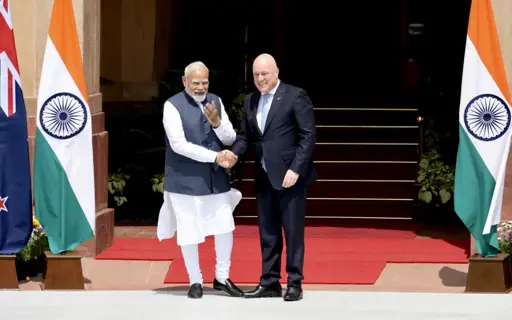

“The government is aggressively utilising Te Tiriti to secure elite global market access, while actively dismantling the domestic legal architecture that is required to give the text any real meaning,” writes Nicola Hoobin about NZ trade agreements such as the one signed with India this year. (Photo: RNZ Marika Khabazi)
Aotearoa is facing its sharpest constitutional crisis in modern history, as the government professes adherence to Te Tiriti abroad while dismantling it at home, writes international legal practitioner Nicola Hoobin.
The coalition government appears to have overlooked a profound legal contradiction as it methodically advances its legislative programme to review, alter, or strip Te Tiriti clauses across 19 separate acts of parliament.
While the government is busy dismissing Te Tiriti at home as a flexible, non-binding political instrument that can be unilaterally dismantled by a simple parliamentary majority, it seems to have forgotten that in international trade agreements, it continues to treat the document as a rigid, foundational constitutional pillar.
In other words, the government is attempting to maintain an impossible double standard.
The smoking gun of this constitutional duplicity sits directly within New Zealand’s premier international trade instruments.
These are Article 20.2.1 of the European Union-New Zealand Free Trade Agreement (signed in July 2023) and Article 26.2.1 of the United Kingdom-New Zealand Free Trade Agreement (signed in February 2022).
To secure unprecedented market access to the European single market and post-Brexit Britain, the Crown formally executed binding international texts. In doing so, it explicitly, deliberately, and repeatedly assured our global trading partners that:
“te Tiriti o Waitangi / the Treaty of Waitangi is a foundational document of constitutional importance to Aotearoa New Zealand.”
Far more than empty diplomatic prose, this is an enacted, state-sanctioned admission within international treaties. Under international law, the doctrine of pacta sunt servanda (agreements must be kept) dictates that treaties must be performed in good faith.
The Crown can’t, in good faith, represent Te Tiriti to the international community as a permanent document of “constitutional importance” to secure lucrative market access, and then turn around domestically to claim it has a democratic mandate to systematically strip that very same constitutional fabric from our statutory architecture.
In public international law, this triggers a principle akin to “estoppel”, which means that a sovereign state can’t blow hot and cold on its foundational legal obligations to suit its immediate economic or political convenience.
Te Tiriti in trade agreements
The EU and UK agreements represent a radical, modern departure in New Zealand’s trade agreement architecture.
In these two agreements, the Crown has shifted from using the Treaty as a passive domestic shield to using it as an active diplomatic marketing asset.
Compare the language of “constitutional importance”, for example, with New Zealand’s foundational 1983 Closer Economic Relations agreement with Australia, which contains absolutely no mention of Te Tiriti o Waitangi.
By explicitly elevating Te Tiriti to a “foundational document of constitutional importance” in modern texts to secure premium global market access, the executive drew a clear, contemporary line in the sand — one that it can’t now legally or logically erase.
Potential for diplomatic friction
The legal mechanics of how these international commitments interact with dispute resolution are also revealing.
In the UK-NZ FTA, Chapter 26, which relates to Māori trade and economic cooperation, is explicitly carved out from the agreement’s formal, binding state-to-state dispute settlement mechanism.
This structural separation means that a failure to cooperate under the terms of the Māori trade chapter can’t trigger formal international trade sanctions or panel arbitrations.
By contrast, the EU-NZ FTA approaches compliance through a highly tailored, progressive framework. While the broader interpretation of the Treaty of Waitangi itself remains shielded from standard commercial arbitration panels, the commitments embedded within Chapter 20 (Māori Trade and Economic Cooperation) are subject to specialised bilateral consultation mechanisms.
The EU agreement establishes a dedicated institutional dialogue where compliance with the spirit of the Indigenous chapter is under continuous review. This creates an active international forum.
If domestic rollbacks undermine Māori economic interests, data sovereignty, or environmental guardianship, it invites direct diplomatic friction and specialised dispute-consultation mechanisms with Brussels.
Lest anyone think this international double standard is a relic of previous administrations, the government’s actions in New Delhi show the pattern is alive and well.
In signing the landmark New Zealand-India Free Trade Agreement in April this year, the current coalition government exported the Treaty yet again, embedding a dedicated “Cultural, Traditional Knowledge and Economic Cooperation Chapter” that requires all actions to be executed in a “manner consistent with the Treaty of Waitangi”.
The Crown continues to play a calculated game.
Although, once again, the chapter is safely insulated from formal international dispute penalties, the contradiction it presents to domestic strategy creates a fatal blind spot.
In New Zealand public law, courts frequently look to international treaties signed by the executive as extrinsic evidence to interpret the scope of the Crown’s fiduciary obligations.
So, for example, if iwi launch judicial reviews against the rollbacks of the 19 targeted statutes — which cover critical resource management, biosecurity, and primary industries — the FTA texts become powerful legal levers.
The Crown cannot easily look a High Court judge in the eye and argue that statutory Treaty obligations are vague, unworkable, or a threat to democratic certainty when the executive branch has formally executed international documents telling the UK and EU the exact opposite.
The explicit acknowledgments in the EU and UK agreements effectively block the Crown from downplaying the constitutional status of Te Tiriti in a domestic courtroom.
This inescapable double standard shifts the ultimate burden of accountability from global panels directly onto our domestic judiciary.
Will the New Zealand courts now hold the Crown strictly accountable for its own international admissions, enforcing the principle that a sovereign government can’t legally define Te Tiriti as a cornerstone of our constitution to the rest of the world while treating it as entirely disposable at home?
Indefensible urgency
With a general election approaching in November, the government is operating within a rapidly shrinking legislative window.
As constitutional conventions require a shift towards a caretaker government framework in the coming months, the use of urgency motions to fast-track these 19 statutory rollbacks becomes increasingly indefensible.
The international community is watching.
If the Crown continues to treat its constitutional partnership with Māori as a disposable asset at home, it risks compromising New Zealand’s standing as a trustworthy partner in global trade, diplomacy, and international law.
Nicola Hoobin is an international lawyer specialising in public and private international law, cross-border wealth, international rights, and the protection of art and cultural heritage. She has offices in Auckland and Melbourne, and holds a Bachelor of Laws from the University of Auckland, a Master of International Laws (LLM) from the Australian National University, and postgraduate qualifications in the Laws of the European Union from the European University Institute in Florence, Italy.
The post Te Tiriti duplicity: honoured abroad but dismissed at home appeared first on E-Tangata.
From E-Tangata via This RSS Feed.