

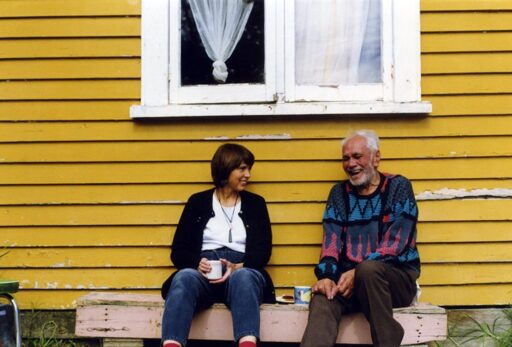

Dr Clare Ward became a Hokianga GP in the early ’90s. She’s pictured here with her close friend and patient, the late Pou Rakena, sitting outside his home in Mangamuka. (Photo supplied)
When Clare Ward, a Pākehā doctor, moved to Hokianga three decades ago, she was a townie who knew little about the Māori world. Now 77, and still working as a GP, “Kahurangi Rata Clare” — the esteemed Dr Clare — has written a memoir, A Place to Stand: A country doctor’s life.
She spoke with Atakohu Middleton about how she found her place in a largely Māori community.
In 1981, Clare Ward was among the thousands of New Zealanders who took to the streets to protest against the Springbok rugby tour.
Taking a stand against apartheid South Africa and its whites-only rugby team was a no-brainer for the Auckland University student: “I didn’t think we should be participating in a racist sport.”
Standing shoulder to shoulder with Māori during the protests, she felt a sense of solidarity and unity. But, looking back, Clare says she had little knowledge or understanding of Māori culture or values. The Māori around her were fellow students, fellow workers, or fellow protesters, rather than a people with their own ways of seeing and being.
Clare had grown up in a Pākehā bubble where Māori were usually a disadvantaged other, and like many New Zealanders, she had a superficial understanding of what happens in the Māori world.
“I think it’s possible to work and exist beside another culture without having much comprehension of what goes on within that culture,” she says. “You can have a superficial knowledge of things without really knowing anything much.”
We’re having our kōrero on Zoom. I’m in Auckland, and she’s in a book-filled room at home in Rawene, a settlement of about 500 people on the south shore of the Hokianga Harbour, where she lives with her partner, Les Carr, a beef farmer.
The thoughtful and softly spoken Clare is held in high regard in Hokianga. For the past 30 years, she’s been a general practitioner with Hauora Health, a community-owned kaupapa Māori service that runs Rawene Hospital and nine outlying clinics. More than 7,000 people are on its books, and 74 percent of them are Māori. The vast majority face significant health issues.
Patients call her “Dr Clare” or “Whaea”, but she’s also known as “Kahurangi Rata Clare” — the esteemed Dr Clare — a name given to her by one of her colleagues.
Clare works part-time these days, serving patients primarily through clinics in Kohukohu and Mangamuka. That’s given her time to work on her first book, A Place to Stand, out this week.
Although it’s billed as a memoir, that label isn’t quite expansive enough. Clare has long been a keen creative writer and poet, and her story of learning to serve the people of Hokianga unfolds in poignant, dramatic, and reflective vignettes.
The book is a love letter to Hokianga and its people. It’s full of atmospheric black-and-white portraits of people and landscapes, mostly by Clare, whakataukī (sayings in te reo Māori), and philosophical musings.
A Place to Stand is also about Clare’s awakening to the Māori world and what it means to live biculturally and respectfully. As she writes: “It was not until I came to Hokianga that I understood how much I did not know and had not thought about.”

The mouth of the Hokianga Harbour (Photo: Clare Ward)
Clare was born in Nelson, the eldest of four children. She grew up in “a totally Pākehā environment”, barely aware of the Māori world. Her mother, Patricia, a physicist turned high-school teacher, was of Irish heritage, and her father, Noel, whose occupations over time ranged from tomato grower to lace dyer to stained-glass window repairer, had English roots.
Education was valued, and at the University of Auckland, Clare earned a PhD in zoology. She was active in student politics, becoming president of the Auckland University Students’ Association in 1974.
But a career in a lab didn’t appeal, so Clare, then in her late 20s, trained as a doctor. After graduating, she worked in a variety of areas, including general practice, paediatrics, obstetrics, and child protection.

Clare completed a PhD in zoology before she trained as a medical doctor. Here, on the day she graduated as a doctor, she wears regalia acknowledging both qualifications. (Photo supplied)

Clare during her years in obstetrics. (Photo supplied)
The turning point came in 1987, when Clare, 38, spent three months at Hauora Hokianga, filling in for a friend. She fell in love with Hokianga’s natural beauty and did more locum stints there, feeling “some other breath of fresh air coming through my life, widening my horizons”.
Back in Auckland between locums, Clare couldn’t stop thinking about “things like the sun, the moon and the stars”, she says. “And that’s what I chose — the sun, the moon and the stars. I’ve never really regretted that, ever.”
She also remembered the words of a woman she’d met in Hokianga, the late Matekino Makene, who told Clare that she would need to learn te reo Māori when she returned to Hokianga.
“She was saying two things there. One was: ‘You’re going to come back.’ But the second was: ‘l want you to understand me.’”
Clare returned to Hokianga for good four years after her first visit — but not before taking a university paper on te reo Māori to give herself a good grounding.
She says that while she sometimes felt culturally clumsy in her early days, she never felt rejected. As a GP in Hokianga, she was in a privileged position. Her medical services were needed, so the locals were forgiving as she learned about tikanga. They’ve been equally kind to other non-Māori doctors.
“They make a lot of room for people who are clumsy, make mistakes, do things wrong. They figure out that you’re coming from a place of wanting to do the right thing by them.”
But as she learned a new way of being, Clare also found herself confronting her own ingrained biases. One experience in particular “totally shifted my world around”. She was sitting on a Hokianga marae when she was taken aback to see a man she knew as a grader driver leading the whaikōrero. He was clearly held in very high esteem by all present. “I said, ‘He’s a grader driver. How can he be this?’” she recalls.
“It was a sort of dawning to realise that you don’t actually have to have a doctorate or a law degree, or anything at all in the Māori world. Your qualifications are something completely different. It’s more about the person you are and the skills you’ve acquired.”

Clare and the late Violet Harris. Clare: “She was very involved in the kōhanga reo movement, especially in Mangamuka, and she was one of the leading kaikaranga for Mangamuka Marae.” (Photo supplied)
The Māori value system speaks deeply to Clare because it centres people and community. Manaakitanga (showing care for others), aroha (compassion), care for the whenua, Māori spirituality, and the awareness in daily life of those who have come before and those yet to come — all resonate with her. Many of her patients are also longtime friends.
I asked Clare what she thinks non-Māori frequently misunderstand about the Māori world, and she reached back to her early experiences in Hokianga.
“I can’t answer for all Pākehā, but in my own case, I think that I completely misunderstood the complexity of the Māori world and the depth of the Māori worldview,” she says. “What comes as second nature to a five-year-old tamaiti takes real effort for someone who is new to it all.”
Her advice to those who are reluctant to engage with the Māori world because they’re terrified of making mistakes is this: “I think the only way you can overcome this fear is to know that you are afraid, but be prepared to try anyway. In an ideal world, you will have a friend or colleague who can stand beside you.”

View towards Mangamuka Marae. (Photo: Clare Ward)
Clare retired from full-time work in 2022 and spent that year improving her reo through a full-immersion course at Te Wānanga Takiura o Ngā Kura Kaupapa Māori in Auckland.
She’s not ready to retire completely, and still can’t envisage not being a Hauora Hokianga doctor. She thinks this will probably be her last year, but she’s not 100 percent certain. “It’s such a fantastic job. You’re always coming up against something interesting and new.”
In the meantime, Clare’s learning journey continues, both in and out of the doctor’s office.
As she writes in her book: “Sometimes I think that there are thousands upon thousands of things left to learn to be able to treat people in ways that are completely respectful of their cultures.
“There are assumptions to challenge, expectations to discard, insights to glean, blunders to commit, offences to give and grace to receive. All of this is part of the business of being a halfway good doctor in a largely Māori community.”

Clare and her partner Les, taken on the day in 2022 that Clare retired from full-time work at Hauora Hokianga. (Photo supplied)
A Place to Stand: A country doctor’s life in Hokianga (Allen and Unwin, $37.99) is published on June 16. There are two launch events: Devonport Library, Auckland, on Sunday, June 21, at 2pm, and the Village Arts Gallery, 1376 Kohukohu Rd, Kohukohu, on Saturday, June 27. Clare will read at both events.
- See also Once upon a time in Whirinaki, an extract from Clare’s book.
The post A love letter to Hokianga and its people appeared first on E-Tangata.
From E-Tangata via This RSS Feed.