

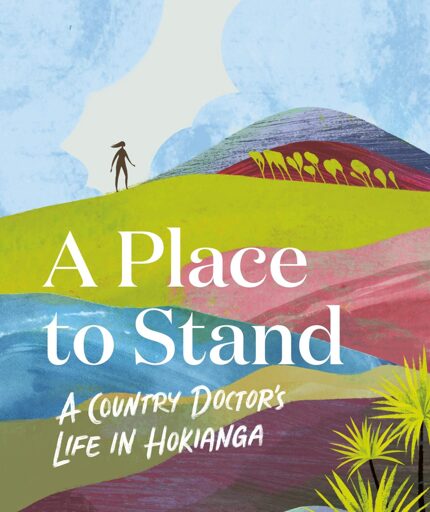

Clare Ward’s book, A Place to Stand: A country doctor’s life in Hokianga, published by Allen & Unwin, published next week.
Dr Clare Ward’s memoir, A Place to Stand: A country doctor’s life*, is about how she found her place in Hokianga, as a Pākehā doctor in a largely Māori community. This is an extract.*
Whirinaki is a place in my own heart peopled by old friends. Most of them are dead now. If I want to see them, I must go to the cemetery on a Sunday.
Except for burials, Rātapu is the only day sanctioned for passing through the gates of the urupā. If I want to find these aunties and uncles on other days, I look into my heart. They are always there.
In my mind, I have written about a night in which a car stopped for a man. A man who lay on the road, groaning and bleeding. The car stopped a few feet short of where he lay.
A woman got out and crossed the space in which present and presence meet each other. Something happened, and from that point on, her life took another course. This is not a story about her, and it will not describe the breakdown in her marriage. It will not describe how she flew from all that had been familiar into an unknown future.
On that night, she knelt over him. Other cars stopped. A man came and leaned over the wounded one from the other side of her. He was making his breath slow so that the bleeding one, who was gasping for breath, could take in air, and the will of the other to make him keep on breathing, keep on living. The only thing they could do was to keep the injured man company.
Then, a phone call from my colleague: “Can you come? I have a situation.” I am at home, and I am not thinking about emergencies. I am reading a book or doing a crossword or watching television. “What situation?”
There is an emergency bed and a body, two nurses and my colleague. There is blood on the floor. The doctor is trying to put a tube into the man’s chest so that he can breathe. He wants me to put another tube into a vein so that fluid can be put back into the man. I take the man’s hand. I am looking for a vein. He grasps my hand and holds on to it. In that moment, I know two things:
This man needs another human being to hold on to.
I cannot hold his hand and put in an intravenous tube at the same time.
Medical pragmatism wins and I disentangle his fingers from mine. I put in the line through which we will run in salt and water. The tube from his chest drains blood that changes from the colour of dark roses to a thin pink, the colour of pale rosé.
As fast as fluid goes in, it runs out again. His face fades. He was probably gasping for air, but that part I do not remember. I do remember how he looked afterward, still and pale and no longer alive. No breath, no heartbeat, eyes that looked at nothing.
The man is alone. His body is a crime scene. Soon the police will come. He will go to a mortuary room where his body will be cut up and analysed, where he will suffer another violation. His friend had fired the bullet that tore apart the artery from his lung to his heart. A stranger will open up his chest — and not just his chest, his belly and head too — to be sure that it was the gun and the torn artery that had brought him to this end. A lawyer will not be able to argue that his friend should not be charged with murder.
This man is alone here. He is not from here. His family do not know that their grandson, their son, brother, cousin, nephew is in a strange place among strangers. I go to find someone who can do karakia, who can bless the man so that this whānau will know he was safe, that his spirit was protected.
There is someone who might help. He is a patient who is here because his heart is crook. I know him. He is Māori, he is ahi kā. His is the shovel in the hāngī pit, he is the digger of graves, he is the knife at the edge of a kūtai. He is also a man who once presented me with a gift wrapped in newspaper. Whenever I look at my shelf with its big glass purple heart, I think of him.
It is late, and I have to wake him up. He says that he does not have the right clothes, but he gets up and puts his sports jacket over the top of old blue hospital pyjamas. He puts on his slippers, and he comes into the room where now there is just the young man lying on a hospital bed. There is nothing else.
He looks down at the young man and he sees his own sons. He sees a 28-year-old who has played his last rugby game, whose arms have built their last fence, dug in their last strainer posts. He sees a man whose legs have run through the bush with his dogs on the hunt for his last pig. A man who is unblemished and unlined with the whiteness of death. A man whose life has stopped in this world and is making its way to somewhere else. The older man is silent. Many moments go by before he can make the blessing, before he is able to let this young one go.
I think about that night often. I never knew where the young man went afterward, what marae he was carried to, what urupā he lies in. I never found out the name of his friend who was angry enough to seize a gun, to pull the trigger and, in a fraction of a second, fell him.
The only chance he had to hold on to his life lay somewhere else. Somewhere with an operating theatre, a table, a surgeon leaning over him. If blood could have been given for blood lost, he might have lived.
Extracted from A Place to Stand by Clare Ward, published by Allen and Unwin Aotearoa New Zealand, RRP $37.99. Out June 16.
- See also Atakohu Middleton’s interview with Clare here.

Dr Clare Ward, 77, has been a GP in Hokianga since the early 1990s. She still works part-time for Hauora Hokianga, Rawene. (Photo supplied)
The post Once upon a time in Whirinaki appeared first on E-Tangata.
From E-Tangata via This RSS Feed.