

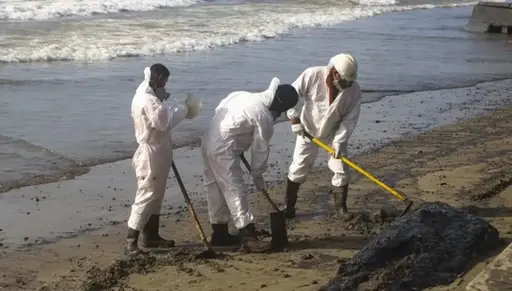
Pollutants threaten Venezuelan marine ecosystems, fishing activities and coastal communities.
On Friday, Venezuelan Foreign Affairs Minister Yvan Gil denounced before the international community a new oil spill in the Caribbean Sea originating from Trinidad and Tobago.
“Confirmed by satellite imagery, this event exceeds in magnitude the one that occurred in May and confirms the drift of pollutants toward Venezuelan waters, posing risks to marine ecosystems, fishing activities and coastal communities.
“In light of this situation, the competent agencies of the Venezuelan state have activated the necessary monitoring and mitigation protocols to protect the affected coastlines.
Venezuela Requests Compensation & Cooperation from Trinidad & Tobago Over Oil Spill
“Venezuela demands that the Government of Trinidad and Tobago fully assume its responsibility by adopting immediate measures to prevent new incidents and guaranteeing full transparency regarding the causes, scope and consequences of this spill.
“Venezuela also reserves the right to pursue the corresponding actions before the competent international bodies to determine liability, demand any compensation that may be warranted and prevent the recurrence of similar events.
“The Bolivarian Republic of Venezuela reaffirms its unwavering commitment to the protection of the environment, life and the defense of its maritime spaces,” Gil stated.
On May 9, Venezuela had already denounced an oil spill originating from Trinidad and Tobago that caused serious environmental damage in the coastal areas of the states of Sucre and Delta Amacuro and in the Gulf of Paria, which the two countries share.
One day later, Trinidad and Tobago’s Energy Minister Roodal Moonilal said that the oil spill was not visible. Venezuela requested compensation for the consequences of the hydrocarbon leak affecting its waters, coastlines, ecosystems, and fishing communities.
On May 18, Gil said that Venezuela had sent various communications to the Trinidadian government to assess the impact of the spill. He also warned that the contamination affected 1,625 square kilometers across 12 strategic wetlands and placed four national parks at risk.
(Telesur) by JF
From Orinoco Tribune via This RSS Feed.