

Bullets:
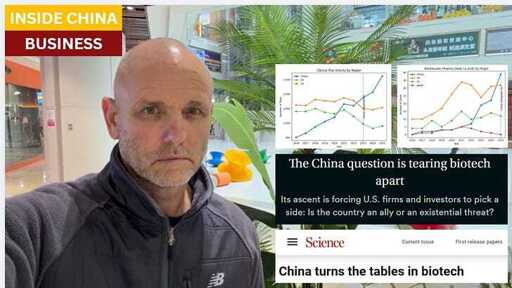
Western drug companies are pouring tens of billions of dollars into China, to develop medicines that can be resold at premium prices in Europe and the United States.
China dominates all phases of the pharmaceutical industry, from new drug development, testing, and mass production.
Inside China / Business is a reader-supported publication. To receive new posts and support my work, consider becoming a free or paid subscriber.
Report:
Good morning.
Last week the Pentagon blacklisted a group of Chinese companies, including a biotech firm, Wuxi AppTec. That means that US government contracts with Wuxi AppTec are restricted going forward. The Untied States wants to reduce its dependence on China’s pharmaceutical industry, and the Pentagon’s move is a warning to Chinese companies who want access to the $500 billion drug market in the US.
The thinking is that Beijing’s dominance in biotech research and drug development will put the United States in the same spot as in for most of the world’s raw materials supply chains, and in rare earth metals and magnets. China’s restrictions on the exports of rare earths means that the Pentagon can’t build advanced weapons platforms, or even replace the missiles and radars that Iran is blowing up in the Persian Gulf, until they can get new mines and refineries online, and then learn how to make the magnets.
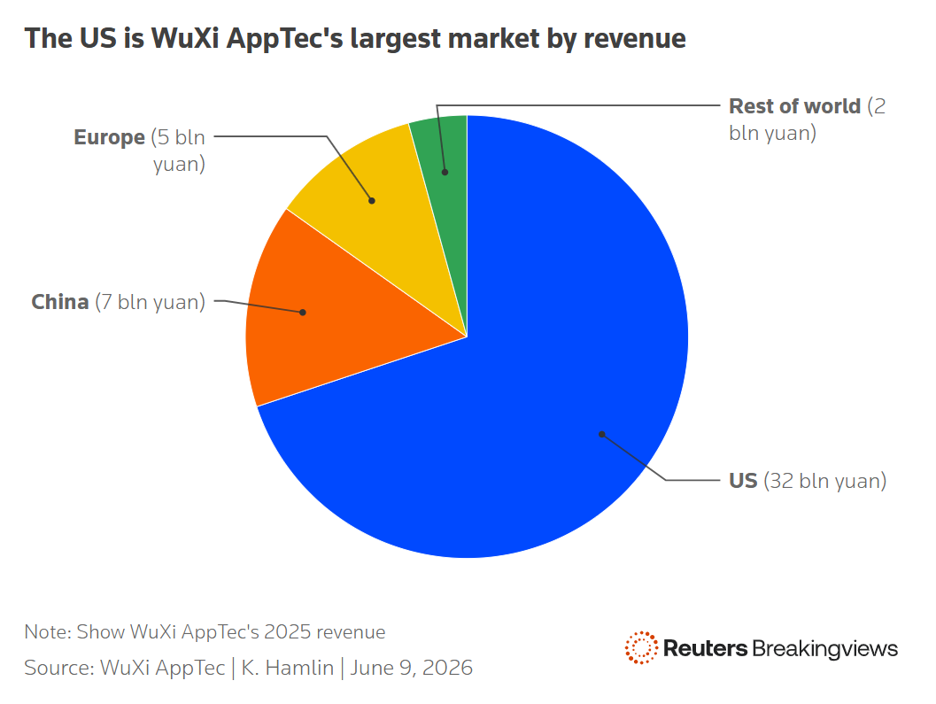
That’s the background there. In 2025, Wuxi revenues in the American market were 32 billion RMB, which is about $4.7 billion USD. So the US is a major market for Wuxi AppTec; about two thirds of their total sales. But here is the problem on the Americans side: Wuxi helps make a fourth of the drugs and medicines used in the United States, including for the most expensive drugs.
Members of Congress are drafting laws, which also target Chinese biotech firms. American drug companies like Pfizer and Bristol Myers are outsourcing research and development work and manufacturing to the Chinese companies, and the Biotech Investment National Security Act would subject those deals to the same high scrutiny they use on Nvidia, for example. Investments in biotechnology will be reviewed by the Treasury Department, and the War Department will assess whether they affect national security.
These investments now are enormous, and suddenly so. Pfizer and BMY were two of dozens of companies, which combined for $136 billion worth of licensing deals with Chinese drugmakers. That is a 27 times increase in just five years.
Drug companies in the United States and Europe pay Chinese labs to develop the medicines, which are then sold in Western markets with big markups. Naturally that also attracts venture capital money, and VC firms are worried that Congress may harm China’s biotech industry, which will in turn blow up the money-printing machine they’ve got going.
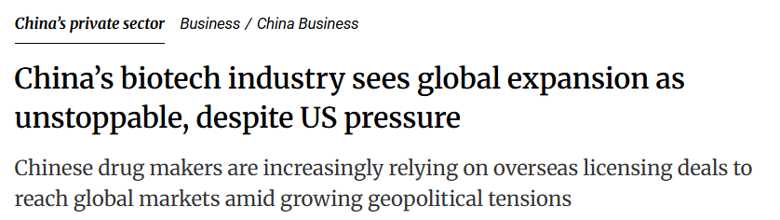
They shouldn’t worry about that first part though: It’s already too late to stop Chinese biotech firms. Whether or not they are allowed to license drugs in the US is irrelevant, when they are building drugs for the entire world. The United States is the most lucrative pharmaceutical market, but it’s American and European drug companies who grab most of those profits, along with VC and Private Equity firms who buy up shares in the early-stage drugs.
And there are lots of headlines now like this one: drugs developed in China perform better than blockbuster, high-profit drugs on the market in the US.
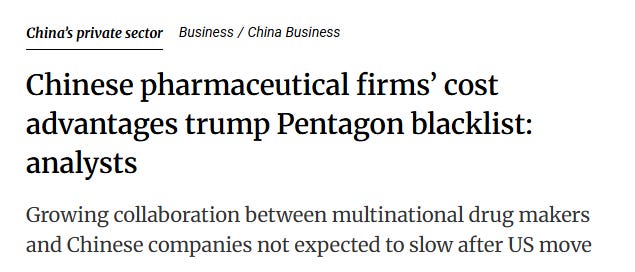
Industry insiders know all that, and the Pentagon blacklisting won’t move the needle at all, on the partnerships between Chinese drug development companies, and the big pharma companies who put their logo on the side of the box and jack up the price a hundred times. China has no peer in building quality compounds at low cost.
One issue is keeping all the executives at Western pharma companies awake at night: it’s the patent expirations problem. Morgan Stanley crunched the numbers, and Big Pharma had sales last year of $171 billion from drugs that will go off-patent over the next five years. At Pfizer, it’s an $18 billion problem by 2028, and $20 billion by 2030:
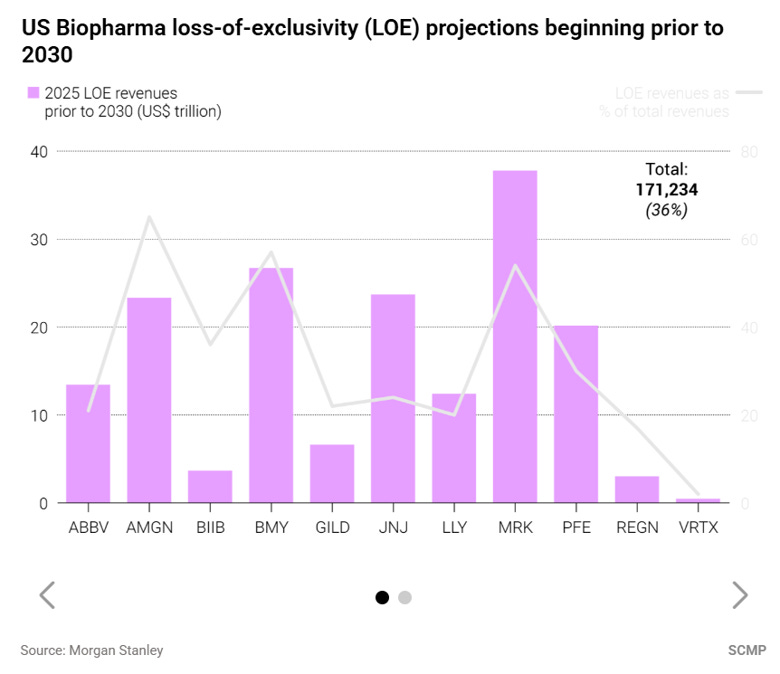
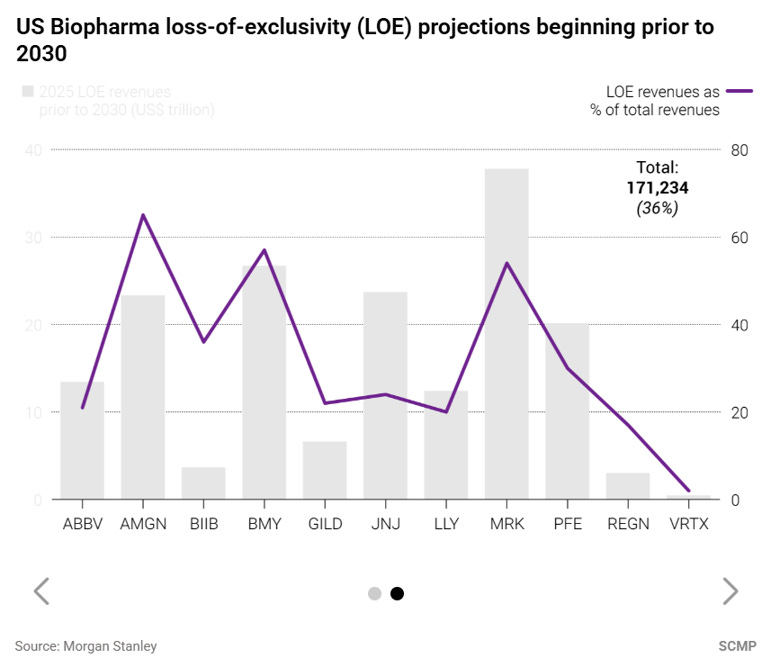
(These charts are in billions, not trillions.)
Pfizer is PFE, and that $20 billion is about 30% of its total sales, which will be dramatically reduced when those particular drugs go off-patent. At Bristol Myers, BMY, it’s $26 billion in sales that go away, and nearly 60% of its sales. Amgen needs to build new drugs to replace over 60% of their sales.
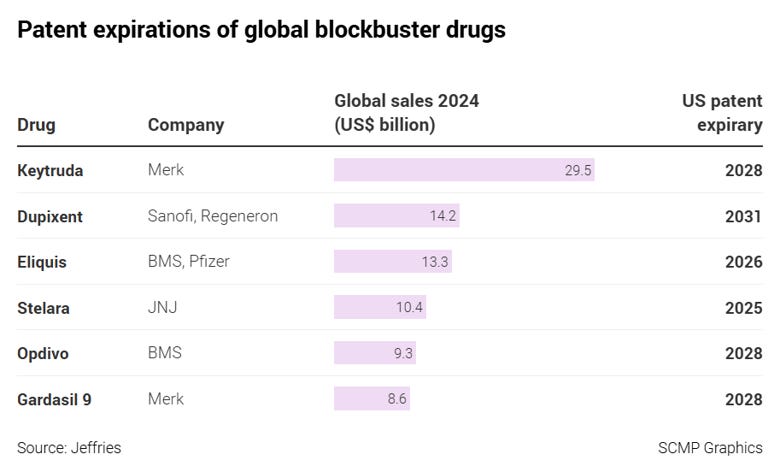
At the moment a drug loses its patent protections, the market opens up to generics from several companies, and the price collapses, along with profit margins. Drug prices fall from 30 to over 80% on average, and the steepest declines are in the American market, because that’s where the prices are set the highest. So Keytruda is a $30 billion drug for Merck, and goes off-patent in 2028 both here and in the United States.
And this is why it’s a much bigger problem for them, in the United States: In, Keytruda treatments cost $1,500 to $3,000 dollars each, with a full year cost of $20,000, at the most. In the United States, that’s the cost of a single dose. And a full year of Keytruda treatment costs $150,000 in the United States. Over seven times as much, for the same drug.
And your first thought is probably something like, why don’t patients in the United States just fly to China, check into a luxury hotel right next to the hospital, get the treatment there, and fly home and save a hundred thousand dollars? If it’s obvious to us, it’s obvious to Chinese too, and we’ll come back to that. Plus, we’ve just learned that Akeso developed a drug that works better than Keytruda, anyway.
Eliquis is a blood-thinner drug used to prevent clots. It comes from Bristol Myers Squibb, and last year threw off over $13 billion in sales. It loses patent protection in 2028 in the United States. In China, Eliquis costs $60 for a 30-day supply. In the US it’s anywhere from 5 to 10 times that depending on the pharmacy the patient is using.
Those “patent cliffs” are a major crisis for Big Pharma, but a major opportunity for firms here. China’s biotech companies work faster, with lower costs, and so companies are paying up-front for research to be done here, as soon as possible, to get new drugs ready to sell.
Neil Roberts is one of our channel’s compadres, and he’s always sniffing around the internet for stories and angles that are flying under everyone else’s radars. He doesn’t like these deals any more than our Congress does, but for a different reason. His concern is that the Chinese companies may be compromised, by spending their valuable time to develop high-profit-margin drugs for Pfizer and other companies operating in the US market, instead of doing what’s best for everyone else, everywhere else. And that’s valid.
We also find it curious that Pfizer donated thousands of dollars to help those two members of Congress get elected, who are now drafting laws to prevent Pfizer from developing new drug pipelines in China. And that Pfizer donated millions of dollars to help President Trump celebrate his election party. And that Pfizer is at the same time sending Chinese labs billions of dollars to make sure they have drugs to sell after 2028.
Wuxi Apptec does it all: the R&D, the drug discovery, scientist recruitment and training, and the mass-production. And so there are two points we want to emphasize here, with respect to the Chinese system: the government negotiates hard with drug companies, no matter where from, on fair pricing in exchange for access to China’s population of over a billion patients. But those low prices are even more a function of these Chinese companies’ capability to build and test the drugs, and the capacity to quickly scale up production after approval.
Marco Rubio was a Senator in 2024, and reported that the US once enjoyed a comfortable lead in the highest-value research, and China’s biotech industry is now an instrument of “soft power”. The Chinese are selling low-cost drugs to the developing world, and Mr. Rubio—now Secretary of State Rubio—is alarmed.
Going back to those math problems we did earlier, the cost differences between China and the United States, for the exact same treatments. Likang is a Chinese company that developed a personalized cancer vaccine. It’s in clinical trials for the FDA; it’s going through the approval process here in China. But the drug is already being offered to patients in Hainan.
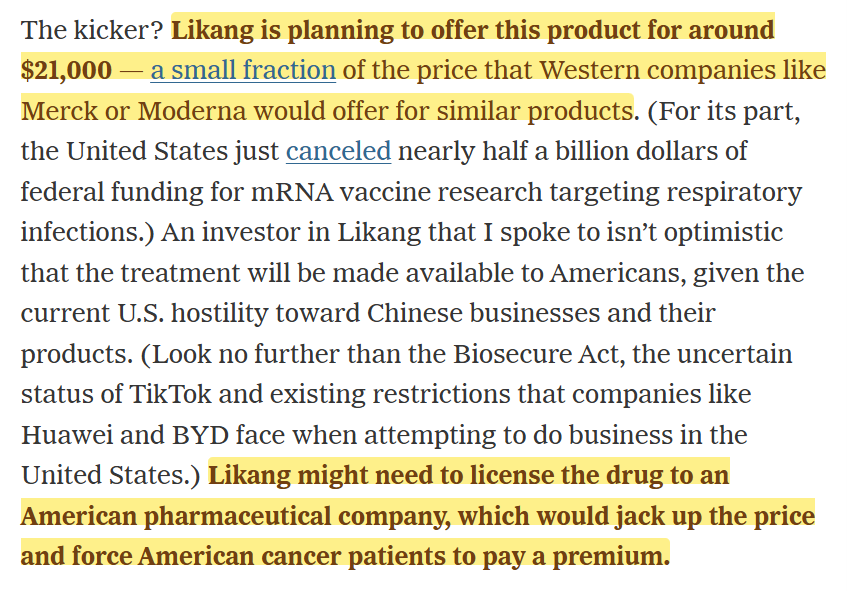
Very important section, right there. The cost of the treatment will run around $21,000. A similar drug from Merck or Moderna would be multiples of that. This drug may not ever be approved in the US at all, and if so, only at a very high price. So if you’re an American reading that, and maybe your doc has just told you there’s not much they can do for you, what are your options? And it’s on that question that American venture capital and drug companies should be really worried. There is a market for that drug, right now, but China is the only place anyone can get it.
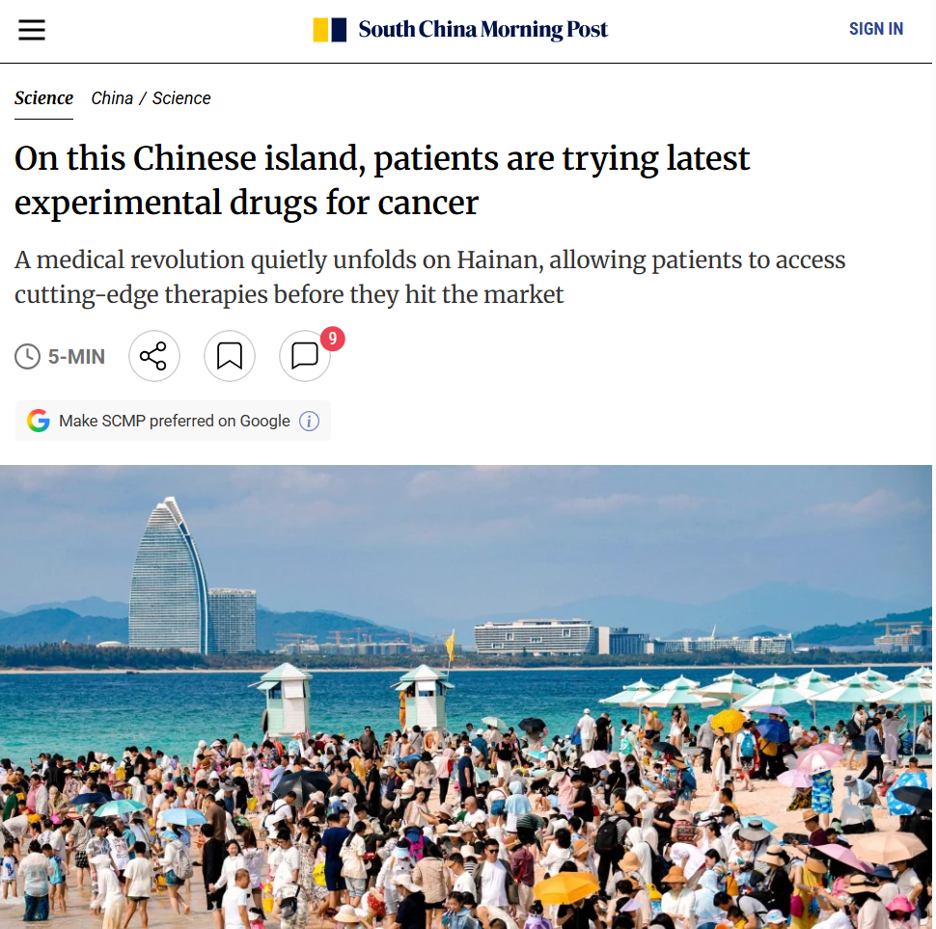
Hainan is the world’s largest free-trade zone and is also a giant zone for medical treatments. Over 30 hospitals, offering treatments and therapies that have not yet been approved even here on Mainland China.
This will be a multi-trillion dollar industry, for Hainan Island, and for hospitals on the mainland who can offer treatments at a fraction of what hospitals in Europe, or especially in America will charge. Chinese firms developing treatments, and American patients unable to buy them, in the United States; for those patients, those Chinese hospitals are the only ones who can help.
Chinese drugmakers will win, either way. Wuxi builds therapies that are in turn sold by American companies, at high profit margins, for the treatment of conditions that are money-no-object from the perspective of patients. These are terminal illnesses, and Wuxi is the only company making the treatments for some of them. Replacing Wuxi in the supply chains means there’s no more coming for years, and remember, American drug companies don’t have “years”. A third of their revenues are going away, starting next year.
So the money is pouring in to China to develop new drugs, and soon enough the money will be pouring into China by patients who need treatments that are not even approved in their home countries, or who do the math and figure that it’s like being paid a hundred thousand dollars to take a vacation in Hainan and receive treatment there. This is another company, Hengrui, who is now the top clinical sponsor in the world, with over 400 ongoing clinical trials, and multi-billion-dollar deals with Merck and Glaxo Smith Kline.
This did all happen very fast. Just like in everything else, no matter how much our political leadership likes to pretend otherwise. True experts and industry insiders know it. “There is no sense that these are areas the US can win”. Precision medicine, biotech, and medical equipment are literally national-level priorities, national security priorities, for the Chinese government.
And while that kind of emphasis would drive prices and costs way up in the American market, like we see at the Pentagon, for example, in China the cost structures go the other way. The system is more efficient, so costs fall, and timelines speed up. Since 2021—and that five-year plan—the number of drugs under development increased eight times. China is committed to excellence in service, and the US is not stepping up and competing, and cannot.
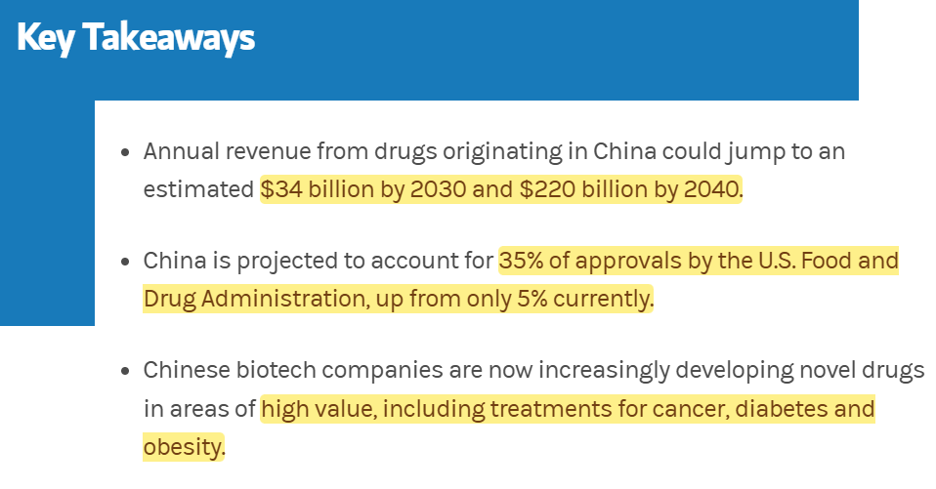
Morgan Stanley again, and drugs coming from China will grow to $34 billion in five years, and $220 billion in fifteen years, and a major driver of that increase is that the treatments are for the high-profit-margin drugs.
China is investing in the R&D, and in the people and facilities. Zhangjiang Gaoke is in Shanghai, and home to over 1700 medical companies in a single zone. Seed capital investment in US biotech is at the lowest level in over 20 years, so it’s only the Chinese companies now who are doing the hard work of drug research and discovery. Much of that work is very labor-intensive, by highly skilled chemists. So, it’s cost-prohibitive to even try it in San Francisco or Boston. Pudong, Shanghai isn’t cheap, either, but China is where the people are, and those Chinese PhD’s are building the highest-value drugs.
China built a new system, while the industry in the United States headed the opposite way. China approved 20,000 new drugs in just two years; in the same time it takes the FDA to look at three hundred or so.
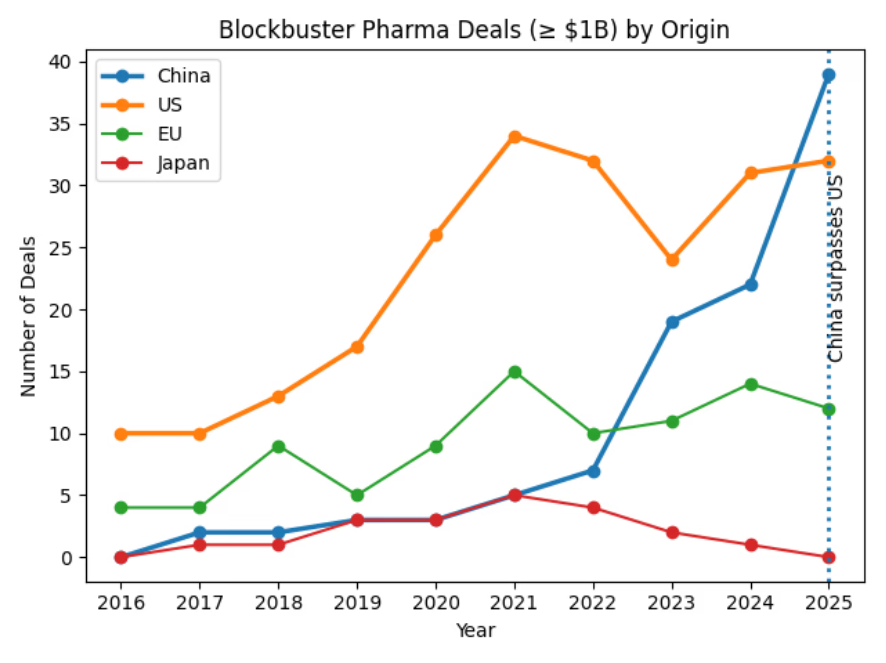
And so Chinese companies, and some American ones, are indifferent as to what the Pentagon or Congress does. China is that blue parabola that now is the world leader in new drug discovery and development for the most valuable drugs:
China is also that blue line, for Clinical Trial Activity:
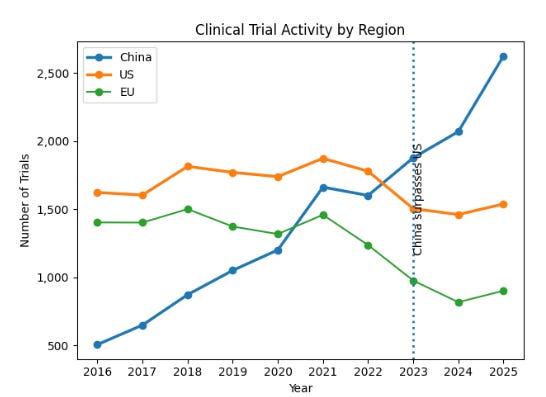
China is doing more trials than the United States and the EU combined, and there’s a big reason why: Phase I trials take two years in the US but get done in about a third that time in China. In other words, China is doing more trials, and finishing them faster.
Here’s another blue line: license-out deals, which tripled from 2024 to 2025. Last year worth $135 billion:
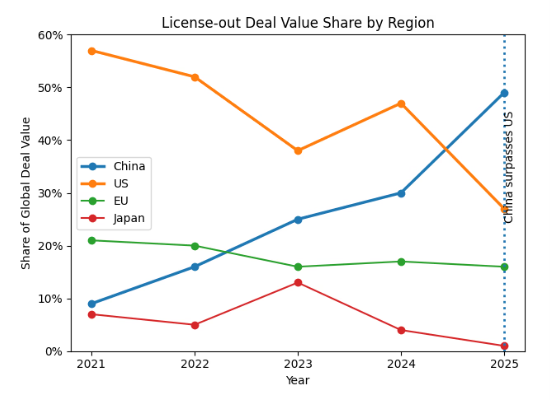
And this year, 2026, it’s growing even faster. In the first three months, $60 billion, which is two times the rate of 2025, and 2025 was 10 times bigger than 2021.
So that’s the concern on the US side: Western companies are addicted to the low-cost drugs coming out of China, which they can mark up to American patients for hundreds of billions of dollars.
But it’s also causing some problems here, for Chinese policymakers, who are concerned in the same way Neil Roberts was in his email to us. The first priority for Chinese drugmakers, should be to care for Chinese patients.
Regulators understand that some of these most novel and revolutionary treatments fall far outside the traditional processes for testing and approval. Personalized medicine – precision medicine – is completely different, and millions of patients are suffering, right now. Those patients need faster approvals for those therapies, and they also need companies who will build them.
Anew regulatory pathway for treatments for rare and terminal-stage diseases is being established. The objective, specifically, is improved access to the most advanced therapies for Chinese patients. Those new protocols will offer vast new revenue opportunities for Chinese biotech firms, while reducing their need to partner with the Pfizer’s and the Merck’s of the world just to keep the lights on and their people paid.
There is massive demand, right now: patients who need new drugs, and need Chinese companies specifically to build them. That new industry will be all-China: all the drug development, and all the treatment, first to Chinese patients, and then to anyone else who buys a plane ticket to Hainan.
Be Good.
Resources and links:
Pentagon casts dark cloud over China biotech
https://www.reuters.com/commentary/breakingviews/pentagon-casts-dark-cloud-over-china-biotech-2026-06-09/
Moolenaar, Dingell Introduce Legislation to Prevent Offshoring Biotech Industry to China
https://chinaselectcommittee.house.gov/media/press-releases/moolenaar-dingell-introduce-legislation-to-prevent-offshoring-biotech-industry-to-china
House bill aims to crack down on China biotech deals
https://www.biopharmadive.com/news/binsa-china-biotech-deals-house-moolenaar-dingell/821841/
China’s Biotech Is Cheaper and Faster
https://www.nytimes.com/2025/08/17/opinion/china-biotech.html
Chinese Company Under Congressional Scrutiny Makes Key U.S. Drugs
https://www.nytimes.com/2024/04/15/health/wuxi-us-drugs-congress.html
China’s biotech industry sees global expansion as unstoppable, despite US pressure
https://www.scmp.com/business/china-business/article/3356778/chinas-biotech-industry-sees-global-expansion-unstoppable-despite-us-pressure
Chinese drugmaker becomes top trial sponsor — and other clinical trends
https://www.pharmavoice.com/news/chinese-china-drug-clinical-trial-pharma-jiangsu-hengrui/804665/
US drug pricing policies are ‘red lights’ for investors, and China beckons
https://www.pharmavoice.com/news/drug-pricing-red-lights-biopharma-china-venture-capital/810167
China turns the tables in biotech
https://www.science.org/doi/10.1126/science.aef7757
Patent cliffhanger: will China biotech throw Big Pharma a lifeline?
https://www.scmp.com/business/china-business/article/3337038/patent-cliffhanger-will-china-biotech-throw-big-pharma-lifeline
Chinese pharmaceutical firms’ cost advantages trump Pentagon blacklist: analysts
https://www.scmp.com/business/china-business/article/3356564/chinese-pharmaceutical-firms-cost-advantages-trump-pentagon-blacklist-analysts
The paradox of biotech protectionism: Why walling off China biotech weakens America
https://rapport.racap.com/all-stories/the-paradox-of-biotech-protectionism-why-walling-off-china-biotech-weakens-america
The Innovation Boom in China Biotech
https://www.morganstanley.com/insights/articles/china-biotech-boom-generics-to-innovators
How China Became the Biotech Industry’s Back-Office
https://www.forbes.com/sites/shimiteobialo/2026/01/21/how-china-became-the-biotech-industrys-back-office/
As China biotech crackdown calls reverberate in Washington, the pushback gets louder, too
https://www.fiercebiotech.com/biotech/divisive-bill-seeks-add-biotech-industry-law-limiting-investment-chinese-industry
The Year China Surpassed the USA in Biotech Innovation, Deal Value, and Clinical Output
https://www.synbiobeta.com/read/the-year-china-surpassed-the-usa-in-biotech-innovation-deal-value-and-clinical-output
The China question is tearing biotech apart
https://www.statnews.com/2026/05/18/biotech-industry-split-chinese-drugs-opportunity-versus-existential-threat/
Amid a flurry of biotech deals, China looks to keep innovation at home
https://www.pharmavoice.com/news/licensing-pharma-deal-china-regulation-policy/822443/
Political contributions data from OpenSecrets.org
US says BYD, Baidu, Alibaba and other tech giants are aiding China’s military
https://www.reuters.com/world/asia-pacific/pentagon-lists-entities-designated-chinese-military-company-2026-06-08/
On this Chinese island, patients are trying latest experimental drugs for cancer
https://www.scmp.com/news/china/science/article/3310623/chinese-island-patients-are-trying-latest-experimental-drugs-cancer
Inside China / Business is a reader-supported publication. To receive new posts and support my work, consider becoming a free or paid subscriber.
From Inside China / Business via This RSS Feed.