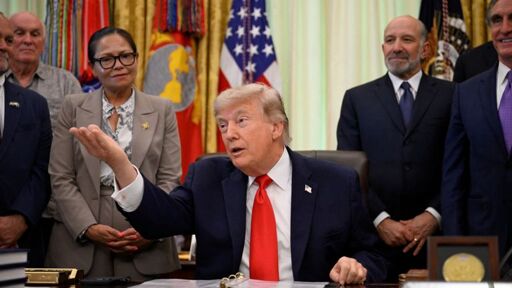
After threatening on Thursday, June 11, to launch more destructive strikes against Iran, seize Kharg Island, and confiscate Iranian oil, Donald Trump once again suspended his colonial ultimatum that evening, before announcing that a memorandum was on the verge of being approved by Iran. According to Axios, clauses include the reopening of the Strait of Hormuz without tolls, sanctions relief, and a 60-day ceasefire on all fronts, paving the way for a new round of nuclear negotiations. According to the Iranian media outlet Mehr, it also includes the withdrawal of U.S. forces from Iran’s immediate periphery, the lifting of the blockade, the unfreezing of certain assets, and the end of all sanctions against its oil and petrochemical exports.
While Trump announced that the agreement would likely be signed in Europe in the coming days, Iranian leaders have yet to confirm his statements. Regardless of the outcome of the negotiations, the terms of the memorandum represent a diplomatic manifestation of the United States’ strategic failure in Iran: a return to the pre-war status quo, which began on February 28, would be accompanied by the lifting of some of the sanctions that have crippled the country for 47 years. In recent weeks, the neoconservative camp has railed against such an agreement, which could grant Iran new room for maneuver in the region, particularly at the expense of Israel.
Trump’s announcement comes after a week of high tension. The anxiety of U.S. imperialism is palpable, and several narratives are beginning to emerge regarding the negotiations. For Hassan Ahmadian, a professor at the University of Tehran:
The initial Iranian terms — previously agreed upon in principle — had left Trump no room to claim a clear victory. So, after that preliminary agreement, he backtracked, sending his own amendments back to Tehran through mediators. But Iran did not respond. Instead, it left him in a state of wait-and-see for days, while signaling its readiness to resume the war — by striking Israel first and the ‘incident’ in Hormuz second….In response, Trump attempted military pressure…Yet Iran answered on both nights of escalation…At that point, he seems to have lost any hope of forcing Tehran into acceptance.
The announcement of an agreement actually constitutes the announcement of a retreat — a return to what had already been agreed upon previously.
For other analysts, Trump’s maneuvers were less about securing more favorable terms than about creating the illusion of a U.S victory over the regime, achieved through a new series of strikes, thus offering Trump a way out of his strategic impasse. This, at any rate, was the line of communication adopted by the White House throughout yesterday evening after the suspension of Trump’s latest ultimatum: speaking to reporters, Trump declared it a “very solid memorandum” and that there had “really been regime change,” with the new Iranian leaders, in his view, being more “reasonable.” This rhetorical posturing comes at a time when the United States has failed to achieve any of its strategic objectives, and this agreement acknowledges Iran’s new position of strength.
Symptomatically, the tone of the Israeli statement reveals Israel’s unease with the text:
Although Israel is not a party to the memorandum of understanding, the Prime Minister expressed his appreciation for President Trump’s commitment that the final agreement resulting from the negotiations will include the removal of enriched nuclear material, the dismantling of enrichment infrastructure, limits on missile production, and an end to Iran’s support for its terrorist proxies in the region.
Using a certain degree of doublespeak, the statement reaffirms Israel’s maximalist demands, which are not contained in the text. It simultaneously distances itself from the text without directly confronting Trump.
Indeed, an agreement with Iran would represent a slap in the face for Netanyahu, especially as Iran attempts to impose a new “strategic equation” and no longer hesitates to interpose itself between Israel and Lebanon, which has been under attack. While it remains to be seen how long the Iranian bourgeoisie will follow this line, it is a clear sign that Israel’s room for maneuver is now more limited, particularly in Lebanon, where Israel has failed to achieve its strategic objectives despite the extreme violence of its genocidal methods.
Meanwhile, the relationship between the United States and Israel continues to deteriorate. While Netanyahu has jeopardized the negotiations by crossing the red line established by Washington and Tehran and bombing Beirut last Sunday, Trump merely called for calm after the Iranian response. On Wednesday, J.D. Vance spoke about the relationship between the United States and Israel, noting that “sometimes we have interests that are perfectly aligned and sometimes we have interests that are misaligned.” Netanyahu “aggressively asserts the interests of his country. Sometimes that means we’re on the same page, and sometimes we’re not,” Vance explained.
The situation remains open in any case, as Iranian negotiators have not responded to Trump’s announcements, and Tehran might be tempted to wait even longer in order to gain more, as Hamidreza Azizi points out:
Apart from the horizontal structure of decision-making in the Islamic Republic post-Ali Khamenei, which requires time for consensus-building, another consideration is how to frame any agreement in a way that would be acceptable to the hardline constituency.
On the other hand, Trump himself, faced with the contradictions revealed by the U.S. failure, already seems to want to revisit certain points of the agreement, accusing Iran of having published terms different from his own. In a message on Truth Social this Friday, Trump indicated that “the terms that Iran leaked… have absolutely NOTHING to do with the terms that were agreed to, in writing.…What they said, including their weak and pathetic statement on having a deal, bears no relation to the truth. They are a very dishonorable people to deal with.” A potential last-minute reversal, in an attempt to find another way out that would allow him to conceal his failure, is therefore not impossible, given that Trump has no viable option for ending the war.
And even if the agreement were signed, this new round of 60-day negotiations on Iran’s nuclear program — which excludes the missile issue and support for Tehran’s various allies in the region, which Trump had placed at the heart of his war aims — demonstrates both the retreat of the United States and the possibility that it could end like the previous rounds: that is, with a resumption of hostilities. While Washington seems to have resigned itself to backing down on some demands in the face of the war’s strategic failure, there’s no guarantee that Israel won’t try to disrupt these high-stakes negotiations to avoid a major setback. Already, Israel launched airstrikes against the Palestinian people in Gaza on Thursday night, threatening to reignite a high-intensity genocidal war, seemingly to avenge its defeat against Iran and Lebanon.
In any case, while the effects of the U.S. defeat are already being felt and Washington is trying to restore its credibility by threatening to invade Cuba and increasing pressure on Bolivia, where the pro-Trump government of Rodrigo Paz is facing a powerful workers’ and popular rebellion, there is more urgency than ever to build a mass anti-imperialist movement that calls for the defeat of the United States and Israel in Iran and throughout the region, completely independent from the Iranian regime and the leaderships allied with it, and that fights for the end of the genocide of the Palestinian people.
Originally Published in Révolution Permanente on June 12
The post Trump’s Latest Proposal to End the With Iran Marks a Major Retreat for the United States appeared first on Left Voice.
From Left Voice via This RSS Feed.
🌮
and it’s not even Tuesday