

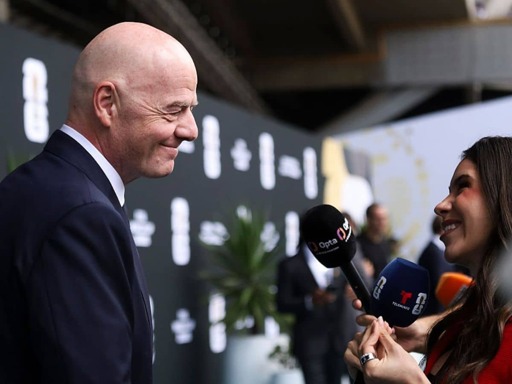
When Gianni Infantino reserved an empty seat for French journalist Christophe Gleizes and called for his release so he could attend the 2026 World Cup, the FIFA president wanted to send a message of solidarity with a reporter who had been prevented from covering the world’s biggest football tournament.
But there are many more empty seats that FIFA’s president has chosen not to acknowledge.
There are Palestinian journalists who covered previous international tournaments, some of whom attended the 2022 World Cup in Qatar, but who will never make it to the 2026 tournament. Not because they are behind bars, but because they were killed during the war. There are also dozens of journalists in Gaza who have been deprived of the opportunity to cover the World Cup because of the realities imposed by war, siege, and border closures — circumstances that have found no place in Infantino’s speeches or press conferences.
Infantino defends French journalist
If Infantino believes that preventing a single journalist from attending the World Cup is an issue worthy of international attention, then surely the plight of journalists who have been prevented from practising their profession altogether — or who lost their lives while carrying a camera or a notebook — deserves at least the same concern.
This is not about ranking one journalist’s suffering above another’s. It is about consistency.
Over recent months, Infantino has repeatedly argued that FIFA cannot intervene in sovereign decisions made by states. He has said that visa restrictions and the exclusion of journalists, officials, and athletes from entering the United States fall outside FIFA’s remit and are matters for American authorities.
If that principle is valid in those cases, then it should apply consistently across all cases. It cannot be invoked when convenient and discarded when it is not.
He could have stood for principles
The FIFA president could have spoken up for the French journalist while also acknowledging the dozens of Palestinian journalists who will never have the chance to reach a World Cup stadium — or even return to their work. He could also have spoken out for the Somali referee who was denied entry to the United States to participate in the tournament, as well as journalists and sporting delegations who have encountered visa obstacles despite receiving official accreditation.
Instead, by highlighting one case while remaining silent on others that are arguably broader and more severe, FIFA leaves itself open to legitimate questions about double standards and the limits of the responsibility it chooses to exercise.
If football is, as Infantino often says, a force for bringing people together rather than dividing them, then fairness and solidarity should be applied universally. They should extend to every journalist denied the opportunity to cover the World Cup, regardless of their nationality or the circumstances that prevented them from being there.
Featured image via Angel Delgado/Getty Images
By Alaa Shamali
From Canary via This RSS Feed.