

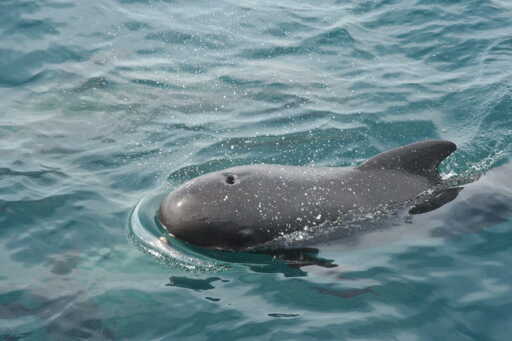
The rumble of ship traffic is drowning out the calls of long-finned pilot whales and potentially other marine species in the Strait of Gibraltar, a narrow strip of water between Morocco and Spain that separates the Atlantic Ocean from the Mediterranean Sea. Researchers who investigated this looked at near and long-distance communication between long-finned pilot whales (Globicephala melas), which are actually a species of large dolphin. They found the mammals were able to increase the volume of their calls used for short distances, but long-distance calling was more challenging, according to their recently published study. The dolphins may not be able to overpower noise pollution in the Strait of Gibraltar when calling pod mates far away, raising concerns that they could become lost and isolated from the group, the researchers said. Roughly 60,000 ships pass through the Strait of Gibraltar each year. “If they cannot communicate with one another, they may need to stay much closer together, or all that communication may become ineffective,” study co-author Renaud de Stephanis, director at the Spain-based organization CIRCE (Conservación, Información y Estudio sobre Cetáceos), told Mongabay by phone. Researchers focused the study on a small resident population of roughly 250 pilot whales in the strait. The team attached suction-cup recorders to the backs of 23 individuals. Later, they categorized more than 1,400 calls into four different categories. They found that pilot whales were able to adjust to the noise pollution for two types of calls, the high-frequency and short-pulsed calls, by simply raising…This article was originally published on Mongabay
From Conservation news via This RSS Feed.