

Drop Site is a reader-funded, independent news outlet. Without your support, we can’t operate. Please consider becoming a paid subscriber or making a 501©(3) tax-deductible donation today.
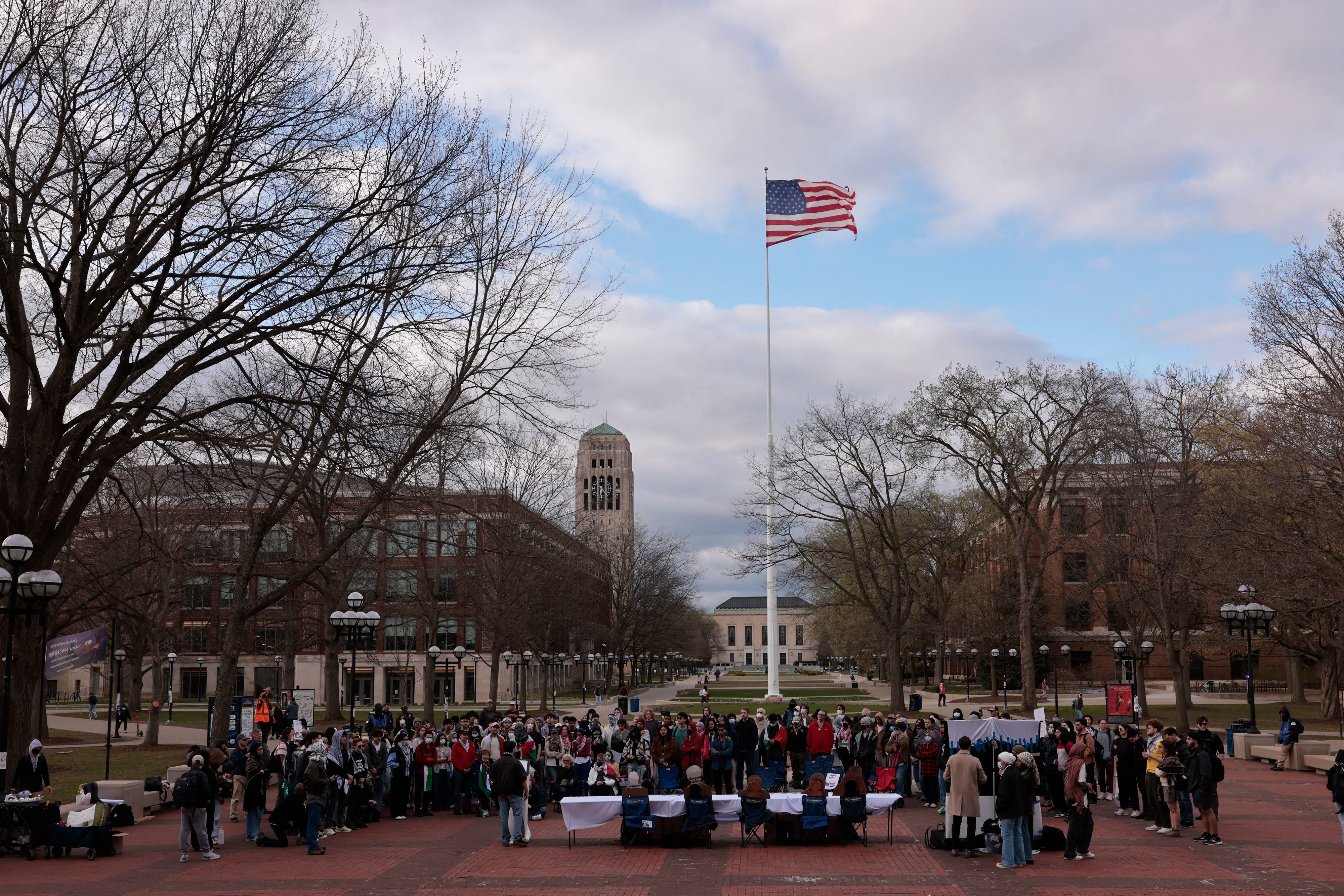
Pro-Palestinian demonstrators gather for a mock trial against the University of Michigan’s Board of Regents on the university’s campus in Ann Arbor, Michigan, on April 21, 2025. Photo by JEFF KOWALSKY/AFP via Getty Images.
Story by Tom Perkins and Ryan Grim
DETROIT, Michigan—Slowly at first, and now all at once, Michigan has turned into the central battleground in the country’s war over the U.S. relationship with Israel—and the American public’s ability to debate it freely.
Campuses across the country erupted in protest in 2024 against U.S. complicity in Israel’s ongoing genocide, with crackdowns of various intensity rolling up encampments, disciplining students, and, in some cases, filing significant charges.
Michigan’s law enforcement moved perhaps the most aggressively. When a local prosecutor in Ann Arbor declined to press felony charges on a group of protest organizers, state Attorney General Dana Nessel moved to take matters into her own hands. Now that those charges have been met with acquittals and dismissals, the federal government is stepping in to target them with felonies, announcing a sweeping indictment filed Wednesday against eight pro-Palestinian advocates.
U M Indictment
43.6MB ∙ PDF file
Along the way, protesters organized against the University of Michigan Regents who pushed for the charges. Jordan Acker, one of the most vitriolic advocates of criminalizing protest against Israel, was replaced by Lebanese American Amir Makled, who campaigned against the crackdown on protest. Then in the race for attorney general, Eli Savit—the very Ann Arbor prosecutor who refused to press charges on the protesters—won the Democratic Party’s nomination.
In the campaign for Senate, despite millions in outside spending from AIPAC, Dr. Abdul El-Sayed recently broke out as the frontrunner for the party’s nomination once the race began to focus on the question of American support for Israel. That primary is in August.
Across the board, voters in Michigan are loudly demanding a change in the relationship. At the heights of power, state and federal leaders are pulling every lever to thwart that democratic will. In the Michigan legislature, state lawmakers have responded to the shock upset in the Board of Regents election by proposing to end elections for the Board of Regents. The constitutional amendments were voted down, but a new proposal is expected to come up in August.
The three-pronged approach to suppressing dissent in Michigan—spending millions in the Senate primary, ending Regent elections, and criminalizing protest at the federal level—marks a dramatic escalation in the government’s crackdown on criticism of Israel.
The University of Michigan-affiliated protesters are accused of vandalizing the homes of the school’s leadership and targeting international businesses, like Rolls-Royce and shipping giant Maersk. But federal prosecutors with the Trump Department of Justice organized crime unit went much further than vandalism charges.
The indictment claims that regular activist activities—like using social media or “buying supplies”—amount to a broad “conspiracy” and “coordinated criminal acts.” Those activities ultimately aimed to threaten U-M leadership and foreign businesses over their support of Israel, the indictment claims, forming the basis for multiple counts of “conspiring to transmit threats in interstate and foreign commerce.”
The charges represent a change in tack from recent pro-Israel legal lawsuits and prosecutions alleging hate crimes or antisemitism. Courts have regularly struck down those, ruling that criticism of Israel is First Amendment-protected speech.
But the government did have success with effectively—and controversially—criminalizing activism in the Prairieland, Texas ICE protest case, in which the Trump administration accused activists of materially supporting terrorism in part because they had anarchist zines. The first Trump administration also tried to use similar tactics against 2017 inauguration protesters, and they have been wielded against animal rights activists.
Experts say they are not surprised the conspiracy charges are now being tested at the University of Michigan. In a statement, Arab-American Civil Rights League director Houda Berri-Harajli said that while vandalism should be investigated, the actions by University of Michigan, Nessel, and Trump represent “overreach” aimed at silencing pro-Palestinian advocates. “The concern is whether the government is increasingly using broad conspiracy theories, political speech, social media posts, and activism itself as evidence to build cases against individuals associated with a movement that has become politically unpopular in certain circles,” Berri-Harajli said.
The Charges
The protesters are largely members of the U-M’s TAHRIR Coalition and Students Allied for Freedom and Equality (SAFE), a Students for Justice in Palestine chapter. Their campaign was aimed at pressuring U-M and businesses to divest from, or stop doing business with, Israel.
The eight defendants are accused of vandalizing the homes of former U-M President Santa Ono, U-M regents, and multiple businesses. The indictment states that the protesters spraypainted “pro-Palestinian” or “anti-Israel graffiti” on homes and businesses, and broke glass at some. In one instance, they allegedly threw a bottle of butyric acid, also known as a “stink bomb,” into a home, and allegedly padlocked or caulked shut the doors of certain businesses.
The DOJ lays the foundation for the “conspiracy” with statements that largely detail common activism activities. “[Protesters] planning efforts included purchasing supplies, meeting to coordinate and distribute supplies, mapping routes, performing surveillance, and using internet-based collaboration tools to draft threats to their targets,” the indictment states.
It further claims the defendants “used the internet” to research “targets,” who are largely public officials. It continues that protesters used “the internet and social media to broadcast their message to ensure their threats and commitment to continuing criminal activity were heard by their victims and others who support Israel.”
The prosecutors are attempting to create a “myth of criminality” in activism, said Liz Jacobs, an attorney for the protesters with Sugar Law Center.
Federal prosecutors allege the “threats” were made in slogans spraypainted on the homes and businesses, including “Intifada” and “Divest now.” The government also claims protesters used “threatening symbols” like red inverted triangles. Courts have ruled that these slogans and symbols are protected speech in most contexts.
The indictment also points to a note taped to the front door of one home: “No matter how many times you call on violent cops to brutalize students, cancel and move your meetings to hide from students, and refuse to admit this university’s and YOUR complicity in genocide, we will continue to protest. You cannot hide. We demand divestment and will remain relentless in the struggle for a free Palestine.”
The threat claims are “very loose,” said Chip Gibbons, policy director at Defending Rights and Dissent. “They are attempting to transform political speech that is undeniably protected by the First Amendment into overt acts of conspiracy,” he added. “It would be a struggle to see these as threats.”
The indictment includes one example of an alleged text exchange among two defendants in which they state that they want to “poison” one of the targets, or “burn down” a house. No such actions were ever taken, and those threats were never made to the regents or other alleged victims.
While the vandalism is illegal, the government is ultimately trying “to take something that is a low-level offense at best and ratchet it way up because of the political speech of the alleged perpetrator,” Gibbons said. “The FBI, the National Security Agency driven by intelligence—they’re not supposed to be spending a lot of time on who is spray painting houses,” Gibbons added.
Drop Site News is reader-supported. Consider becoming a free or paid subscriber.
“A conscious choice by Nessel”
The indictment and escalation come amid a series of U-M-Nessel failures in its war on pro-Palestinian protesters, advocates say. “There is a popular movement across Michigan in support of Palestine, human rights, and disinvestment in Israel and the genocide,” Jacobs said. “Why keep running the same playbook?”
In May 2024, U-M dispatched police to violently break up a Palestinian solidarity encampment, but progressive Ann Arbor prosecutor Eli Savit declined to charge the students. The university then recruited Nessel, a pro-Israel political ally, to take over the investigation.
She filed dozens of encampment-related charges in late 2024, but dropped the cases after her political, personal, and financial connections to pro-Israel donors and the school’s regents were revealed.
Nessel has repeatedly praised herself for “stepping up to the plate” to take on Trump’s assault on Michiganders’ civil liberties, but in April 2025, she and Trump’s FBI opened up a second front, raiding the homes of a new set of protesters over the alleged vandalism.
On Wednesday morning, Nessel’s agents and the FBI again raided students’ homes, using flash bangs and battering rams in the dramatic arrests.
“That was a conscious choice by Nessel to bring in the Trump administration,” Jacobs said.
Amid all of this, the university has fired or suspended pro-Palestinian students and faculty, and spent millions of dollars on undercover surveillance of TAHRIR. Protesters have filed countersuits that judges have largely allowed to move forward.
Wednesday’s federal indictment is “consistent with a pattern of escalation and repression that we’ve been seeing unfolding over the last 2-3 years that’s unprecedented and frightening,” Eman Ali, a TAHRIR organizer, said outside the courthouse where supporters gathered on Wednesday afternoon.
Electoral Consequences
The draconian assault on protesters is having consequences for the political establishment. In the April Democratic primary nominating convention, TAHRIR attorney Amir Makled defeated pro-Israel U-M regent Jordan Acker, who led the attack on pro-Palestinian students.
In the attorney general race to replace Nessel, voters chose Savit, the progressive prosecutor. He beat a candidate backed by the pro-Israel establishment, and would likely end the Nessel investigations if he wins in November, though the Department of Justice likely would not.
The wins ignited establishment calls for a change to how state leaders are selected, and Democratic and GOP leaders responded last week by attempting to carry out what critics labeled a “power grab.” Currently, Michigan’s university board positions, the attorney general, and the secretary of state are voted on by delegates at party conventions.
Constitutional amendments that failed last week either aimed to undo Makled’s election or make university regents gubernatorial appointees. A proposal is expected to be reintroduced when lawmakers reconvene in August.
The constitutional amendment proposals are being pushed “because [the establishment] believes it will help them grab more power,” said Democrat State Rep. Dylan Wegela, a Democratic Socialist of America member who opposes both proposals.
“They’re doing this because progressives won at the convention,” Wegela said. “They’re doing this to strip voters’ ability to pick regents.”
From Drop Site News via This RSS Feed.