

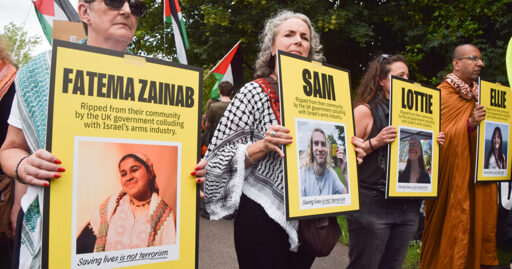
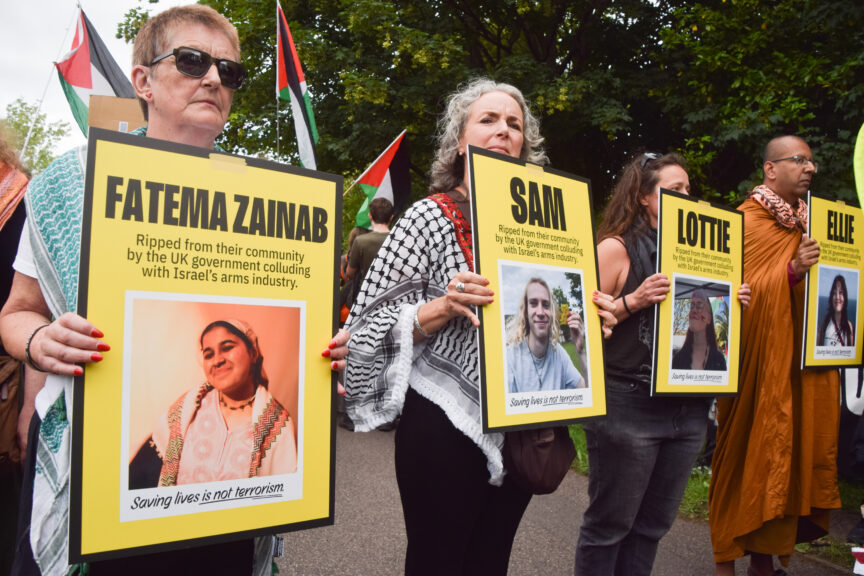
Four Palestine Action activists who damaged Israeli military assets including drones will be sentenced for an “act of terrorism”, a judge has ruled.
Charlotte Head, 29, Samuel Corner, 23, Leona (Ellie) Kamio, 30, and Fatema Rajwani, 21, were found guilty of criminal damage in May after breaking into a factory in Filton, near Bristol, owned by Israeli weapons manufacturer Elbit in 2024. Corner was also convicted of grievous bodily harm without intent.
Justice Jeremy Johnson told the Woolwich crown court that he found that the defendants “were well aware” of “the aims and strategy of Palestine Action” and that the raid was aimed at “shutting down Elbit and ending what they regarded as British complicity in Israeli war crimes” and to “intimidate it into ceasing operations or cause the government to prevent it from operating”.
The destruction of military assets was “one part of a broader and more strategic purpose” to “shut down Elbit” and put “pressure on the government”, he said. He cited the destruction to things which could not be described as weapons including the “smashing of a disabled toilet” and the spraying of paint on the walls.
“I am bound by the legislation to find that the offence in each case has a terrorism connection”, he said.
Rajwani held her head in her hands as the judge made his remarks. Chants of hundreds of supporters of the activists gathered outside the court complex could be heard from inside the courtroom. Sentencing is expected later today.
Details of the military drones damaged in the raid emerged as part of a submission from the prosecution, as it argued that the scale of the damage was significant enough to justify the application of a “terrorist connection” to the direct action group in sentencing.
In court, Mira Hammad KC, representing Kamio, referred to the prosecution’s evidence which included a report from an independent forensic consultant who reviewed Elbit’s insurance claim following the raid. His report listed damage to military assets including the “Magni X” drone and multiple “Thor” drones in the “Legion X” and “Helios” configurations.
Elbit’s website describes the Magni X as an “autonomous multi-rotor platform, developed to provide the Israel Defense Forces (IDF) with the most advanced close-range observation system”.
The Thor is described as “a fully autonomous military tactical mule platform designed for a wide range of military operational applications and reconnaissance missions”.
The Legion X configuration has been described as an “autonomous networked combat solution” helping Israel convert its elite infantry into “seek and strike” units by using “swarming drones”.
Rajiv Menon, acting in the defence of Head, told the court that the terrorist connection ruling would be “dramatic and draconian” and would affect the defendants for the rest of their lives. He said the ruling was of “critical constitutional importance”, believing it to be the first time a terrorism connection has been invoked in a case limited to property damage.
The crown’s application is “fundamentally flawed, misconceived, indeed dangerous”, he said, as well as an “invitation to chilling and creeping authoritarianism that undermines the very democratic fabric of our society”.
He contrasted the actions of Head, who has not been accused of violence against the person, with those of other criminals charged with a terrorist connection, such as Thomas Mair, the far-right extremist who murdered MP Jo Cox in 2016. He said it would be “perverse” to find Head, who was motivated by humanitarian concern about “an arms company trading in death and destruction” to have a terrorist connection.
Tom Wainwright KC, acting for Corner, said: “Redefining direct action protest as terrorism would be… crossing a rubicon.”
“It would mean, potentially, the suffragettes were terrorists,” he said.
Deanna Heer KC, speaking for the prosecution, argued that the activists wanted to influence the UK government and Israeli government and encouraged the judge to consider the “ideology” of Palestine Action and its “ultimate cause” to “liberate Palestine from Israel”.
She pointed to a Palestine Action training manual which referred to Britain’s “imperial” role in the middle east, which she said showed that the raid was not a simple act of crime prevention.
Prosecutors estimate that around £1.2m in damage was caused by the activists, including the military assets. The nature and scale of the damage to private property meant that “this is not a protest, freedom of assembly case”, she said.
The terror connection means that the activists are likely to spend longer in prison than they would for a normal criminal sentence. In February, the high court ruled the government’s proscription of Palestine Action as a terrorist group as unlawful, but the ban remains in place pending the outcome of an appeal on Monday next week.
The activists were acquitted of aggravated burglary at an initial trial in February, by which point they had already spent 18 months in prison on remand, having been found guilty of no crime.
At a retrial in May, a jury convicted the activists of criminal damage, with no knowledge that a terror connection would later be applied by a judge at sentencing. Menon argued that the way that the CPS had tried to apply a “terrorist connection” was “a gross affront to the criminal justice system”. He claimed that the CPS “took a deliberate decision to allow a judge to ultimately decide the issue rather than a jury… That’s manipulation, that’s playing games, that’s abusive.”
Menon criticised the “wholly unacceptable” actions of a police officer and security guards outside of Woolwich crown court. He said a police officer stopped and questioned a young Muslim woman on the way into the court, that security guards attempted to stop the entrance of the mother of one of the defendants, and that two journalists were told that they were not allowed into the compound.
The case has been beset by controversy throughout. On Monday, Justice Johnson apologised for his handling of his unprecedented attempt to have Menon, the lead defence barrister, prosecuted for contempt of court for his final speech in the first trial in which Menon reminded jurors that they had the right to acquit based on their conscience. Judge Johnson said: “I was wrong to do that and I’m sorry about that, of course.” He refused a request to recuse himself from the trial, however, made on the grounds of alleged prejudicial bias.
From Novara Media via This RSS Feed.